
Key Takeaways
Healthcare cost optimization requires more than technology or data alone. Technology creates visibility, data provides evidence, and advisory expertise adds the healthcare-specific context needed to make informed decisions. When these capabilities work together, healthcare organizations can identify meaningful opportunities, navigate complex supplier and contract decisions, implement changes effectively, and support sustained cost management.
The Advantage of Combining Technology, Data, and Advisory Services
Healthcare organizations already generate enormous amounts of financial and operational data. The challenge is often not a lack of information, but knowing how to turn the information into decisions that improve financial performance without disrupting operations.
The scale of healthcare spending makes the challenge increasingly important. CMS reported that U.S. hospital expenditures reached $1.6347 trillion in 2024, an increase of 8.9% from 2023. For health systems managing thousands of vendors, contracts, transactions, and purchased-services categories, understanding where money is going is an essential part of cost management.
Three capabilities can work together to address this challenge:
- Technology makes complex information accessible.
- Data provides evidence for decisions.
- Advisory expertise adds category, supplier, and operational context.
The value comes from connecting these capabilities rather than relying on any one of them individually.
Technology Expands What Healthcare Teams Can See
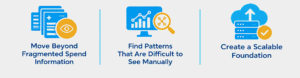
Move Beyond Fragmented Spend Information
Purchased-services information can be spread across facilities, departments, vendors, GL codes, invoices, and contracts. For a large health system, manually bringing that information together can be difficult to scale.
The visibility provides the foundation for understanding the full scope of spending rather than analyzing individual transactions or facilities in isolation.
Find Patterns That Are Difficult to See Manually
Technology can help surface patterns such as:
- Vendor fragmentation
- Pricing differences
- Off-contract activity
- Category concentration
- Duplicate or inconsistent vendor information
- Potential benchmark gaps
The important point is that an identified variance is a starting point, not proof that savings are automatically available.
Create a Scalable Foundation
Purchased-services management involves large volumes of transactions and suppliers. Technology allows healthcare teams to analyze the information consistently and spend less time manually assembling reports.
It also gives teams a common data foundation from which to investigate opportunities, compare performance, and decide where further action is warranted.
Data Gives Decisions Something to Stand On
Replace Assumptions With Evidence
A department may believe that a category is expensive. Data can establish what the organization is actually spending.
Instead of asking whether something “seems high,” leaders can examine:
- Price
- Utilization
- Vendor mix
- Contract coverage
- Facility-level variation
This distinction matters because assumptions can lead teams toward the wrong opportunity.
Put Spend Into Market Context
A number becomes more useful when it can be compared with relevant market information.
Valify’s healthcare benchmarking approach considers more than invoice prices. Its benchmarking solution can review contract status, notice periods, termination language, invoice price ranges, contracted prices, and the impact on patient and staff satisfaction before comparing results with peer organizations.
This provides context for determining whether a difference is potentially actionable.
Separate a Variance From a Real Opportunity
A higher price does not automatically mean overspending.
Differences may result from geography, service scope, utilization, facility requirements, quality expectations, or contract structure. Data can reveal the difference, but interpreting why it exists requires additional context.
This is where advisory expertise becomes important.
Advisory Expertise Adds the Context Technology Cannot
This is where an integrated approach becomes particularly valuable.
Understand the Category Behind the Number
Healthcare purchased services cover areas ranging from clinical services and facility support to IT and telecom, financial services, HR, ancillary services, and insurance. Each category has different pricing drivers, supplier markets, and operational requirements.
A healthcare-specific advisor can help interpret what is driving the numbers and determine whether a finding represents a genuine opportunity.
Know Which Questions to Ask Suppliers
Data may show that spending is high. An advisor can help determine what should be challenged.
This could include:
- Rate structures
- Volume assumptions
- Escalation clauses
- Service scope
- Contract terms
- Performance requirements
This turns an analytical finding into a more focused sourcing or contracting discussion.
Account for Operational Reality
Cost optimization cannot be separated from how a service actually operates.
Advisory expertise helps balance financial opportunities with service continuity, clinical requirements, facility needs, stakeholder expectations, and implementation complexity.
What Healthcare Organizations Gain From an Integrated Approach
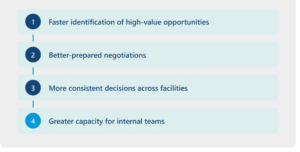
Faster Identification of High-Value Opportunities
Technology can process large amounts of information efficiently. Advisory teams can then focus their attention on opportunities that warrant deeper investigation.
This combination can reduce the time spent manually searching for opportunities and allow teams to concentrate on decisions and implementation.
Better-Prepared Negotiations
Negotiations are stronger when they begin with actual spend information, relevant benchmarks, contract details, and supplier intelligence.
Instead of approaching a supplier with a general request for lower pricing, healthcare organizations can enter discussions with a clearer understanding of their current position and the issues that need to be addressed.
More Consistent Decisions Across Facilities
A common data foundation can reveal where facilities are approaching the same category differently.
This does not mean every facility should automatically use the same supplier or contract. Instead, leaders can determine where standardization makes sense and where local requirements justify differences.
Greater Capacity for Internal Teams
Internal procurement and supply chain teams often manage multiple priorities. Combining technology with advisory expertise can extend their analytical and category-management capacity without requiring every capability to be developed internally.
Why This Matters as Healthcare Purchasing Becomes More Complex
Purchasing scale and market access can also complement data-driven decision-making.
A 2025 Journal of Public Economics study examined GPO scale and hospital supply expenses. It found that a one-standard-deviation increase in GPO scale was associated with a 2.7% reduction in average hospital supply expenses, equivalent in the study’s model to approximately $48 per discharge and $0.72 million annually per hospital.
This research should not be interpreted as evidence about purchased-services technology specifically. It concerns hospital supplies and GPO scale.
It does, however, provide broader evidence that purchasing scale can influence cost outcomes. For purchased services, the principle can complement technology and benchmarking by giving organizations additional sourcing and supplier options.
Valify incorporates this type of market access through its sourcing capabilities, including aggregated sourcing events that combine spend and volume from multiple members for applicable Group RFPs.
What an Integrated Cost Optimization Model Looks Like
A simple way to understand the relationship is:
Technology
Question it answers:
“What are we actually spending?”
Technology creates visibility across fragmented purchased-services data.
Data
Question it answers:
“How does the spending compare, and where is the meaningful variation?”
Data and benchmarking provide evidence and context for evaluating potential opportunities.
Advisory
Question it answers:
“What should we do about it?”
Advisory expertise helps interpret the findings and determine an appropriate sourcing, contracting, or management strategy.
Execution
Question it answers:
“How do we turn the decision into a financial and operational result?”
Implementation, stakeholder alignment, contracting, supplier transitions, and ongoing monitoring determine whether the expected value is realized.
Where Valify Fits
Valify brings these capabilities together through its Spend Analytics Technology, benchmarking, sourcing capabilities, and Purchased Services Advisory. Its broader approach combines expense-management technology, advisory services, and a Preferred Supplier Network to help healthcare organizations move from visibility to action.
The distinction is important. The objective is not simply to add another technology platform or another consulting engagement. It is to have data, technology, and healthcare-specific expertise working from the same information and toward the same objective.
Valify summarizes the progression as:

Conclusion: Better Technology Is Not the Whole Answer
Healthcare organizations need technology to handle the scale and complexity of purchased-services information. They need reliable data to establish what is actually happening. And they need experienced people to interpret the information within the context of healthcare operations, contracts, and supplier markets.
The advantage comes when these capabilities are connected.
Technology creates visibility. Data creates the evidence. Advisory expertise adds the context. Execution turns the resulting decisions into financial and operational results.
For health systems managing complex purchased-services portfolios, the integrated approach can provide a more practical path from fragmented information to informed decisions and sustained cost management.
Ready to turn fragmented purchased-services data into actionable savings? Connect with Valify to explore how Spend Analytics, benchmarking, sourcing, and Purchased Services Advisory can help your organization move from knowing your numbers to making informed decisions and saving money.
FAQs
How can healthcare organizations avoid disrupting essential services while pursuing cost optimization?
Cost optimization should consider service requirements alongside financial opportunity. Reviewing service scope, quality, continuity, stakeholder needs, and implementation requirements can help organizations pursue savings without overlooking operational considerations.
What internal teams should be involved in a purchased-services cost optimization initiative?
Depending on the category, relevant stakeholders may include supply chain, procurement, finance, operations, clinical teams, facilities, IT, and individual facility leaders. Early stakeholder alignment can help ensure that financial and operational requirements are considered together.
How long does it typically take to turn spend analysis into measurable cost savings?
There is no single timeline. It depends on the category, contract status, supplier market, sourcing requirements, stakeholder alignment, and implementation complexity. Some opportunities may be addressed quickly, while others require a longer sourcing or contracting process.
How can healthcare organizations sustain savings after a supplier negotiation or sourcing initiative is completed?
Organizations can monitor actual spend, contract compliance, preferred-vendor utilization, vendor performance, and savings progress after implementation. Valify’s WorkPlan provides ongoing monitoring of savings initiatives, including alerts for issues such as unapproved spend and unexpected category increases.
What should healthcare leaders consider when deciding whether to manage cost optimization internally or work with an external advisor?
Leaders should consider internal expertise, available staff capacity, category complexity, benchmarking requirements, supplier-market knowledge, and implementation needs. External advisory support can complement internal teams when additional category expertise or capacity is required.

The Valify Editorial Team is dedicated to sharing insights, strategies, and innovations that help healthcare organizations gain control of purchased services spend. Backed by years of expertise in data analytics, procurement, and healthcare technology, the team curates practical resources and thought leadership to guide hospitals and health systems toward greater efficiency and savings. By combining industry knowledge with real-world case studies, the Valify Editorial Team delivers content that empowers decision-makers to drive smarter, data-driven sourcing strategies.
