
Key Takeaways
Aggregated sourcing helps health systems turn fragmented purchasing into stronger negotiating power. By combining spend, improving data visibility, increasing supplier competition, reducing unexplained price variation, and strengthening contract terms, organizations can achieve better overall value. Success depends on clean data, comparable requirements, credible volume, coordinated decisions, benchmarking, and post-contract compliance.
Strength in Numbers: Why Aggregated Sourcing Creates Better Negotiating Power
A hospital may have significant purchasing volume, but that does not always translate into negotiating power.
A health system can spend millions on environmental services, waste management, linen, food services, facilities, IT, staffing, and other purchased services. Yet that spend may be divided across individual hospitals, departments, vendors, and contracts. Each facility may negotiate separately, use different suppliers, or operate under different pricing and service requirements.
The result is a familiar challenge: the organization has substantial total spend, but that spend is fragmented.
Aggregated sourcing changes the conversation by bringing that demand together.
Instead of approaching a supplier with the purchasing volume of one facility, a health system can potentially present a larger, more clearly defined opportunity across participating locations. That can increase supplier interest, create stronger competitive tension, and give the organization more information to use during negotiations.
The financial environment makes this increasingly important. The American Hospital Association reports that total hospital expenses grew 7.5% in 2025, more than twice the growth in hospital prices. Supply expenses increased 9.9%, while drug expenses increased 13.6%.
Aggregated sourcing does not mean simply putting more hospitals into the same purchasing event. The real advantage comes when volume is organized, credible, benchmarked, and connected to a clear sourcing strategy.
More coordinated volume can give buyers greater leverage, but only when that volume is organized, credible, and tied to a clear sourcing strategy.
5 Ways Aggregated Sourcing Strengthens Negotiating Power
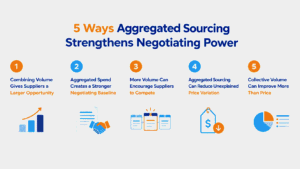
1. Combining Volume Gives Suppliers a Larger Opportunity
A single hospital may represent an attractive customer. A group of hospitals can represent a significantly larger opportunity.
Aggregated sourcing combines spend and service requirements across participating facilities so suppliers can evaluate the opportunity at a broader level.
From a supplier’s perspective, a larger opportunity can mean:
- Greater potential revenue
- A larger share of the health system’s business
- Greater market-share opportunity
- More incentive to compete
- Potential efficiencies in selling and contracting
That can create room for negotiations around unit pricing, service fees, implementation terms, contract structure, and other commercial conditions.
But the leverage comes from credible volume, not simply telling a supplier that multiple hospitals are interested.
Suppliers need to understand how much business is actually included, what services are required, where those services will be delivered, and what the organization expects from the relationship.
A sourcing event built around reliable spend data and defined participation is more compelling than an estimate based on disconnected facility reports.
The larger and more clearly defined the opportunity, the stronger the buyer’s negotiating position can become.
Key takeaway: Volume creates potential leverage when suppliers can see that the opportunity is real, measurable, and worth competing for.
2. Aggregated Spend Creates a Stronger Negotiating Baseline
Negotiations become more difficult when each facility approaches the same supplier with incomplete information.
One hospital may know its annual spend. Another may know its contracted rate. A third may have information sitting in a spreadsheet or departmental system.
No single team has the complete picture.
Aggregated sourcing creates a stronger baseline by bringing together information such as:
- Total category spend
- Current vendors
- Facility-level volume
- Existing contract rates
- Locations
- Service requirements
- Utilization
- Current supplier relationships
That visibility matters because buyers may underestimate their leverage when they do not know the full size of their purchasing opportunity.
It can also reveal pricing variation that would remain hidden in a facility-by-facility review.
Valify’s current purchased-services approach emphasizes centralizing spend data so healthcare organizations can understand where money is going, identify fragmented spending, and make more informed sourcing decisions. Its platform categorizes purchased-services spend across a broad range of categories, giving leaders a more complete view before they approach the market.
This is an important distinction. Aggregated sourcing does not create information. It makes better use of information the organization already has.
Key takeaway: Before asking suppliers for better pricing, make sure the organization understands the full size and structure of its own opportunity.
3. More Volume Can Encourage Suppliers to Compete
Aggregated sourcing can change the competitive dynamic.
Instead of asking:
“Can our current supplier give us a discount?”
the conversation can become:
“Which qualified supplier can provide the best overall value for this larger opportunity?”
That is a meaningful shift.
A larger sourcing event may attract more qualified suppliers and create greater competitive tension. Suppliers may compete on:
- Pricing
- Service levels
- Implementation support
- Contract flexibility
- Reporting
- Performance guarantees
- Transition support
However, more suppliers do not automatically mean better results.
The sourcing event still needs clear specifications, comparable proposals, defined evaluation criteria, and credible volume commitments. Participating facilities also need enough alignment for suppliers to understand what they are bidding on.
For purchased services, this is particularly important. A supplier needs to know whether the opportunity involves the same service model across facilities or whether requirements vary significantly.
The objective is not to create competition for its own sake. It is to create a market environment where qualified suppliers have a reason to put forward their strongest proposal.
That can give healthcare leaders more options than simply negotiating against the incumbent’s latest pricing proposal.
4. Aggregated Sourcing Can Reduce Unexplained Price Variation
Health systems often grow through acquisitions and decentralized operations. Over time, that can create multiple suppliers, contracts, rates, and service specifications for similar categories.
One facility may have negotiated independently for years. Another may have a different supplier because of an acquisition. A third may have renewed an existing agreement without comparing it with other facilities.
Aggregated sourcing allows leaders to examine those differences together.
The objective is not to eliminate every pricing difference.
Geography, facility size, service volume, market conditions, and service requirements can legitimately affect pricing.
The important question is whether the variation can be explained.
Consider two hospitals with similar requirements for the same service. If one is paying significantly more than the other, that difference becomes relevant to the sourcing discussion.
The organization can then determine whether the difference reflects legitimate circumstances or whether standardization, coordinated negotiation, or a broader sourcing event could improve value.
This system-wide view can also identify duplicate or overlapping supplier relationships that may not be obvious when each facility evaluates its own contracts independently.
5. Collective Volume Can Improve More Than Price
Aggregated sourcing is sometimes viewed only as a way to obtain a lower rate.
Price matters, but it is not the entire commercial relationship.
A larger sourcing opportunity can potentially improve:
- Contract terms
- Service-level agreements
- Reporting requirements
- Implementation support
- Renewal provisions
- Performance standards
- Escalation clauses
- Supplier accountability
A supplier may not offer a dramatic price reduction but may provide a stronger overall contract.
That is why healthcare leaders should evaluate total value, not just the unit price.

This matters especially for purchased services because service quality can affect hospital operations. A lower-cost agreement that creates service disruption may not deliver better value.
Valify’s aggregated sourcing model is designed around this broader view of purchased-services sourcing, with sourcing events intended to help organizations engage local vendors and services while creating economic value and addressing healthcare-specific requirements.
The strongest sourcing strategy therefore asks more than, “Who is cheapest?”
It asks, “Which supplier can deliver the best overall value for the volume and requirements we are bringing to market?”
What Makes Aggregated Sourcing Actually Work?
Simply combining hospitals does not automatically create negotiating leverage.
Several conditions need to be in place.
1. Clean, Centralized Spend Data
The organization needs to know how much it spends, where the spend occurs, which suppliers are involved, and how the category is structured.
Without that visibility, projected volume may be incomplete.
2. Comparable Requirements
Participating facilities need sufficiently similar requirements for meaningful competition.
Different service specifications can still be included, but they need to be clearly defined so suppliers can develop comparable proposals.
3. Credible Volume
Suppliers need confidence that the projected volume is real.
A sourcing event becomes more compelling when participating facilities have aligned around the scope and are prepared to follow through on the selected agreement.
4. Coordinated Decision-Making
Facilities need alignment around specifications, supplier evaluation, implementation, and contract adoption.
Without coordination, a health system can complete a successful sourcing event but fail to capture the full value because individual locations continue operating under separate arrangements.
5. Strong Benchmarking
Before evaluating supplier proposals, healthcare leaders should understand the current market position.
Benchmarking can show where existing rates sit relative to relevant data and help teams distinguish a genuinely competitive proposal from one that simply improves on an unfavorable starting point.
The benchmarking capabilities are designed to provide this type of context for purchased-services decisions. Its broader platform connects spend visibility, benchmarking, sourcing, contract management, and savings tracking.
6. Post-Contract Compliance
Negotiated value only matters if the organization captures it.
After a sourcing event, participating facilities need to use the negotiated agreement, follow preferred supplier requirements where appropriate, and monitor spend and performance.
Otherwise, the gap between negotiated savings and realized savings can become significant.
Conclusion: Strength in Numbers, Backed by Data
Aggregated sourcing works because it turns fragmented purchasing into a more coordinated market opportunity.
More volume can increase supplier interest. Better visibility can strengthen the negotiating baseline. Competition can create pressure around price and service. System-wide analysis can expose unexplained variation. And coordinated contracts can create opportunities to improve terms beyond pricing alone.
But volume is only one part of the equation.
Visibility makes the volume credible. Healthcare benchmarking makes the negotiation informed. Supplier competition creates leverage. Contract compliance turns negotiated value into realized savings.
This is why aggregated sourcing should not be viewed as simply combining purchase orders or asking a larger group of hospitals to negotiate together.
It is a structured process that starts with understanding the spend and ends with measuring whether the organization actually captured the value identified during sourcing.
Valify healthcare-specific model brings together spend analytics, benchmarking, sourcing capabilities, contract management, and advisory support to help health systems approach purchased-services decisions with better information and greater coordination.
For healthcare leaders evaluating purchased-services categories in 2026, the question is not simply how much the organization spends.
It is whether that spend is organized well enough to create negotiating power.
Frequently Asked Questions
When does aggregated sourcing make sense for a health system?
It can make sense when multiple facilities purchase similar services, spend is fragmented across suppliers, pricing varies across locations, and the organization has enough combined volume to create a meaningful market opportunity.
What categories of purchased services are best suited for aggregated sourcing?
Categories such as environmental services, waste management, linen, facilities, food services, IT, and other recurring purchased services can be candidates when requirements are sufficiently comparable across participating facilities.
What challenges can prevent hospitals from participating in a group sourcing event?
Common challenges include fragmented spend data, inconsistent service requirements, different contracts and renewal dates, facility-level decision-making, and lack of alignment around implementation.
How should health systems measure the success of an aggregated sourcing initiative?
Success should be measured beyond negotiated price. Consider realized savings, contract adoption, supplier performance, service levels, compliance, improved terms, and whether participating facilities actually transition to the negotiated agreement.
Does aggregated sourcing work for smaller or independent hospitals?
It can. Smaller organizations may have less individual purchasing volume, making coordinated sourcing particularly useful when they can participate in a credible, well-structured opportunity with comparable requirements and clear decision-making.

The Valify Editorial Team is dedicated to sharing insights, strategies, and innovations that help healthcare organizations gain control of purchased services spend. Backed by years of expertise in data analytics, procurement, and healthcare technology, the team curates practical resources and thought leadership to guide hospitals and health systems toward greater efficiency and savings. By combining industry knowledge with real-world case studies, the Valify Editorial Team delivers content that empowers decision-makers to drive smarter, data-driven sourcing strategies.
