
Key Takeaways
Healthcare contracts can lose competitiveness as pricing, utilization, vendors, and requirements change. Leaders should benchmark pricing, verify purchased services, assess variation across facilities, review renewal terms, and evaluate vendor performance. Using spend, contract, market, and supplier data together helps determine whether to renegotiate, source competitively, consolidate, revise scope, or renew with confidence.
Is Your Contract Really Competitive? Five Questions Every Healthcare Leader Should Ask
Once a healthcare contract has been negotiated, signed, and implemented, it is easy to consider the category managed.
But signing a contract does not guarantee that the agreement will remain competitive.
Market pricing changes. Utilization shifts. Vendors increase rates. Health systems acquire new facilities. Service requirements evolve. Contracts approach renewal dates, and some may automatically renew without a meaningful review. Over time, an agreement that once represented strong value can become less competitive without anyone making an obvious mistake.
The financial stakes are significant. According to CMS, U.S. hospital expenditures reached $1.6347 trillion in 2024, an 8.9% increase from 2023.
That makes contract management more than an administrative responsibility. Healthcare leaders need to know whether the agreements supporting their purchased services still reflect competitive pricing, appropriate scope, and acceptable performance.
The question is not simply, “How old is this contract?”
It is, “Do we have enough information to know whether this contract still represents good value?”
Before renewing or renegotiating a purchased-services agreement, healthcare leaders should ask five questions.
5 Questions to Determine Whether a Healthcare Contract Is Still Competitive
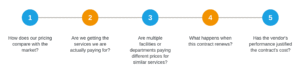
1. How Does Our Pricing Compare With the Market?
This should be the first question because knowing what your organization pays is not the same as knowing whether it pays a competitive price.
A contract may have been negotiated aggressively several years ago. But if market conditions have changed, that original rate may no longer be favorable. The reverse can also be true. A higher price may be justified by a broader scope, higher service levels, geographic requirements, or other factors.
That is why healthcare benchmarking needs context.
When evaluating a contract, consider:
- Geography and local market conditions
- Facility size and service volume
- Utilization
- Service requirements and scope
- Staffing or coverage expectations
- Contract terms and conditions
- Vendor performance
The goal is not to compare a contract with a generic industry average. It is to determine whether the agreement is reasonably positioned against relevant healthcare peers and market data.
Benchmarking can reveal unusually high rates, facility-level variation, inconsistent vendor pricing, or potential opportunities for renegotiation.
Valify’s Advisory team brings healthcare sourcing experience to the process, helping organizations use benchmarking and category knowledge to develop stronger contracting strategies.
Key takeaway: If you cannot compare your current pricing against relevant market data, you cannot confidently call the contract competitive.
2. Are We Getting the Services We Are Actually Paying For?
Price is only one part of contract value.
A contract can have a competitive unit rate and still become expensive if utilization, scope, or additional charges have changed.
Healthcare leaders should review:
- Contracted scope
- Service frequency
- Actual utilization
- Staffing levels
- Included services
- Additional fees
- Service-level requirements
- Invoice activity
The next step is to compare what the contract says with what is actually happening.
For example, a service may have been priced by volume when the agreement was signed. If that volume has changed significantly, the economics of the contract may look very different today.
The same applies to services that have expanded across newly acquired facilities or changed because operational requirements have evolved.
This is why contract data should not be reviewed in isolation. Invoice and spend data can show whether the organization is actually buying what the contract anticipated.
A lower negotiated rate does not automatically mean a better contract if utilization has increased, additional charges have accumulated, or the organization is paying for services it no longer needs.
Executive question: Are we paying for today’s needs, or for the assumptions that existed when the contract was signed?
3. Are Multiple Facilities or Departments Paying Different Prices for Similar Services?
Health-system scale can create an advantage, but only when leaders can see the spend across the organization.
Acquisitions, decentralized purchasing, and facility-level contracting can result in multiple agreements for similar services. Different vendors may serve the same category, while facilities may pay different rates or operate under different terms.
Look for:
- Multiple vendors serving the same category
- Different rates for similar services
- Separate contracts across facilities
- Different renewal dates
- Inconsistent contract terms
- Unexplained differences in spend
Variation is not automatically a problem. A facility in a different market may have different labor costs. A specialized hospital may require a different service model. Local conditions can legitimately influence pricing.
The opportunity is to identify unexplained variation.
A system-wide view can help leaders determine whether differences stem from legitimate operational requirements or fragmented purchasing.
Current Valify Advisory case studies show how the team helps health systems turn spend visibility into measurable savings. Explore Valify’s Advisory Solutions case studies to see the full results.
- Print Management & Elevator Maintenance: Valify consolidated facility-level spend, benchmarked categories, and identified opportunities for vendor consolidation. The health system achieved $2.4 million in print-management savings and $1.2 million in elevator-maintenance savings.
- Interpretation Services: Valify analyzed supplier performance, ran an RFP, and negotiated new rates, helping a health system reduce suppliers from eight to three and achieve$507,000 in annual savings.
- Reference Laboratory Services: Valify benchmarked spend, gathered detailed supplier information, and supported competitive proposals, resulting in more than $500,000 in savings.
- BioMed Services: Valify helped streamline suppliers and improve contract management, generating $945,000 in annual savings and $3.8 million over the contract term.
Key takeaway: The question is not, “Can we consolidate vendors?” It is, “Do we understand why we have different vendors, prices, and terms?”
4. What Happens When This Contract Renews?
Renewal is one of the easiest points in the contract lifecycle to overlook.
An automatic renewal can keep a service running without disruption, but it can also allow outdated pricing and terms to continue without meaningful review.
Before a contract reaches its renewal window, review:
- Expiration date
- Notice period
- Renewal provisions
- Price escalators
- Termination provisions
- Performance requirements
- Current pricing
- Current utilization
- Available market benchmarks
Waiting until a contract is 30 days from renewal can severely limit the organization’s options. Procurement and operational teams need time to benchmark the category, engage stakeholders, evaluate alternatives, and negotiate from an informed position.
Recent Valify research identifies auto-renewals, limited contract visibility, and outdated pricing as recurring sources of purchased-services overspending.
A useful rule is:
That review does not automatically mean replacing the vendor. The right decision could be renegotiation, competitive sourcing, scope revision, or renewal with improved terms.
The important point is that the decision should happen before the renewal deadline, not because of it.
5. Has the Vendor’s Performance Justified the Contract’s Cost?
The final question moves the discussion from price to value.
A competitive contract needs to deliver acceptable pricing and acceptable service.
Evaluate:
- Service-level performance
- Quality
- Responsiveness
- Compliance
- Operational disruption
- Stakeholder satisfaction
- Contract performance requirements
A low-priced contract that creates service problems may not be good.
At the same time, strong vendor performance does not mean pricing should never be questioned. A reliable supplier may be providing excellent service while market pricing has changed.
The strongest decisions come from looking at vendor performance alongside spend, pricing, and contract information.
For example:
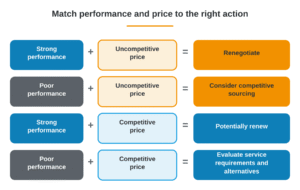
This approach keeps the focus on total value rather than simply selecting the lowest price.
Valify’s Advisory model specifically emphasizes reducing cost while improving service levels and aligning stakeholders around purchased-services strategies.
Key takeaway: The best contract balances price, service, quality, risk, and operational value.
Which Contracts Should Healthcare Leaders Put on the Renegotiation List?
Not every contract needs immediate action. But several warning signs should trigger a closer review.
A purchased-services contract deserves attention when:
- Pricing is above relevant benchmarks.
- It has not been competitively reviewed recently.
- Multiple facilities have different agreements for similar services.
- Spend has increased without a corresponding change in service volume.
- The contract contains significant price escalators.
- Renewal is approaching.
- Invoice-level spending is difficult to track.
- Vendor performance has declined.
- Additional charges are difficult to explain.
- The contract no longer reflects current operational requirements.
One red flag alone does not mean renegotiation is necessary.
The stronger signal is the combination of high spend, pricing variation, contract risk, and an upcoming renewal.
That combination gives healthcare leaders a reason to move beyond routine contract administration and conduct a deeper category review.
Use Data Before You Decide to Renegotiate
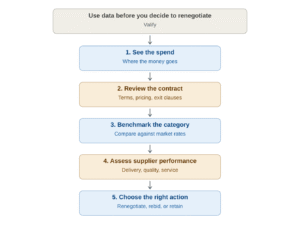
A strong contract review should follow a clear sequence.
1. See the Spend
Understand total spend by category, vendor, facility, and department.
2. Review the Contract
Examine pricing, scope, terms, obligations, renewal dates, and termination provisions.
3. Benchmark the Category
Determine whether current pricing is competitive against relevant healthcare market data.
4. Assess Supplier Performance
Review quality, service levels, compliance, stakeholder feedback, and operational impact.
5. Choose the Right Action
Based on the evidence, decide whether to renegotiate, competitively source, consolidate, revise the scope, or renew.
This is where technology and advisory expertise can work together.
Valify’s current purchased-services model combines spend analytics technology, benchmarking, contract management, sourcing capabilities, advisory services, and savings tracking. Its technology categorizes health-system AP spend and connects that information to purchased services opportunities, while Valify Advisory helps organizations develop and execute consistent contracting strategies.
Valify’s 2026 Purchased Services Maturity Assessment Framework identifies four core areas for managing purchased services: visibility of information, contract management, sourcing process, and cost savings.
That framework reinforces an important point: contract competitiveness cannot be evaluated through the contract document alone. Leaders need visibility into the spend, the market, the supplier, and the outcome.
The Bottom Line: Don’t Renew a Contract You Have Not Tested
A contract can be compliant, operationally necessary, and still be uncompetitive.
Healthcare leaders should not wait until the renewal date to ask whether an agreement still makes sense. The strongest opportunities become visible when spend data, contract terms, market benchmarks, and supplier performance are reviewed together.
The goal is not to renegotiate every contract.
It is to identify the contracts where the evidence suggests a better outcome may be possible.
For health systems managing hundreds or thousands of purchased-services agreements, that requires more than periodic contract reviews. It requires an ongoing approach to visibility, benchmarking, contract management, sourcing, and savings realization.
Before the next renewal cycle, ask the five questions. If the answers are difficult to find, that may be the first indication that the contract deserves a closer look. That’s where Valify can help you. Contact Us.
Frequently Asked Questions
What are the hidden costs of an underperforming healthcare contract?
Hidden costs can include outdated pricing, automatic renewals, additional fees, unused services, inconsistent rates across facilities, poor utilization, and service problems that create operational disruption.
How often should healthcare contracts be reviewed?
High-value purchased-services contracts should be reviewed regularly rather than only at renewal. The frequency should depend on spend, contract terms, market changes, supplier performance, and operational importance.
Can contract standardization reduce healthcare system costs?
It can, particularly when multiple facilities are purchasing similar services under inconsistent terms. Standardization can improve visibility and negotiating leverage, although legitimate geographic and operational differences should be preserved.
What data should procurement teams collect before a contract review?
Teams should collect spend by vendor and facility, contracted rates, invoice data, utilization, contract terms, renewal dates, supplier performance, service levels, and relevant market benchmarks.
How can healthcare leaders prioritize contract reviews?
Start with high-spend categories, upcoming renewals, unfavorable benchmark results, significant pricing variation, multiple vendors, increasing spend, and declining supplier performance. Contracts with several of these indicators should generally receive earlier attention.

The Valify Editorial Team is dedicated to sharing insights, strategies, and innovations that help healthcare organizations gain control of purchased services spend. Backed by years of expertise in data analytics, procurement, and healthcare technology, the team curates practical resources and thought leadership to guide hospitals and health systems toward greater efficiency and savings. By combining industry knowledge with real-world case studies, the Valify Editorial Team delivers content that empowers decision-makers to drive smarter, data-driven sourcing strategies.
