
Key Takeaways
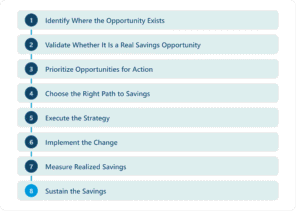
Healthcare cost optimization requires more than identifying potential savings. Organizations must validate opportunities, prioritize initiatives, select the right sourcing strategy, execute and implement changes, measure realized savings, and sustain results. This eight-step lifecycle transforms spend data into actionable decisions, purchasing changes, measurable financial outcomes, and an ongoing process for continuous cost improvement.
How Healthcare Organizations Move From Opportunity Identification to Savings Realization
Healthcare organizations do not create financial value simply by identifying where savings may exist. An analysis can reveal pricing differences, fragmented suppliers, off-contract spending, or unfavorable contract terms, but none of these findings automatically becomes a realized saving. The value comes from moving an opportunity through the steps required to validate it, act on it, implement the change, and measure the result.
The scale of healthcare spending makes this process increasingly important. According to the CMS National Health Expenditure data, U.S. hospital expenditures reached $1.63 trillion in 2024, an 8.9% increase from 2023.
For purchased services, the path from data to savings can be viewed as a lifecycle:

Each stage answers a different question. Together, they create a repeatable process for turning information about healthcare spend into measurable financial results.
8 Steps to Turn Healthcare Cost Opportunities Into Realized Savings
Stage 1: Identify Where the Opportunity Exists
Build a Reliable Spend Baseline
The process starts with understanding what the organization is actually spending. AP and purchasing data can provide visibility across facilities, departments, vendors, general ledger codes, invoices, and service categories.
Valify technology uses data categorization and expert quality control to cleanse health system AP spend and create a more complete view of purchased services expenses. Its platform provides visibility across more than 1,400 purchased-services categories.
Look for Signals, Not Just High Spend
Organizations can then look for signals such as:
- Benchmark variance
- Supplier fragmentation
- Off-contract spending
- Unusual pricing differences
- Contract expirations
- Unapproved or unexpected spending
High spend alone does not mean a category should automatically be targeted. It is a signal for further investigation.
Stage 2: Validate Whether It Is a Real Savings Opportunity
Add Market Context
The next step is determining whether an identified variance represents a genuine opportunity. Healthcare benchmarking can provide context by comparing current pricing with relevant market or peer information.
Valify’s Check Point and PinPoint benchmarking capabilities provide category-specific context to help organizations evaluate purchased-services costs.
Review the Contract and Service Requirements
Teams should examine:
- Current rates
- Escalation provisions
- Renewal dates
- Termination terms
- Service levels
- Volume commitments
- Scope of services
This helps determine whether the opportunity comes from pricing, contract structure, utilization, supplier strategy, or another factor.
Confirm Operational Feasibility
A lower price is not automatically a better outcome. Organizations must consider clinical requirements, service continuity, quality expectations, facility needs, and stakeholder requirements before pursuing a change.
Stage 3: Prioritize Opportunities for Action
Not every opportunity can be addressed at once. Prioritization should consider annual spend, potential savings, benchmark position, contract timing, number of facilities involved, and implementation complexity.
Some opportunities may qualify as quick wins because they have clear spend visibility, established supplier markets, significant pricing variation, or contracts approaching expiration. However, speed should not replace proper validation.
Organizations can also create an opportunity pipeline:

This provides leadership with a clearer view of potential savings and helps teams plan resources around upcoming initiatives.
Stage 4: Choose the Right Path to Savings
Once an opportunity is validated and prioritized, the organization must determine how to pursue it.
Optimize the Existing Contract
If the current supplier remains appropriate, the organization may renegotiate pricing, modify service levels, restructure terms, or address escalation provisions.
Introduce Competitive Sourcing
An RFP may be appropriate when competing suppliers could offer better commercial terms or service options. Category-specific requirements should shape the sourcing process.
Consider Aggregated Sourcing
Combining compatible purchasing requirements can potentially increase supplier leverage. A 2025 Journal of Public Economics study found that a one-standard-deviation increase in GPO scale was associated with a 2.7% reduction in average hospital supply expenses.
This research relates specifically to hospital supply expenses and GPO scale, not purchased-services savings or Valify’s technology.
Determine When Supplier Changes Make Sense
Supplier consolidation or replacement should depend on service requirements, supplier performance, market alternatives, and transition costs. Fewer suppliers do not automatically mean lower total cost.
Stage 5: Execute the Strategy
Execution should be based on the evidence gathered during validation.
Teams can build negotiations or RFPs around:
- Validated spend
- Benchmark information
- Service requirements
- Supplier alternatives
- Desired commercial terms
Internal alignment is equally important. Finance, supply chain, operations, clinical leadership, and affected facilities may all need to participate depending on the category.
Negotiations should also look beyond the headline rate. Escalators, contract length, service levels, termination rights, implementation commitments, and reporting requirements can all affect the agreement’s overall value.
Stage 6: Implement the Change
A signed contract does not automatically create savings.
Organizations must translate the agreement into actual purchasing behavior by moving spend to the agreed supplier or updated terms and communicating changes to relevant teams.
If a supplier changes, implementation should account for service continuity, facility requirements, training, technology changes, and implementation timelines.
The organization should also establish a new baseline by documenting the contracted rate, expected utilization, implementation date, and savings target.
Stage 7: Measure Realized Savings
This is where the difference between an opportunity and an actual result becomes critical.
Separate Projected From Realized Savings
Projected savings represent what analysis or negotiation suggests could be achieved.
Contracted savings reflect improvements included in the new agreement.
Realized savings represent the financial benefit actually captured after implementation.
These figures should not automatically be treated as interchangeable.
Compare Actual Spend With the Right Baseline
Actual spending should be compared with the appropriate pre-change baseline while accounting for implementation dates, utilization, volume, and other relevant changes.
Organizations should also track contract compliance. Off-contract purchases or inconsistent adoption can reduce the financial benefit of an otherwise successful sourcing initiative.
Stage 8: Sustain the Savings
Savings require continued monitoring because utilization, suppliers, pricing, facilities, and contracts can change.
Valify’s WorkPlan supports ongoing monitoring of savings initiatives, including spending changes, data-quality issues, unapproved spending, preferred-vendor conversion, and savings progress.
The process should also continue beyond a single initiative. Once one category has been optimized, the organization’s spend data can reveal the next opportunity.
Before renewal, teams can review actual performance, supplier results, and updated market information. This creates a continuous cycle:

What the Full Savings Lifecycle Looks Like
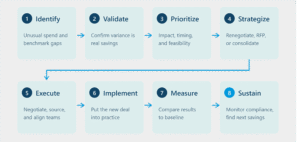
Every step answers a different question. Skip one and the savings usually don’t hold.
1. Identify: Where could we save?
Look at your spend for pricing gaps against benchmarks, too many suppliers in one category, off-contract buying, or contracts coming up for renewal.
2. Validate: Is the savings real?
Check the gap against market data and the contract itself. Some variances are just a different scope or service level, not an opportunity.
3. Prioritize: What do we go after first?
Rank opportunities by size, timing, effort, and how realistic they are to pull off. Some will be quick wins, others will take longer.
4. Strategize: How do we pursue it?
Pick the right approach for that category: renegotiate, run an RFP, aggregate volume, consolidate suppliers, or switch.
5. Execute: Turn the strategy into an agreement
Negotiate or source using the evidence from validation, and look beyond the rate to terms like escalators, service levels, and termination rights.
6. Implement: Make it stick
A signed contract saves nothing until purchasing follows it. Move spend to the new terms and tell the teams who buy.
7. Measure: What did we actually save?
Compare real spend to the pre-change baseline, not to the projection.
8. Sustain: Keep it going
Track compliance and performance, and use the data to find the next opportunity before the next renewal.
Conclusion: The Savings Opportunity Is Only the Starting Point
Analytics can show healthcare organizations where money may be left on the table, but identification is only the beginning.
A potential opportunity must be validated against market and operational realities, prioritized against competing initiatives, matched with the right sourcing or contracting strategy, and implemented across the organization. Only then can the organization determine how much of the projected value has actually been realized.
This is the broader logic behind Valify approach to purchased services: use technology and data to know your numbers, use the resulting insight to make informed decisions, and then move those decisions into action that can save money. Valify’s platform combines spend visibility, benchmarking, sourcing capabilities, and savings tracking to support that process across the purchased services lifecycle.
The goal is not simply to produce a list of potential savings. It is to create a repeatable process that moves opportunities from data into contracts, from contracts into purchasing behavior, and from purchasing behavior into measurable savings.
FAQs
How can healthcare organizations ensure savings initiatives align with broader financial goals?
Organizations should evaluate each opportunity against broader financial priorities, including expected savings, timing, implementation requirements, operational impact, and resource needs. This helps leadership focus on initiatives that support the organization’s overall financial objectives rather than pursuing isolated cost reductions.
What role does leadership play in turning identified savings opportunities into results?
Leadership provides prioritization, stakeholder alignment, and accountability. Savings initiatives may require coordination across finance, supply chain, operations, clinical teams, and individual facilities. Executive support can help ensure that validated opportunities receive the resources and organizational alignment required for implementation.
How can organizations avoid common obstacles that prevent negotiated savings from being realized?
Organizations should establish clear implementation plans, communicate purchasing changes, monitor supplier adoption, and track actual spending against the agreed terms. Regular monitoring can identify off-contract spending or other issues before they significantly reduce the expected financial benefit.
What types of data should healthcare organizations monitor after implementing a savings initiative?
Relevant data can include actual spend, contracted rates, utilization, supplier usage, facility-level purchasing, contract compliance, and savings against the established baseline. Monitoring these measures helps distinguish negotiated improvements from savings that are actually being captured.
How can healthcare organizations build a repeatable approach to savings across multiple service categories?
A repeatable approach starts with consistent spend visibility and categorization, followed by validation, prioritization, sourcing or contracting, implementation, measurement, and ongoing monitoring. Maintaining an opportunity pipeline and revisiting categories before contract renewal can help turn individual projects into a continuous savings process.

The Valify Editorial Team is dedicated to sharing insights, strategies, and innovations that help healthcare organizations gain control of purchased services spend. Backed by years of expertise in data analytics, procurement, and healthcare technology, the team curates practical resources and thought leadership to guide hospitals and health systems toward greater efficiency and savings. By combining industry knowledge with real-world case studies, the Valify Editorial Team delivers content that empowers decision-makers to drive smarter, data-driven sourcing strategies.
