
Key Takeaways
A hospital vendor performance scorecard gives supply chain, finance, and operational leaders a consistent way to evaluate vendor performance before renewal, renegotiation, or sourcing decisions. Instead of relying on informal feedback or a long-standing vendor relationship alone, organizations can evaluate pricing, contract compliance, service performance, and responsiveness using defined criteria and documented results. The most useful scorecards combine financial and operational information. Valify provides purchased services spend visibility, benchmarking, contract and compliance insights, and advisory support that health systems can use as inputs to their own vendor evaluation process. This gives leaders a more complete view of vendor performance and helps connect operational feedback with financial and market data. A consistent scorecard process also improves contract governance. When vendor performance is reviewed throughout the contract lifecycle rather than only immediately before renewal, health systems have more information available when deciding whether to renew, renegotiate, or evaluate alternative suppliers.
Hospital Vendor Performance Scorecard: Metrics That Matter
Introduction
Vendor relationships can be difficult to evaluate when performance information is spread across departments, invoices, contracts, and individual experiences.
A department leader may have a clear view of service quality. Finance may see invoice or pricing issues that are not visible to the department. The supply chain may have information about contract terms, purchasing activity, and vendor alternatives. Each perspective is useful, but none provides the complete picture on its own.
A hospital vendor performance scorecard creates a structured way to bring these perspectives together.
The goal is to establish consistent criteria that help leaders evaluate whether a vendor is meeting financial, contractual, and operational expectations.
For purchased services, this is particularly important because vendors often support essential functions across multiple departments and facilities. A structured review helps health systems distinguish between a vendor that is performing well and one that has a long-standing relationship with the organization.
What Is a Hospital Vendor Performance Scorecard?
A hospital vendor performance scorecard is a structured evaluation tool that healthcare organizations use to measure vendor pricing, service quality, responsiveness, and contract compliance. By tracking key vendor performance metrics, hospitals can make more informed renewal, renegotiation, and sourcing decisions while improving accountability across purchased services categories.
Hospital Vendor Performance Metrics to Track
The exact criteria should reflect the category, contract requirements, and operational importance of the vendor. However, four areas provide a practical starting point:
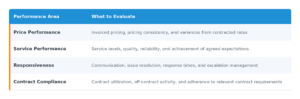
These categories should not necessarily carry the same weight for every vendor.
For example, service performance may carry greater importance for a patient-facing or operationally critical service, while pricing and contract compliance may receive greater emphasis for a highly standardized category. The scorecard should reflect the actual risks and requirements of the purchased service instead of applying the same formula to every vendor.
The purpose of standardization is consistency.
Key Vendor Performance KPIs for Healthcare Organizations
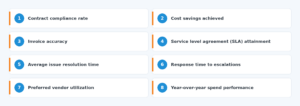
Before evaluating individual vendors, healthcare organizations should identify the key performance indicators (KPIs) that support their strategic goals. Common vendor performance KPIs include:
- Contract compliance rate
- Cost savings achieved
- Invoice accuracy
- SLA attainment
- Average issue resolution time
- Response time to escalations
- Preferred vendor utilization
- Year-over-year spend performance
These KPIs establish the foundation for an objective vendor performance scorecard and help hospitals compare vendor performance consistently across purchased services categories.
Price Performance
A vendor can provide strong service and still warrant a pricing review.
Health systems should evaluate whether invoiced pricing aligns with the negotiated agreement and whether pricing remains competitive in the current market. Useful measures may include invoice accuracy, contracted-rate compliance, pricing variance, and changes in rates over the contract term.
Internal pricing data provides one part of the answer. Market context provides another.
Valify’s Spend Analytics Technology helps health systems cleanse and categorize accounts payable data across 1,400+ purchased services categories, providing visibility into purchased services expenses and savings opportunities.
PinPoint Benchmarks can provide additional context by comparing purchased services performance with peer and market information. Valify’s healthcare benchmarking process can examine invoices, contract terms and conditions, operational considerations, and peer comparisons to help organizations determine where pricing or contract terms may warrant further review.
This distinction matters. A vendor may be billing according to the contract while the contract itself is no longer competitive. Price compliance and market competitiveness are related, but they are not the same question.
Vendor Service Performance
Financial performance should not be evaluated separately from operational performance.
A vendor that meets pricing expectations but consistently fails to meet service requirements may not provide the value the organization expects. The scorecard should therefore include measures tied to the actual services being delivered.
Depending on the category, these measures may include:
- Achievement of agreed service levels
- Quality of service
- Reliability and consistency
- Operational issues or disruptions
- Performance against documented requirements
- Feedback from the departments receiving the service
The specific measures should come from the contract, statement of work, service-level requirements, and operational expectations established for the category.
Standardized evaluation criteria are particularly useful when the same vendor serves multiple facilities. Without a common framework, one facility may consider a vendor’s performance strong while another evaluates the same vendor differently.
A consistent scorecard gives both locations a common set of questions and creates documentation that can be reviewed at the system level.
Responsiveness and Issue Resolution
Vendor performance is also reflected in what happens when something goes wrong.
A scorecard can capture how effectively a vendor responds to service issues, communicates with stakeholders, and resolves problems. Depending on the category, organizations may evaluate:
- Response time
- Communication quality
- Issue resolution
- Escalation management
- Follow-through on corrective actions
These measures are most useful when they are tied to specific expectations rather than general impressions.
Instead of documenting that a vendor is responsive, for example, a department can record whether issues were acknowledged within the expected timeframe or corrective action was completed, and recurring issues were addressed.
This creates a more useful record for both internal reviews and vendor discussions.
Contract Compliance
A vendor relationship can appear successful while purchasing activity gradually moves outside the agreement.
Health systems should therefore evaluate whether actual purchasing activity aligns with the organization’s contracted and preferred arrangements. This may include reviewing:
- Off-contract purchasing
- Preferred vendor utilization
- Invoice or pricing variances
- Relevant contractual obligations
- Changes in purchasing activity during the contract term
Valify’s technology provides visibility into purchased services spend and contract-related activity, while Work Plan is designed to track the impact and progress of savings initiatives. Valify also provides contract management capabilities within its technology offering.
Monitoring these factors throughout the contract lifecycle can help organizations identify issues before they become renewal problems.
How Often Should Vendor Performance Be Reviewed?
There is no single review cadence that applies to every vendor.
Review frequency should reflect the vendor’s spend, operational importance, contract requirements, and risk to the organization.
A health system might choose to review strategic or high-spend vendors quarterly, conduct less frequent reviews for lower-risk vendors, and increase the frequency when performance concerns arise or a renewal deadline approaches.
The important point is consistency.
A vendor should not receive its first meaningful performance review two weeks before a renewal notice deadline. Regular reviews create a record of performance and give supply chain and operational leaders time to address issues before they affect the renewal decision.
Using the Scorecard Before a Contract Renewal
A vendor scorecard becomes particularly valuable when it is connected to the contract lifecycle.
Before renewal, leaders can review the vendor’s financial and operational performance together and ask several practical questions:
- Is invoiced pricing consistent with the agreement?
- Is the current agreement competitive with relevant market or peer information?
- Is the vendor meeting documented service expectations?
- Are there recurring performance issues that require corrective action?
- Is purchasing activity aligned with the agreement?
- Does the current contract continue to meet the organization’s operational needs?
The answers can inform the next step.
A strong-performing vendor may be a candidate for renewal. A vendor with specific gaps may require a performance improvement or renegotiation discussion. If pricing, service, or contract performance does not meet expectations, the organization may determine that a competitive sourcing process is appropriate.
The scorecard does not make the decision. It gives leadership better evidence on which to base the decision.
Why Informal Vendor Feedback Is Not Enough
Operational feedback remains an important part of vendor management. The problem occurs when it is the only input into the renewal decision.
A positive relationship with a vendor does not establish that pricing is competitive. A vendor that responds quickly to department requests may still have invoice variances or purchasing activity outside the agreement. Conversely, a vendor with strong pricing may not be meeting the service requirements that matter most to the organization.
A structured scorecard brings these perspectives together.
It allows health systems to evaluate the vendor relationship from multiple angles without treating any single measure as a complete representation of performance.
That distinction is important for purchased services, where financial, contractual, and operational considerations often intersect.
How Valify Supports a Data-Driven Vendor Review
Valify’s capabilities provide several of the data inputs health systems need when evaluating purchased services vendors.
Spend Analytics Technology provides visibility into purchased services spending by cleansing and categorizing accounts payable data across 1,400+ purchased services categories.
PinPoint Benchmarks provide market and peer context for purchased services pricing, contract terms, and relevant operational considerations.
Valify Advisory helps healthcare organizations align stakeholders, implement centralized contracting practices, identify fragmented or rogue spending, and develop category sourcing strategies.
Together, these capabilities can give supply chain and finance teams stronger information to incorporate into their own vendor performance management processes.
Build a More Consistent Vendor Review Process
A vendor performance scorecard is most useful when it becomes part of an established review process rather than a document created only when a contract is about to expire.
Health systems can start by defining the performance criteria that matter for each category, establishing who is responsible for providing each input, and determining how frequently the information should be reviewed.
Financial data, contract information, market benchmarks, and operational feedback can then be reviewed together.
The result is a more consistent approach to vendor management and one that helps leaders identify performance issues earlier, document renewal decisions, and determine when renegotiation or sourcing may be appropriate.
Benefits of Using a Vendor Performance Scorecard
A well-designed vendor performance scorecard helps healthcare organizations:
- Improve vendor accountability
- Strengthen contract negotiations
- Increase contract compliance
- Identify savings opportunities
- Improve service quality
- Reduce operational risk
- Support data-driven sourcing decisions
By consistently measuring vendor performance, healthcare organizations can move beyond anecdotal feedback and make decisions based on objective data.
Evaluate Your Purchased Services Vendor Performance
Vendor performance decisions are stronger when they are based on more than a single department’s experience or the age of an existing relationship.
By combining spend visibility, market benchmarks, contract information, and structured operational feedback, health systems can develop a more complete view of vendor performance and make more informed decisions about renewal and sourcing.
Valify helps healthcare organizations gain visibility into purchased services spend, benchmark performance, and act on identified opportunities.
Schedule a conversation with the Valify team to discuss your purchased services vendor performance strategy.
FAQs
What should be included in a hospital vendor performance scorecard?
A hospital vendor performance scorecard can include price performance, service performance, responsiveness, and contract compliance. The specific measures should reflect the purchased services category, contract requirements, operational importance, and risks associated with the vendor.
How often should hospital vendors be evaluated?
There is no universal review schedule. Strategic and high-spend vendors may warrant more frequent reviews, while lower-risk vendors may be reviewed less often. Review frequency should also increase when performance issues arise or when a contract approaches renewal.
How can hospitals make vendor evaluations more objective?
Hospitals can improve consistency by establishing defined evaluation criteria, documenting performance against those criteria, and combining operational feedback with financial, contract, and market information. This reduces reliance on informal impressions and makes vendor performance easier to compare over time.
Can a vendor scorecard help with contract renewals?
Yes. A structured scorecard can provide evidence for renewal, renegotiation, or sourcing decisions. Reviewing pricing, service performance, responsiveness, and contract compliance before renewal gives stakeholders a more complete view of the vendor relationship.
How does Valify support vendor performance management?
Valify provides purchased services spend visibility through Spend Analytics Technology, market and peer context through PinPoint Benchmarks, savings initiative tracking through WorkPlan, and purchased services expertise through Valify Advisory. These capabilities can provide data and insights that health systems incorporate into their vendor management and renewal processes.

The Valify Editorial Team is dedicated to sharing insights, strategies, and innovations that help healthcare organizations gain control of purchased services spend. Backed by years of expertise in data analytics, procurement, and healthcare technology, the team curates practical resources and thought leadership to guide hospitals and health systems toward greater efficiency and savings. By combining industry knowledge with real-world case studies, the Valify Editorial Team delivers content that empowers decision-makers to drive smarter, data-driven sourcing strategies.
