

For a purchased-services team, the value of a spend analytics platform is not in how much data it can display. It is in what that data enables the team to do next.
A list of vendors, a category-level spend report, or a dashboard showing year-over-year changes can be useful. But none of these, on their own, tells a leader whether a service is competitively priced, whether multiple facilities are buying from too many vendors, whether an agreement is being followed, or where the next meaningful savings opportunity is likely to come from.
That is the standard healthcare organizations should apply when evaluating spend analytics technology.
A strong platform should make it easier to move from understanding spend to identifying opportunities, taking action, and measuring results.

This is particularly important for purchased services because spending is often distributed across facilities, departments, vendors, and service categories. The right technology should bring those pieces together and give purchased-services leaders the context they need to decide where to focus.
Valify’s Spend Analytics Technology is designed around this broader approach, helping healthcare organizations categorize purchased-services spend, identify opportunities, benchmark performance, support sourcing decisions, and track savings.
Why Purchased Services Need Specialized Analytics
Purchased services are unusually broad. They can include facility support, clinical services, financial services, IT and telecommunications, ancillary services, HR services, and insurance.
Valify identifies these as seven major purchased services lines of business and notes that these services span departments across the health system.
That breadth makes purchased services difficult to manage through disconnected reports.
A platform designed for this environment should understand the healthcare context and help leaders move from individual transactions to a system-wide view of the services being purchased.
What Should a Spend Analytics Platform Actually Do?
Give Leaders a Complete View of Spend
The first expectation should be visibility.
A purchased-services leader should be able to understand:
- Total purchased-services spend
- Spend by category
- Spend by vendor
- Spend by facility
- Spend by department
- Contract and non-contract spend
- Historical spending patterns
Ideally, the platform should allow leaders to move from:

Rather than forcing them to piece together information from multiple reports.
Valify’s technology categorizes health-system spend data to provide visibility into purchased-services expenses. Its Immediate Insights capabilities also help users understand which vendors provide outsourced services by facility and department.
That matters because visibility should not stop at “how much did we spend?” It should help reveal where the spending is coming from and how it is distributed across the organization.
Data Quality Should Be a Core Capability, Not an Afterthought
Raw AP Data Is Not Ready for Strategic Analysis
AP data can contain inconsistent vendor names, different GL accounts, duplicate vendors, inconsistent descriptions, and different coding practices across facilities.
Simply importing that information and placing it into a dashboard does not solve the underlying problem.
The data needs to be cleaned, organized, and categorized before it can support meaningful analysis.
Categorization Should Reflect Purchased Services, Not Just Accounting Codes
GL-level reporting can be useful for financial management, but it may not provide enough detail for purchased-services decisions.
A leader needs to understand the actual service being purchased, not simply the accounting code attached to a transaction.
Valify says its technology quickly categorizes health-system spend data and provides expert quality control to measure and cleanse AP spend, giving healthcare organizations visibility into their purchased-services expenses.
That distinction is important: better analytics starts with better data.
Expect the Platform to Identify Opportunities, Not Just Report Spend
Leaders Should Know Where to Focus First
A purchased-services team should not have to start with a massive spreadsheet and determine every potential opportunity manually.
A useful platform should help answer:
- Which categories deserve attention?
- Where is spending unusually high?
- Which vendors represent significant exposure?
- Where is spending fragmented?
- Which contracts need attention?
- Where are potential quick wins?
Valify’s Immediate Insights capabilities use data-driven opportunity-identification metrics to help rank savings opportunities and quick wins.
Prioritization Matters as Much as Identification
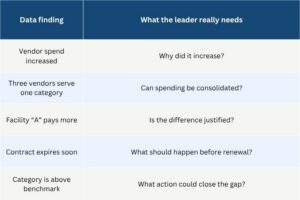
The difference between interesting data and actionable intelligence is prioritization.
Benchmarking Should Tell You What Good Looks Like
Internal Spend Alone Isn’t Enough
Knowing that a hospital spends $3 million on a service does not tell leadership whether that amount is competitive, excessive, or appropriate.
That requires context.
Healthcare-specific benchmarking can help leaders compare spending, pricing, terms, and other relevant factors against appropriate peers.
Benchmarks Should Reflect Healthcare Realities
Purchased services do not have a universal price.
Hospital size, facility scale, patient volume, geography, utilization, service requirements, and operational complexity can all influence what an appropriate arrangement looks like.
That is why purchased-services leaders need more than a generic procurement benchmark. They need context that helps answer:
“Is this a reasonable price and arrangement for an organization like ours?”
Valify’s benchmarking approach evaluates factors including pricing, terms and conditions, patient and staff impact, and comparisons with peers.
Expect Visibility Into Vendor and Market Dynamics
Vendor Analysis Should Go Beyond a Spend Ranking
Knowing which vendors receive the most money is useful. Knowing what that means is more valuable.
Leaders should be able to understand:
- Vendor concentration
- Facility-level vendor usage
- Category penetration
- Vendor market share
- Local, regional, and national vendor presence
- Potential alternative suppliers
Valify’s Vendor Market Share capability provides visibility across more than 550,000 vendors and 1,400+ purchased-services categories, including comparisons with peers.
The objective is to move from:
“Who do we use?”
to:
“Are we using the right vendors, at the right price, under the right terms?”
That is where vendor data becomes a sourcing tool rather than simply a reporting tool.
Contract Visibility Should Be Built Into Spend Analytics
Spend Data and Contract Data Should Not Live in Separate Worlds
Purchased-services leaders need to connect spend with the agreements governing that spend.
That means bringing together information such as:
- Vendor
- Category
- Spend
- Contract
- Expiration date
- Renewal timeline
- Contract compliance
Valify’s Immediate Insights capabilities include visibility into contracts approaching expiration and on- and off-contract spending.
The goal should not simply be to answer:
“When does this contract expire?”
It should be:
“What should we do about this contract before it expires?”
That shift from information to action is what makes analytics useful.
Expect the Platform to Connect Analytics With Sourcing
Spend Analysis Should Not End With a Report
Once an opportunity is identified, the purchased-services team may need to benchmark pricing, issue an RFP, compare vendors, negotiate terms, or consolidate suppliers.
Analytics should support that next step.
Valify’s Accelerated Sourcing capabilities include PinPoint Benchmarks, eRFP, and Vendor Market Share, connecting spend intelligence with sourcing decisions.
The difference can be simple:
Basic analytics:
“Here is your spend.”
Actionable analytics:
“Here is your spend, here is the opportunity, here is the benchmark, and here are the next steps you can take.”
For a purchased-services team with limited time and resources, that difference matters.
Expect Savings Tracking After the Contract Is Signed
Negotiated Savings Are Not the Same as Realized Savings
A lower negotiated price does not automatically mean the health system will realize the expected savings.
- Negotiated savings: The organization agrees to better pricing or terms.
- Realized savings: The organization implements the change, purchasing behavior follows the agreement, and the expected financial impact appears in actual spend.
A spend analytics platform should help monitor the second.
Monitor Contract Compliance
Leaders should be able to determine:
- Are departments using the preferred vendor?
- Did spending actually move?
- Are prices consistent with the agreement?
- Has an unapproved vendor appeared?
- Did spending unexpectedly increase?
Valify’s WorkPlan is designed to track annual goals and monthly progress while monitoring data-quality issues, unapproved spending, vendor conversion, and captured savings.
That ongoing visibility is critical because savings can erode after implementation if purchasing behavior changes.
Alerts Should Help Leaders Catch Problems Early
Automated Monitoring Matters
Purchased-services leaders should not have to manually search through reports every month to find problems.
A useful platform should help flag issues such as:
- Incorrect GL coding
- Missing purchase orders
- Unexpected spending increases
- Unapproved vendors
- Contract-related issues
- Other compliance concerns
Valify’s WorkPlan includes automated data-quality and unapproved-spend alerts, including notifications when an incorrect GL is used, an invoice is missing a purchase order, spending spikes unexpectedly, or an unapproved vendor is used. It can also help identify the facility and department behind an issue so teams can address the root cause.
That turns monitoring from a periodic reporting exercise into an ongoing management process.
Conclusion: Don’t Buy Another Dashboard. Buy a Path to Action.
The right spend analytics platform should answer more than “Where did the money go?”
It should help purchased-services leaders move through a much more useful sequence:

That final question is the standard that matters.
For purchased-services leaders, a platform should not be judged by the number of dashboards, charts, or reports it produces. Its value should be measured by how effectively it helps the organization identify opportunities, make informed decisions, execute changes, and sustain the resulting savings.
Valify’s approach is built around that broader purchased-services workflow, combining spend analytics with opportunity identification, benchmarking, sourcing, contracting, and savings tracking. Its technology and advisory capabilities are designed specifically around the complexities of healthcare purchased services.
FAQs
What should purchased-services leaders look for in a spend analytics platform?
Look for a platform that provides clean, categorized spend data, opportunity identification, healthcare-specific benchmarking, vendor and contract visibility, sourcing support, and ongoing savings tracking.
Why is data cleansing and categorization important for purchased-services analytics?
Raw AP data may contain inconsistent vendor names, GL coding, descriptions, and classifications. Cleaning and categorizing that data makes it possible to analyze purchased-services spending accurately and identify meaningful opportunities.
How can a spend analytics platform help identify savings opportunities?
It can surface fragmented spending, pricing variation, vendor concentration, contract issues, and other patterns, then help prioritize which opportunities warrant further review.
Why should spend analytics include healthcare-specific benchmarking?
Purchased-services pricing can vary based on factors such as facility size, utilization, geography, and service requirements. Healthcare-specific benchmarks provide more relevant context than generic comparisons.
How can a spend analytics platform help healthcare organizations track and sustain savings?
By monitoring purchasing behavior, preferred-vendor conversion, contract compliance, spending changes, and savings progress, the platform can help teams identify when an implemented savings initiative is not performing as expected.

The Valify Editorial Team is dedicated to sharing insights, strategies, and innovations that help healthcare organizations gain control of purchased services spend. Backed by years of expertise in data analytics, procurement, and healthcare technology, the team curates practical resources and thought leadership to guide hospitals and health systems toward greater efficiency and savings. By combining industry knowledge with real-world case studies, the Valify Editorial Team delivers content that empowers decision-makers to drive smarter, data-driven sourcing strategies.
