
Key Takeaways
A mature purchased services program is not defined by the size of a health system or the number of tools it uses. It is defined by how consistently the organization can see its spend, make informed sourcing decisions, manage contracts, and measure results over time. A health system can have sophisticated procurement resources and still have gaps in one or more of these areas. The purchased services maturity model provides a practical framework for evaluating where an organization stands today and which capabilities may need to be strengthened next. Valify supports health systems across these areas through spend analytics, benchmarking, sourcing, contract management, savings tracking, and purchased services expertise.
Purchased Services Maturity Model: Where Does Your Hospital Rank?
Introduction
Ask ten supply chain leaders how mature their purchased services program is, and most will describe it in general terms.
“We have good visibility.”
“We review our contracts.”
“We benchmark when we can.”
The challenge is that these statements are difficult to measure.
Purchased services span hundreds of vendors, categories, facilities, and contracts. When purchasing decisions are decentralized or data is inconsistent, leadership may know opportunities exist without having a clear way to prioritize them.
A purchased services maturity model provides a more structured approach. Instead of asking whether a program is good or bad, it evaluates how consistently the organization manages four areas: spend visibility, sourcing, contract governance, and savings management.
The objective is to identify where the organization has strong processes and where additional structure could improve purchased services management.
The Four Stages of Purchased Services Maturity
The model can be viewed across four stages, from a primarily reactive approach to a program with established processes, accountability, and ongoing measurement.
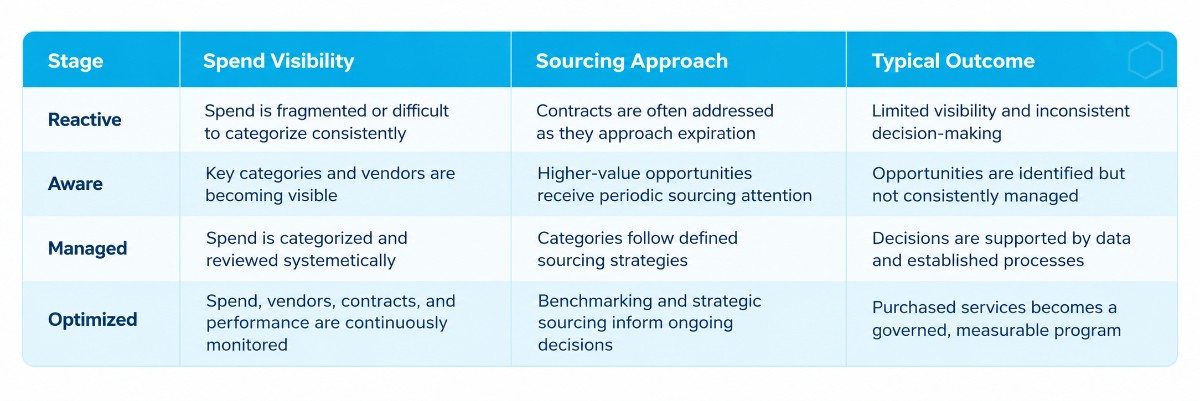
A health system does not need to be at the same stage across every category. One category may have strong sourcing and contract governance while another remains largely reactive.
That variation is useful because it identifies where the next improvement should occur.
Self-Assessment Questions for Each Stage
These questions can help supply chain and finance leaders assess their current position.
Reactive
- Can we identify total purchased services spend by category and vendor?
- Are contracts primarily reviewed when they approach expiration?
- Do different facilities maintain separate information about the same vendors?
Aware
- Do we have reliable visibility into our highest-spend categories?
- Are sourcing opportunities identified before contracts reach renewal?
- Is there a defined process for evaluating vendor and pricing performance?
Managed
- Does each major purchased services category have an established sourcing approach?
- Are contract compliance and purchasing activity reviewed regularly?
- Can savings be measured against actual spend?
Optimized
- Are sourcing decisions informed by current market and peer data?
- Are contract performance and savings monitored throughout the contract lifecycle?
- Do finance, supply chain, and operational leaders work from consistent information?
The answers can vary by category. A health system may have a mature approach to environmental services while still developing its process for IT or clinical services.
What Moves a Health System to the Next Stage?
Advancing maturity requires strengthening the capabilities behind the program instead of adding another technology or process.
Build Reliable Spend Visibility
A mature program starts with a consistent understanding of what the organization is purchasing, from whom, and where the spend occurs.
This means categorizing purchased services consistently, resolving duplicate or inconsistent vendor records, and creating visibility across facilities and departments. Without that foundation, it becomes difficult to compare categories, identify fragmented purchasing, or determine where sourcing attention should be focused.
Valify’s Spend Analytics Technology provides visibility into purchased services spend by cleansing and categorizing health system spend across 1,400+ purchased services categories, with line-item visibility. Valify states that its technology categorizes approximately 95% of a health system’s total spend.
Use Benchmarking to Inform Decisions
Benchmarking can provide additional context when a health system is evaluating a category, supplier, or sourcing opportunity. Rather than relying only on historical internal pricing, organizations can use relevant market information to understand how current results compare with peers.
Valify’s CheckPoint Benchmarks provide directional benchmarks across more than 1,400 purchased services categories. Valify’s website cites more than $1 trillion in total categorized spend across more than 1,400 hospitals as the foundation of its benchmarking insights.
The purpose of benchmarking is not to assign a maturity score. It is to give supply chain leaders additional information for making sourcing and purchasing decisions.
Establish Contract Governance
Contract maturity means more than maintaining a repository of signed agreements.
Organizations need processes for monitoring upcoming expirations, reviewing on- and off-contract spend, evaluating pricing against negotiated terms, and assigning responsibility for contract decisions.
Valify’s Contracts Dashboard helps organizations identify expiring contracts, receive visibility into upcoming action items, and evaluate on- and off-contract spend.
Measure Savings Over Time
A sourcing decision is not complete when a contract is signed.
Organizations need a way to determine whether negotiated improvements are reflected in actual purchasing activity and whether initiatives continue to deliver their expected results.
Valify’s WorkPlan tool helps track the impact and progress of savings initiatives, providing visibility into performance after an initiative has been implemented.
Common Reasons Health Systems Get Stuck
Organizations can struggle to advance maturity even when leadership recognizes the need for change.
- Fragmented data: Spend information is spread across facilities, departments, vendors, and systems.
- Decentralized purchasing: Individual facilities make reasonable local decisions without an enterprise-wide view.
- Reactive sourcing: Contracts receive attention primarily when renewal deadlines approach.
- Limited ownership: No single team or leader is responsible for the purchased services program as a whole.
- Inconsistent measurement: Savings and contract performance are not tracked using a consistent methodology.
These challenges do not necessarily require a complete restructuring of the supply chain function.
Often, the first step is establishing ownership, creating a consistent process, and gaining enough visibility to determine which categories require attention first.
Valify’s purchased services consulting team supports organizations with best practices, centralized contracting, expense management, and savings initiatives as they work to strengthen their purchased services programs.
Maturity Is a Process, Not a Finish Line
A mature purchased services program is not one in which every category is managed identically.
Different categories have different operational requirements, supplier markets, contract structures, and levels of risk. The objective is to establish enough visibility and governance to make those differences clear and manage them intentionally.
For one health system, the next step may be categorizing fragmented spend. For another, it may be benchmarking a high-value category before renewal. For another, it may be establishing a process for tracking savings after contracts are implemented.
The maturity model helps leadership identify those priorities and create a practical path forward.
Find Your Health System’s Maturity Stage
Understanding the current state of purchased services management is the first step toward improving it.
Health systems can evaluate their maturity by looking at how consistently they manage spend visibility, sourcing, contract governance, and savings measurement across their major purchased services categories.
Valify combines spend analytics, benchmarking, sourcing, contract management, savings tracking, and purchased services expertise to help healthcare organizations identify opportunities and strengthen their programs.
Schedule a maturity benchmarking conversation with the Valify team to explore where your health system stands today.
Frequently Asked Questions
What does purchased services maturity mean for a hospital?
Purchased services maturity describes how consistently a health system manages spend visibility, sourcing, contract governance, and savings measurement across its purchased services categories. The framework ranges from a Reactive approach to an Optimized program with established processes and ongoing measurement. Purchased services represent a substantial percentage of hospital non-labor operating expenditures and are therefore essential from a maturity standpoint for health care organizations, according to the Costs of Caring report 2026 by the American Hospital Association.
How do I know if my hospital is in the Reactive stage?
A health system may be operating at the Reactive stage when purchased services data is fragmented, contracts are primarily reviewed near expiration, and leaders have limited visibility into spend by category and vendor.
What is a practical starting point for improving purchased services maturity?
Establishing reliable spend visibility is a practical starting point because organizations need a clear understanding of their categories, vendors, and purchasing activity before they can effectively prioritize sourcing or contract management opportunities.
Does hospital size determine purchased services maturity?
No. Size can affect the complexity of the program, but maturity is primarily determined by the processes, visibility, governance, and measurement an organization has established. A smaller health system can have a highly structured purchased services program, while a larger system may still have fragmented processes.
How is maturity different from cost-cutting?
Cost-cutting generally focuses on reducing a specific expense or achieving savings through an individual initiative. Purchased services maturity focuses on building the processes and governance needed to consistently identify, execute, monitor, and sustain opportunities over time.

The Valify Editorial Team is dedicated to sharing insights, strategies, and innovations that help healthcare organizations gain control of purchased services spend. Backed by years of expertise in data analytics, procurement, and healthcare technology, the team curates practical resources and thought leadership to guide hospitals and health systems toward greater efficiency and savings. By combining industry knowledge with real-world case studies, the Valify Editorial Team delivers content that empowers decision-makers to drive smarter, data-driven sourcing strategies.
