
Key Takeaways
During financial pressure, healthcare organizations need more than internal spending data; they need external context. Purchased-services benchmarking helps compare pricing, contract terms, invoice costs, service considerations, and peer results. It identifies areas for deeper review without assuming every difference means overpayment. Combined with spend visibility, benchmarking supports informed, timely cost-management decisions.
Why Benchmarking Matters More During Times of Financial Pressure
When healthcare organizations face rising expenses, understanding what they spend is only part of the challenge. Leaders also need to understand whether the prices, contract terms, and service arrangements behind that spending are competitive.
The pressure is significant. The American Hospital Association’s March 2026 Costs of Caring report states that total hospital expenses increased 7.5% in 2025, while hospital prices grew 3.3%. Supply expenses increased 9.9% during the same period.
Healthcare Benchmarking does not solve these broader cost pressures. Its value is more specific: when financial flexibility is limited, healthcare organizations need better information about where their purchased-services spending stands relative to relevant peers and contracted pricing.
The central question becomes not simply, “What are we spending?” but also, “How does that spending compare?”
Can Rising Costs Tell You If a Purchased Service Is Competitively Priced?
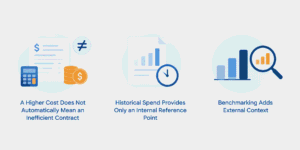
A Higher Cost Does Not Automatically Mean an Inefficient Contract
Purchased service costs can increase for legitimate reasons. Market conditions, labor costs, utilization, service requirements, geography, and changes in scope can all affect what an organization pays.
Therefore, a year-over-year increase does not automatically demonstrate that a contract is unfavorable. It shows that something changed and may warrant further review.
Historical Spend Provides Only an Internal Reference Point
Comparing current spending with previous spending can show whether costs have increased, decreased, or remained stable.
However, it does not answer whether another comparable health system is paying less for a similar service under similar conditions.
For example, knowing that a facility’s environmental services costs increased by 5% tells leadership that spending moved. It does not, by itself, establish whether that increase is consistent with the broader market.
Benchmarking Adds External Context
Benchmarking adds another reference point by comparing relevant results with a peer group.
Valify specifically positions its purchased services benchmarking around comparing terms, pricing, service considerations, and other results against an organization’s peers.
What Valify’s Purchased Services Benchmarking Looks Beyond Price
Benchmarking is more useful when it evaluates the conditions surrounding a price rather than treating one number as the complete picture.
Contract Status and Terms
Valify’s in-depth benchmarking analysis reviews contract status, notice periods, termination language, and co-terminous opportunities within the health system.
These details matter because identifying a pricing difference is only useful if an organization understands when and how it can act on it.
A contract approaching renewal may provide a different opportunity and timeline than an agreement with a long remaining term and restrictive termination provisions. Co-terminous opportunities can also help organizations evaluate related agreements together.
Invoice Prices Compared With Contracted Prices
Valify also identifies invoice price ranges and averages compared with contracted prices as part of its benchmarking analysis.
This is important because annual spend totals alone can conceal differences between what an organization negotiated and what is actually appearing on invoices.
Examining invoice and contracted pricing can help identify areas where additional review may be appropriate.
Patient and Staff Satisfaction
Valify’s benchmarking analysis also considers the impact on patient and staff satisfaction.
That dimension reinforces an important point: the lowest price is not automatically the appropriate target.
Purchased services support healthcare operations, and changes to a service arrangement can affect employees, patients, facilities, and day-to-day operations. Financial analysis therefore needs to be considered alongside service outcomes.
Peer Comparison
The final step is comparing these findings against the organization’s peer group.
This gives healthcare leaders a broader reference point for understanding whether a particular result appears relatively strong, warrants further investigation, or requires additional context before action is taken.
How Can Benchmarking Help You Prioritize What to Review?
Benchmarking should not be presented as a guarantee of savings. Its role is to provide evidence that can help healthcare leaders decide where further evaluation makes sense.
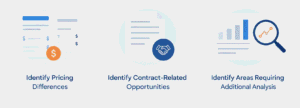
Identify Pricing Differences
A comparison can reveal where contracted or invoice pricing differs from relevant peer results.
That difference is a reason to investigate, not proof that the organization is overpaying.
Identify Contract-Related Opportunities
Notice periods, termination provisions, and renewal timing can influence when an organization can take action.
Co-terminous opportunities may also identify contracts that could be evaluated together rather than handled as isolated agreements.
Identify Areas Requiring Additional Analysis
A benchmark can point to categories that deserve a closer look. Depending on the findings, the next step could involve contract review, supplier discussions, competitive sourcing, vendor consolidation, or simply gathering more information.
This aligns with how Valify describes its benchmarking capability: comparing results with peers to determine where an organization is in a strong position and where it needs to re-evaluate.
Why Benchmarking Becomes More Important When Financial Flexibility Is Limited
Financial pressure changes the importance of prioritization.
Prioritization Becomes More Important
Organizations with limited financial flexibility cannot investigate every purchased-service category at the same depth at the same time.
Benchmarking can provide information that helps determine where additional review may be warranted. Instead of treating every cost difference equally, leaders can use comparative information to focus attention on categories that require further evaluation.
Existing Contracts Can Represent Ongoing Commitments
Purchased-services agreements can include defined terms, renewal periods, notice requirements, and termination provisions.
Understanding those conditions alongside benchmark information provides a more complete picture of both the potential opportunity and the timing required to address it.
A category may appear worth reviewing based on pricing, but the organization also needs to know whether the contract can actually be changed and when.
Decisions Need More Than an Internal Cost Target
A broad instruction to “reduce spending” does not identify which contracts or services should be examined first.
Benchmarking can add evidence to that decision-making process by providing an external reference point for evaluating current results.
External financial indicators reinforce why this context matters. Kaufman Hall reported an adjusted year-to-date hospital operating margin of 1.7% through March 2026, while noting continued pressure from lower margins, higher bad debt and charity care, and higher drug expenses. Its National Hospital Flash Report draws on data from more than 1,300 hospitals.
The implication for purchased-services management is not that benchmarking will resolve these pressures. Rather, tighter financial conditions increase the importance of making informed decisions about where additional review and resources should be directed.
Benchmarking Works Best When It Is Connected to Complete Spend Visibility
Benchmarking is only as useful as the spending information being evaluated.
Valify’s Spend Analytics Technology is designed to categorize health system spend data and provide visibility into purchased-services expenses. Its platform categorizes spend across more than 1,400 purchased-services categories and provides detailed visibility into the underlying spend.
That visibility provides the foundation for meaningful comparison. Instead of looking at an isolated invoice or individual contract, organizations can understand the broader category, suppliers, facilities, and spending patterns involved.
Valify’s broader model connects spend visibility with benchmarking, sourcing, contracting, and ongoing savings management.
The important point is that benchmarking should support the decision-making process rather than exist as a separate exercise.
From Benchmark to Decision: What Should Happen Next?
Benchmarking provides information. Healthcare leaders still need to determine what that information means and what, if anything, should happen next.
Validate the Finding
First, confirm that the peer comparison is appropriate and understand whether differences in pricing or terms have legitimate explanations.
Review the Contract
Next, examine renewal dates, notice requirements, termination provisions, service levels, and other relevant contract conditions.
Determine the Appropriate Action
Depending on the findings, an organization may decide to:
- Review the existing contract
- Renegotiate terms or pricing
- Conduct a competitive sourcing event
- Examine vendor consolidation
- Continue monitoring the category without immediate action
The appropriate response depends on the category, contract, market, and operational requirements.
Track the Outcome
If action is taken, the organization should monitor the resulting pricing, contract performance, and financial impact.
This closes the loop between benchmarking and actual cost management.
Conclusion: Better Context for Better Purchased-Services Decisions
Financial pressure makes it increasingly important for healthcare organizations to understand the context behind purchased-services costs.
Benchmarking does not mean assuming that every price difference represents a savings opportunity. Instead, it provides a structured way to compare contract terms, invoice and contracted pricing, service considerations, and peer results.
That information can help healthcare leaders determine where further evaluation may be warranted, understand the timing and conditions surrounding an opportunity, and decide what action is appropriate.
For Valify, benchmarking is part of a broader purchased services approach that connects spend visibility with informed decision-making. Its core model is straightforward:

When financial flexibility is limited, knowing where costs stand is important. Knowing how those costs compare, and what the comparison means for the organization, is what gives that information greater value.
FAQs
How often should healthcare organizations benchmark their purchased-services contracts?
There is no single frequency that applies to every category. Organizations can consider benchmarking when reviewing major contracts, preparing for renewal, evaluating significant pricing changes, or reassessing categories where spending has changed materially.
What types of purchased services can be evaluated through benchmarking?
Purchased services span categories such as facility support, clinical services, financial services, IT and telecommunications, ancillary services, HR services, and insurance. The appropriate benchmarking approach depends on the characteristics of the specific category.
What makes a peer group appropriate for healthcare benchmarking?
An appropriate peer group should provide meaningful context for the category being evaluated. Factors such as organization characteristics, service requirements, geography, and other relevant operating conditions can affect whether a comparison is useful.
What data does a healthcare organization need before starting a benchmarking analysis?
Useful information can include spend data, vendor information, invoices, contracted pricing, contract terms, service requirements, and relevant operational information. A more complete view of the underlying spend can make the resulting comparison more meaningful.
How can healthcare leaders maintain the value of benchmarking after a contract has been renegotiated?
Benchmarking should not necessarily end when a contract changes. Organizations can continue monitoring pricing, contract compliance, supplier performance, and spending patterns. This helps determine whether the expected improvement is being maintained and when the category may need to be reassessed.

The Valify Editorial Team is dedicated to sharing insights, strategies, and innovations that help healthcare organizations gain control of purchased services spend. Backed by years of expertise in data analytics, procurement, and healthcare technology, the team curates practical resources and thought leadership to guide hospitals and health systems toward greater efficiency and savings. By combining industry knowledge with real-world case studies, the Valify Editorial Team delivers content that empowers decision-makers to drive smarter, data-driven sourcing strategies.
