
Key Takeaways
Hospitals overspend on purchased services because data is fragmented and hard to interpret. Real savings come when teams stop reacting to totals and start understanding cost drivers through clean data, benchmarking, and governance. That shift turns purchased services from a blind spot into a managed program.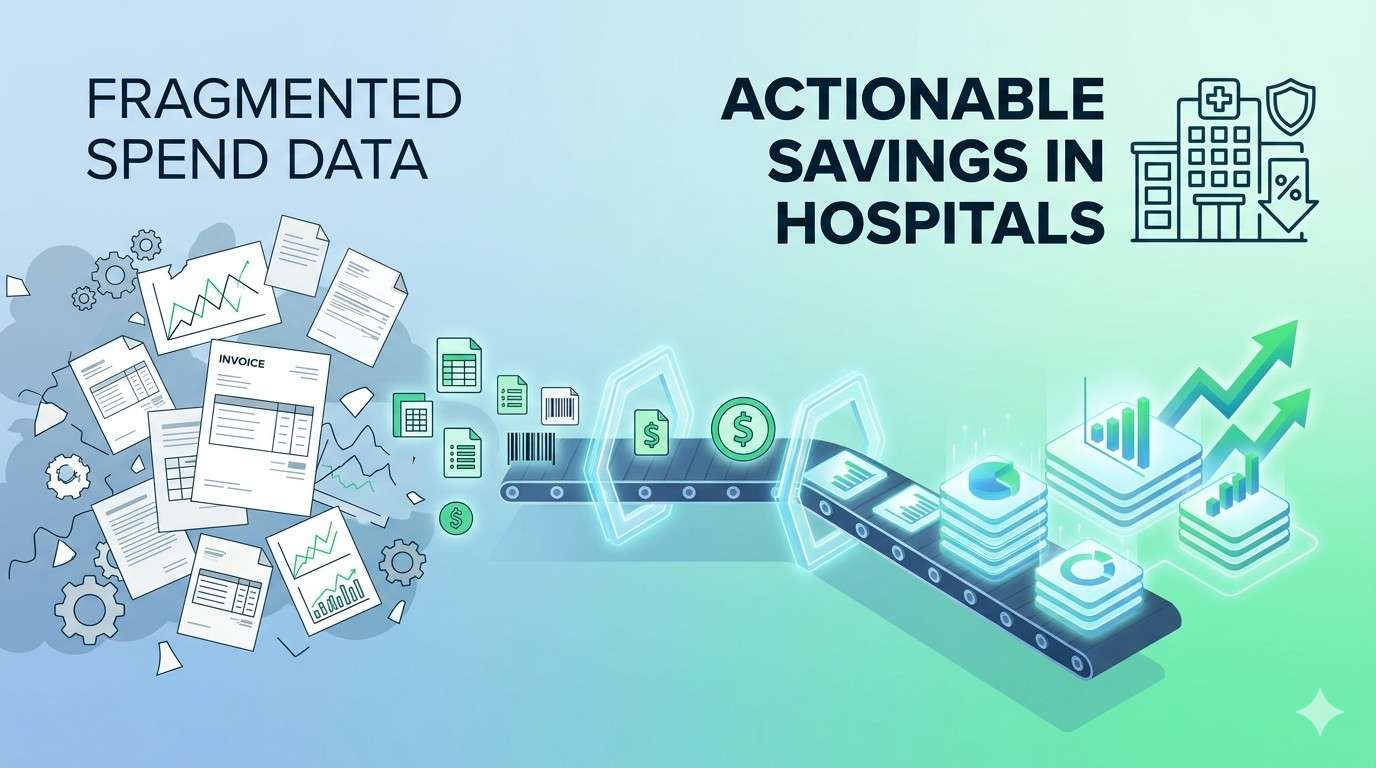
From Raw Spend Data to Actionable Savings in Hospitals
Hospitals don’t have a data problem, they have a translation problem.
Every year, health systems process thousands of invoices, service agreements, and vendor payments. All of it gets captured somewhere; accounts payable, ERP systems, contract files. But very little of that information turns into decisions that actually reduce cost or improve how the organization runs.
That gap matters. Hospital care accounts for about 31% of total U.S. healthcare spending, which means even small inefficiencies scale fast. And with nearly 60% of hospitals seeing increases in non-labor expenses, pressure is coming from areas that are often the hardest to see clearly.
Purchased services sit right in the middle of that blind spot.
Understanding the Challenge: Why Raw Spend Data Alone Isn’t Enough
Most hospital leaders can pull a spend report today. It will show totals by vendor or department. It might even show trends over time.
What it usually won’t show is what’s actually happening underneath.
Spend data is fragmented by design. One facility codes services differently than another. Vendor names show up in multiple versions. Invoices describe work in vague terms. Contract details live in folders that don’t talk to finance systems.
So teams end up reacting. A cost spike shows up. Someone asks why. The answer is often a guess.
Without clean, normalized, and categorized data, procurement and finance teams can’t confidently answer basic questions, which services are driving increases, where pricing is out of line, or whether contracts are performing as expected. That’s how organizations slip into firefighting mode instead of running a plan.
What Are Purchased Services and Why They Matter
Purchased services are outsourced or contracted services provided by third-party vendors, not internal staff. They’re part of non-labor spend, and they touch almost every corner of a hospital.
Purchased services touch nearly every part of a hospital, from facilities and environmental services to clinical contracts, IT and software, revenue cycle support, and other operational functions that keep care moving. What makes purchased services tricky is that they don’t behave like supplies. There’s no simple unit price. Scope varies. Labor is embedded. Geography matters. Two hospitals can buy the same type of service and pay very different rates.
Because of that complexity, purchased services often grow without much resistance. They don’t trigger the same scrutiny as labor or major capital expenses. And over time, they quietly become one of the largest cost centers in the organization.
The Cost Impact of Purchased Services on Hospital Budgets
Non-labor expenses have been climbing, and purchased services are a big part of that story.
The challenge isn’t usually a single bad contract. It’s accumulation. Auto-renewals that never get revisited. Vendors adding scope. Departments solving problems locally without enterprise visibility.
Each change feels reasonable. Together, they create cost creep that’s hard to reverse.
The financial impact shows up first, but it doesn’t stop there. When too much money is tied up in inefficient service spend, hospitals have less flexibility. Investments get delayed. Operational strain increases. Patient experience eventually feels it too.
A Step-by-Step Framework to Turn Raw Data Into Savings
Getting control of purchased services isn’t about running one analysis and calling it done. It’s about building a repeatable way to move from data to action and then keep it working.
Step 1: Collect and Centralize Spend Data
The first real shift happens when all purchased services spend is viewed together.
That means pulling accounts payable data across facilities, not one location at a time. It means including invoices and contract references where possible. Without that full picture, analysis always misses something.
Centralization doesn’t solve the problem on its own, but nothing works without it.
Step 2: Cleanse and Normalize for Consistency
Once data is in one place, the cleanup begins. This step isn’t glamorous, but it’s where insight starts.
Vendor names need to be standardized. Duplicate records removed. Descriptions aligned enough to be comparable. When this doesn’t happen, spend looks smaller or more fragmented than it really is.
Clean data builds confidence. And confidence is what gets teams to act.
Step 3: Categorize Spend Into Actionable Buckets
High-level categories don’t tell you much. Purchased services need more precision.
Detailed categorization lets hospitals compare similar services across facilities and vendors. It makes benchmarking possible. It also surfaces things that don’t belong where they landed, which is often where the opportunity is.
This is where spend starts to become understandable, not just visible.
Step 4: Analyze Trends to Identify Savings Opportunities
Now the questions change.
Instead of “Did spend go up?” the focus becomes “Why did it go up?” Was it price? Volume? A new vendor? A contract change?
With the right structure, patterns show up. One facility pays more than others for the same service. A category drifts upward year after year. A vendor’s pricing sits outside normal ranges.
Benchmarking adds context. It shows whether an issue is internal or market-driven and whether it’s worth acting on.
Step 5: Prioritize Actions With Benchmarking and Insights
Not every opportunity is worth chasing. Some gaps are noise. Others are meaningful.
Benchmarking helps separate the two. Category-level comparisons, vendor pricing ranges, and facility-specific views point teams toward the areas with the biggest upside.
This is where analysis stops being academic and starts shaping decisions.
Step 6: Execute Strategic Sourcing and Contract Improvements
Once priorities are clear, action becomes easier.
Sourcing events are more focused. Negotiations are grounded in data. Contracts are revisited with context instead of guesswork. In some cases, hospitals consolidate vendors. In others, they move into preferred supplier agreements that already reflect competitive terms.
This is where savings actually show up.
Step 7: Monitor With Dashboards and Governance Tools
One-time savings don’t last without oversight.
After contracts are signed or vendors are changed, spend needs to be watched. Not obsessively, but consistently. Dashboards help track compliance. Alerts surface issues early. Governance keeps decisions from drifting back to old habits.
This is how savings turn into something sustainable.
The Role of Advisory and Follow-Through
Why Good Data Still Isn’t Enough
Even with solid analytics, execution can stall. Purchased services decisions cut across finance, supply chain, operations, and departments that all have competing priorities.
Aligning Stakeholders Around the Same Priorities
Advisory support helps bring those groups onto the same page. It creates shared context around what matters most and where action will have the biggest impact.
Turning Insight Into Decisions That Stick
The value isn’t in more analysis. It’s in helping organizations move from agreement to action and keeping momentum when day-to-day pressures take over.
What Hospitals Gain When Purchased Services Are Managed Well
More Predictable Operations
When services are aligned to contracts and performance expectations, operations run smoother and disruptions decrease.
Stronger Vendor Performance
Clear expectations and governance lead to more consistent service delivery and fewer surprises.
Time Back for Teams
With fewer issues to untangle, teams spend less time firefighting and more time focused on care and core responsibilities.
Financial Flexibility That Supports Care
Sustainable savings create room to invest in staffing, technology, and patient experience, the outcomes hospitals are actually working toward.
How Valify Helps Hospitals Turn Insight Into Action
-
Built Specifically for Healthcare Purchased Services
Valify is designed specifically for healthcare purchased services, not general procurement or expense management. By cleansing and categorizing accounts payable data across more than 1,400 purchased services categories, Valify gives hospitals clear, line-item visibility into non-labor spend across facilities and vendors, making services spending understandable and actionable.
-
From Visibility to Context With Benchmarking
Understanding spend is only useful when it can be compared to the market. Valify’s benchmarking capabilities, including PinPoint Benchmarks, draw from over $1 trillion in categorized spend to help hospitals see how their pricing, vendor mix, and category performance compare to relevant peers, allowing teams to focus on opportunities that truly matter.
-
Supporting Smarter Sourcing and Contract Decisions
With clearer insight and benchmark context, hospitals can move more confidently into sourcing and negotiation. Valify supports smarter contract decisions by helping teams evaluate vendors, consolidate services where it makes sense, and access a broad portfolio of purchased services contracts that balance national buying power with local market needs.
-
Sustaining Savings With Ongoing Governance
Achieving savings is only the first step. Valify’s WorkPlan dashboard helps hospitals monitor purchased services spend over time, track savings initiatives, and identify off-contract vendors or unusual spend patterns early, supporting accountability and long-term control.
-
Advisory Support That Helps Organizations Follow Through
Purchased services initiatives often involve many stakeholders, which can slow execution. Valify’s advisory services help hospitals align finance, supply chain, and operations around shared priorities, ensuring that insights turn into action and that savings efforts continue even as day-to-day demands compete for attention.
From Data to Sustainable Savings
Raw spend data doesn’t reduce costs. Decisions do.
Hospitals that centralize purchased services data, clean it, analyze it properly, and act on it consistently gain real control over one of their largest expense areas. They stop reacting and start managing. Valify helps hospitals make that shift, from fragmented data to clear insight to sustained savings.
If you want to see what that looks like in practice, schedule a demo with Valify and explore how purchased services visibility can translate into real, measurable results.
Frequently Asked Questions
What is purchased services spend?
Purchased services include vendor-provided services such as facilities management, clinical support contracts, IT services, and administrative outsourcing. They make up a large share of non-labor expenses.
Why is spend data hard to analyze in hospitals?
Data lives across multiple systems and facilities. Without normalization and categorization, trends and drivers stay hidden.
How does benchmarking help reduce costs?
Benchmarking adds context. It shows how pricing and performance compare to peers, which helps teams focus on real opportunities.
Can better spend analysis improve patient experience?
Yes. When waste is reduced, resources can be redirected toward care delivery and patient-facing improvements.
What’s required to sustain savings over time?
Ongoing visibility, governance, and accountability. Without monitoring, savings tend to fade.

The Valify Editorial Team is dedicated to sharing insights, strategies, and innovations that help healthcare organizations gain control of purchased services spend. Backed by years of expertise in data analytics, procurement, and healthcare technology, the team curates practical resources and thought leadership to guide hospitals and health systems toward greater efficiency and savings. By combining industry knowledge with real-world case studies, the Valify Editorial Team delivers content that empowers decision-makers to drive smarter, data-driven sourcing strategies.
