
Key Takeaways
Traditional spend reporting often misses fragmented spending, unexplained cost differences, and opportunities requiring prioritization. Valify addresses these blind spots through automated spend categorization, benchmarking, savings opportunity identification, and contract visibility. These capabilities help healthcare organizations understand purchasing patterns, evaluate spending differences, prioritize reviews, and make informed decisions toward potential savings.
Three Blind Spots Traditional Spend Reporting Misses. Valify Doesn’t.
Healthcare organizations have plenty of financial data. Accounts payable (AP) systems and purchasing platforms can show total spend, vendor payments, departmental expenses, facility-level costs, and historical trends. These reports help leaders understand where money is going.
But knowing what was spent does not necessarily explain why the spending looks the way it does, or where an opportunity to improve it might exist.
Purchased services spend is particularly challenging to analyze because expenses can be spread across facilities, departments, vendors, and general ledger (GL) codes. Traditional reporting may show individual transactions without revealing the relationships between them.
Three blind spots can limit that visibility:
- The true scope of spend: Related expenses may be scattered across vendor records, GL codes, and facilities.
- The differences hidden inside the spend: Variances may be visible without enough context to explain them.
- The action opportunities hidden behind contracts and timing: Reports may identify spending patterns without showing what deserves attention first.
Valify’s Spend Analytics Technology helps healthcare organizations move beyond basic reporting through spend categorization, benchmarking, opportunity identification, and contract visibility.
Three Blind Spots Traditional Spend Reporting Can’t Identify
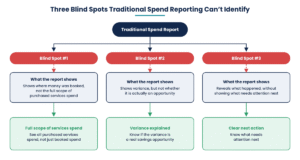
Blind Spot #1 — The Report Shows Where Money Was Booked, Not the Full Scope of Purchased Services Spend
A report can only present the information available in the underlying data. When records are inconsistent, related expenses may appear as separate items, making it difficult to understand the full scope of purchased-services spending.
For example, the same vendor may appear under different names across facilities. Similar services may be assigned to different GL codes, and individual departments may purchase services outside established vendor arrangements. Decentralized and non-purchase-order (non-PO) transactions can make the picture even harder to piece together.
Common issues include:
- Duplicate vendor names that make one supplier look like several.
- Multiple GL codes associated with similar services, complicating category-level analysis.
- Fragmented facility and department spending that makes health system-wide comparisons difficult.
- Rogue spending involving purchases outside preferred-vendor arrangements.
The problem is not necessarily that transactions are missing. It is that the information may not be organized in a way that reveals the complete spend picture.
Valify’s Immediate Insights uses machine-learning algorithms to categorize total non-labor spend. Its platform provides:
- Categorization into 1,400+ unique purchased-services categories across seven service lines.
- Visibility down to the line-item level.
- Categorization coverage of 95% of total health system spend, according to Valify.
- Identification and consolidation of duplicate vendor names and categories using multiple GL codes.
- Identification of rogue spending, including decentralized and non-PO purchases outside preferred-vendor arrangements.
- Vendor visibility by facility and department within each service category.
This helps organizations examine related expenses together instead of relying solely on how individual transactions were originally recorded.
The key takeaway: The first blind spot is fragmented data that prevents leaders from seeing the full scope of purchased-services spend.
Blind Spot #2 — A Spend Report Can Show Variance Without Explaining Whether the Variance Is Actually an Opportunity
Seeing a difference in spending is one thing. Understanding what caused it is another.
Suppose two facilities report different spending levels for the same service. The numbers may raise a question, but they do not automatically explain the difference. One facility may use the service more frequently, while another may have different contract terms, service requirements, or vendor arrangements.
Before treating a variance as a potential savings opportunity, leaders need to understand what is driving it.
Questions worth investigating include:
- Does the difference reflect service volume or pricing?
- Do the facilities have different contract terms?
- Are multiple vendors providing similar services?
- Are the service arrangements comparable?
- Could a change affect patient or staff satisfaction?
Without this context, a comparison can identify where spending differs but cannot establish whether that difference is justified or actionable.
Valify’s Healthcare Benchmarking capabilities add another layer of analysis by examining spending alongside contract details, pricing information, and peer comparisons.
The analysis can consider:
- Contract status, notice periods, and termination language.
- Opportunities to make agreements coterminous across the health system.
- Invoice price ranges and averages compared with contracted prices.
- Comparisons with the organization’s peer group.
- Potential impacts on patient and staff satisfaction.
These details help leaders evaluate spending differences in context. For instance, invoice prices that differ from contracted prices may warrant further investigation. Contract notice periods may affect when an organization can act, while service-quality considerations may influence whether a proposed change makes sense.
Benchmarking is not simply about finding the lowest price. It helps healthcare organizations understand what their data indicates, which differences merit attention, and where further investigation may be worthwhile.
Blind Spot #3 — Reports Can Reveal What Happened Without Showing What Needs Attention Next
Even when spending is visible, and differences are better understood, healthcare leaders still need to decide where to focus.
A health system may have hundreds of purchased-services categories, multiple suppliers, and an extensive contract portfolio. Reviewing every category with equal attention is rarely practical. Without prioritization, useful findings can remain buried in lengthy reports.
Leaders need to know which categories deserve attention first, where quick wins may exist, which contracts are approaching expiration, and where off-contract spending needs review.
Valify’s Purchased Services Assessment (PSA) helps organizations identify and prioritize potential savings opportunities. It uses four data-driven opportunity-identification metrics to help target categories likely to yield savings and identify quick wins.
The assessment can help teams:
- Generate customized lists of top savings opportunities.
- Identify standardization opportunities and rogue spending.
- Rank benchmark opportunities for further evaluation.
- Improve data quality by identifying vendors with multiple names, accounts tied to multiple categories, and categories associated with multiple GL accounts.
This gives teams a more focused starting point for deciding which opportunities to investigate.
Contract timing is another important part of prioritization. An opportunity may look promising, but the appropriate next step can depend on contract expiration dates, notice periods, and existing commitments.
Valify’s Contracts Dashboard provides visibility into:
- Expiring contracts, upcoming expiration dates, and related action items.
- Opportunities to make agreements coterminous.
- On- and off-contract spending by category.
- Purchased-services contracts in a centralized location.
Together, the assessment and contract visibility help teams evaluate both where to focus and when to act. The findings support decision-making; healthcare teams must still validate opportunities and carry out the appropriate sourcing, contracting, or operational changes.
What Changes When These Three Blind Spots Are Addressed Together?
Addressing fragmented data, unexplained variances, and limited prioritization creates a clearer path from financial reporting to informed decisions.
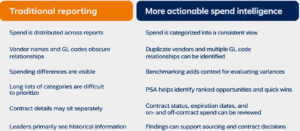
Valify’s Spend Analytics Technology brings together data categorization, quality control, benchmarking analysis, market-share insights, and category-specific RFP templates. Savings initiative tracking through WorkPlan supports the work that follows opportunity identification.
These capabilities serve different purposes, but their value becomes clearer when used together. Categorization establishes a more consistent view of spend. Benchmarking helps explain differences. Opportunity identification helps teams prioritize their efforts, while contract visibility adds practical context for planning next steps.
Identifying an opportunity does not automatically produce savings. Teams still need to validate the findings, evaluate service requirements, make sourcing or contracting decisions, and implement changes. Better spending intelligence helps give that work a more informed starting point.
From Reporting to Actionable Intelligence: What Healthcare Leaders Should Expect
Healthcare leaders can evaluate spend analytics by asking five practical questions:
- What did we spend?
Traditional reports provide totals, vendor payments, departmental expenses, facility-level costs, and historical trends.
- What did we actually spend across the health system?
Cleaned and categorized data helps bring related transactions together across vendors, facilities, departments, and service categories.
- How does that spend compare?
Benchmarking adds context through pricing, contract details, and peer comparisons.
- Where should we focus?
Opportunity identification helps teams prioritize categories, quick wins, rogue spending, benchmark opportunities, and contracts that need attention.
- What action follows?
The findings can inform sourcing, contract reviews, vendor evaluations, standardization initiatives, and contract-management activities.
Not every finding will lead to an immediate cost reduction. Some may require further investigation, while others may confirm that an existing arrangement is appropriate. Either way, the goal is to help leaders make better-informed decisions about where to direct their attention.
That is the difference between having reports and having information structured to support decision-making.
Conclusion: The Biggest Blind Spot May Be Assuming the Report Is the Analysis
Traditional reporting remains useful for understanding historical spending. But totals and charts do not always reveal the full scope of purchased services, explain why spending differs, or show which opportunities deserve attention first.
The three blind spots are fragmented visibility, unexplained spending differences, and a lack of prioritization.
Valify’s Spend Analytics Technology helps address these challenges through spend categorization, benchmarking, opportunity identification, and contract visibility. These capabilities help healthcare organizations move beyond reviewing transactions toward understanding spending patterns and evaluating where action may be warranted.
Explore Valify’s Spend Analytics Technology to learn how your organization can move from fragmented purchased-services reporting to clearer, more actionable spend intelligence.
Frequently Asked Questions
What should healthcare organizations look for when choosing a spend analytics solution?
Consider how the solution handles data quality, purchased-services categorization, benchmarking, contract visibility, and opportunity prioritization. It should also fit the organization’s existing data environment and support the decisions teams need to make.
How can healthcare organizations distinguish a genuine savings opportunity from a temporary spending change?
Review spending over an appropriate period and consider volume, service requirements, contract terms, and operational changes. Comparing isolated figures without that context can lead to misleading conclusions.
Why is vendor data standardization important for purchased-services analysis?
Inconsistent vendor names can make related transactions appear to belong to different suppliers. Standardizing vendor information helps organizations review supplier relationships and spending more consistently across departments and facilities.
What is the difference between identified savings and realized savings?
Identified savings represent potential opportunities uncovered through analysis. Realized savings reflect results achieved after an opportunity has been validated and the relevant change implemented. Tracking them separately gives leaders a clearer view of actual progress.
How can healthcare organizations use spend analytics to prepare for contract negotiations?
Spend analytics can help teams review historical spending, compare invoice prices with contracted prices, examine relevant benchmarks, and understand contract terms and expiration dates. These findings can inform negotiation priorities and preparation, although the outcome depends on the specific agreement and negotiations.

The Valify Editorial Team is dedicated to sharing insights, strategies, and innovations that help healthcare organizations gain control of purchased services spend. Backed by years of expertise in data analytics, procurement, and healthcare technology, the team curates practical resources and thought leadership to guide hospitals and health systems toward greater efficiency and savings. By combining industry knowledge with real-world case studies, the Valify Editorial Team delivers content that empowers decision-makers to drive smarter, data-driven sourcing strategies.
