Top GPO Cost-Saving Strategies for Hospitals in 2026

Top GPO Cost-Saving Strategies for Hospitals in 2026

Key Takeaways

Cost pressure isn’t letting up in 2026. Inflation, vendor consolidation, and rising purchased services spend are forcing hospitals to look beyond surface-level savings. While most organizations already participate in GPOs, access alone no longer guarantees results. The hospitals seeing real impact are using GPOs differently. They focus on high-spend purchased services, benchmark pricing against peers, standardize contracts, reduce sourcing complexity, and actively monitor compliance so savings don’t disappear after contracts are signed. When GPO participation is supported by clear spend visibility and ongoing governance, purchased services become one of the most controllable areas of hospital spend. That’s where sustainable savings come from; not one-time negotiations, but better decisions backed by data.

Hospitals are entering 2026 under sustained financial pressure. Inflation remains elevated, vendor consolidation is increasing prices, and purchased services continue to grow as a share of non-labor spend. For hospital leaders, cost control is no longer a short-term exercise. It is a long-term operational requirement.

Group Purchasing Organizations (GPOs) remain one of the most powerful tools hospitals have to manage costs. Yet nearly all U.S. hospitals already use GPO contracts. That means access alone is no longer the differentiator.

In 2026, real savings come from how hospitals use GPOs, supported by spend visibility, benchmarking, and ongoing governance. This article explains the top GPO cost-saving strategies hospitals should focus on in 2026 and how a purchased services–first approach turns GPO participation into sustainable financial results.

Why Hospital Cost Pressure Is Structural in 2026

Healthcare cost increases are no longer episodic. They are embedded in how care is delivered and supported.

National healthcare research shows cost trends continuing near 9% heading into 2026. At the same time, hospitals are relying more heavily on third-party service providers for facilities, IT, clinical support, environmental services, and administrative functions. These purchased services now represent one of the largest controllable non-labor cost categories.

Group Purchasing Organizations are widely adopted. Industry research indicates that more than 95% of U.S. hospitals use GPO contracts. Yet many organizations still experience:

  • Wide price variation across facilities
  • Fragmented contracts for similar services
  • Limited insight into whether pricing is competitive
  • Savings that fade after contracts are signed

This disconnect exists because GPO participation without visibility and governance does not guarantee outcomes.

What GPOs Are Designed to Solve and Where Gaps Remain

At their core, GPOs aggregate purchasing volume across hospitals to negotiate pricing, terms, and service standards with vendors. This reduces transaction costs and improves negotiating leverage.

Modern GPOs provide value through:

  • Aggregated buying power
  • Pre-negotiated contracts
  • Reduced sourcing effort
  • Administrative efficiency

However, GPOs do not manage a hospital’s internal spend behavior. They do not automatically enforce compliance, surface pricing outliers, or prioritize where leverage matters most. That is why hospitals with the same GPO can see very different results.

The Real Cost Problem: Purchased Services Without Visibility

Purchased services costs fluctuate for predictable reasons. Understanding these drivers is essential before discussing solutions.

Why Purchased Services Costs Rise

Cost Driver What Happens Inside Hospitals Why It Drives Overspend
Vendor consolidation Fewer service providers control pricing Hospitals lose negotiating leverage
Contract fragmentation Similar services contracted separately Wide price variation across facilities
Inflation escalators Annual increases compound over time Costs rise faster than budgets
Limited spend visibility Leaders lack line-item insight Overpayment goes unnoticed
Weak compliance Off-contract vendors continue Negotiated savings erode

In 2026, controlling purchased services spend requires moving from reactive negotiations to structured cost architecture.

From Cost-Cutting to Cost Architecture

Historically, hospitals focused on isolated savings events. A contract was renegotiated. A vendor was replaced. Savings appeared, then slowly disappeared.

In 2026, leading hospitals are shifting to cost architecture, a system where:

  • Spend is fully visible and categorized
  • Opportunities are prioritized using benchmarks
  • GPO leverage is applied intentionally
  • Compliance is monitored continuously

GPOs are foundational to this system, but they work best when paired with analytics and governance.

Top GPO Cost-Saving Strategies for Hospitals in 2026

The strategies below reflect how high-performing health systems are using GPOs today to drive measurable, lasting savings.

Expanding Category Management Beyond Supplies

Hospitals are broadening GPO strategies beyond medical and surgical supplies into purchased services such as IT, food service, facilities management, environmental services, security, and HR outsourcing. These categories are often managed independently across departments, which limits visibility and weakens negotiating leverage.

By categorizing purchased services spend holistically, hospitals can consolidate fragmented contracts, reduce vendor overlap, and apply GPO leverage to areas that were previously unmanaged.

Impact:
Unlocks savings in overlooked areas that often account for 20–30% of hospital budgets.

Where GPO Savings Focused and Where They’re Shifting in 2026

Area Traditional GPO Focus 2026 GPO Opportunity
Primary categories Medical & surgical supplies Purchased services
Spend ownership Centralized Fragmented across departments
Visibility High Historically low
Savings potential Incremental Structural
Budget impact Smaller share ~20–30% of operating budgets

Leveraging Data-Driven Contract Optimization

Many hospitals still review contracts on a fixed cycle and assume the pricing holds up in between. In reality, rates drift, usage changes, and savings quietly slip away long before renewal.

Teams are now using data to keep a closer eye on how contracts perform day to day. Pricing is checked against peer hospitals. Off-contract spend is flagged early. Renegotiations happen when the numbers call for it, not just when a contract expires.

GPOs are supporting this shift by making pricing comparisons easier to see. Instead of relying on assumptions or vendor explanations, hospitals can point to real data and have more direct, informed conversations about cost.

Impact:
Ensures hospitals capture negotiated savings and avoid hidden costs.

Why Benchmarking Changes Outcomes

Without Benchmarking With Benchmarking
Vendor price increases accepted Pricing validated against peers
Sourcing done reactively Categories prioritized by impact
Limited negotiating leverage Data-backed negotiations
Hidden overpayment Clear outlier identification

As service providers continue to raise prices in response to labor and inflation pressures, benchmarking becomes essential for informed decision-making.

Building Supplier Diversification & Risk Mitigation

Many hospitals ran into trouble when a single vendor could not deliver. Staffing fell short. Service levels dropped. Prices went up with little warning. When that happened, there were often no alternatives ready.

To avoid being stuck again, hospitals are keeping more than one approved vendor for important purchased services. GPOs make this easier by lining up multiple options under the same category.

This gives teams room to move. If a provider misses expectations or pushes a sharp increase, work can shift without restarting the entire sourcing process. It also keeps pricing conversations more balanced, since vendors know they are not the only option.

Impact:
Helps avoid service gaps and sudden cost increases while keeping negotiation leverage in place.

Aligning Contracts with Value-Based Care

Price alone no longer tells the full story. A service can be inexpensive and still create problems if it slows operations or affects care quality.

Hospitals are reviewing GPO contracts with a wider lens. They are asking whether a service actually supports how care is delivered day to day. That includes reliability, turnaround time, and how much follow-up work it creates for staff.

As payment models change, procurement decisions are being made with more input from clinical and operational teams. The goal is to control costs without creating downstream issues that show up elsewhere in the system.

Impact:
Supports reimbursement models that focus on quality and performance, not just volume.

Digital Transformation of Purchased Services

The biggest shift in 2026 is the digitalization of purchased services management. Hospitals are moving away from spreadsheets and manual tracking toward platforms that automate spend analysis, vendor management, and compliance tracking.

GPOs are often the access point to these tools, enabling hospitals to scale governance and maintain visibility across large, multi-facility systems.

Impact:
Streamlines procurement processes and reduces administrative overhead.

Valify: The Solution for 2026

GPOs set the foundation, but hospitals still need a way to manage purchased services day to day. That is where Valify fits.

Valify, the leading healthcare cost management platform, empowers hospitals to bring purchased services into a single, organized view. Instead of pulling information from multiple systems or relying on manual reports, teams can see where spend sits, how it compares to peers, and where action is needed.

With Valify, hospitals can:

  • Benchmark purchased services spend to understand what is competitive and what is not
  • Spot savings opportunities based on actual usage and pricing patterns
  • Track vendor compliance so negotiated terms do not slowly fall apart
  • Work more effectively with GPO partners using shared data and clearer priorities

Hospitals that put these pieces together are better equipped to handle ongoing cost pressure without sacrificing care delivery. In 2026, cost savings come from making better, data-informed decisions that hold up over time.

Turning GPO Participation Into Measurable Savings

By 2026, most hospitals already know this: signing a GPO contract doesn’t automatically lower costs. Margins are tighter. Vendor prices keep creeping up. And the old approach of “set it and forget it” just doesn’t hold anymore.

What we see in practice is simple. The hospitals that actually protect their savings are the ones that stay close to their data. They know where their purchased services dollars go. They check pricing against peers. They reduce contract sprawl. And they keep an eye on compliance so negotiated rates don’t quietly slip away.

When purchased services are managed as a single, coordinated program instead of a collection of disconnected contracts, cost reduction stops being a one-time event. It becomes repeatable.

If you’re looking to move past short-term wins and build a purchased services strategy that holds up over time, visibility is the starting point.

Schedule a demo with Valify to see exactly where your purchased services sit today and how to turn GPO participation into savings you can actually measure and maintain.

Frequently Asked Questions:

What are the purchased services in healthcare?
Purchased services include non-labor services such as facilities management, IT support, environmental services, clinical outsourcing, and administrative services.

How much can hospitals save using GPO strategies?
Research shows hospitals can save 10–18% on supply and service costs when GPO contracts are used strategically and supported by compliance.

Why do hospitals still overspend even with GPOs?
  Overspending often results from limited spend visibility, fragmented contracts, and a lack of monitoring after agreements are signed.

How does benchmarking improve GPO negotiations?
Benchmarking provides peer-based pricing data that strengthens negotiating leverage and helps hospitals identify pricing outliers.

How does Valify support GPO cost-saving efforts?
Valify provides spend analytics, benchmarking, sourcing support, and compliance tracking that help hospitals turn GPO participation into lasting financial results.
How Regional Hospital Networks Can Leverage Local GPOs for Maximum Savings

How Regional Hospital Networks Can Leverage Local GPOs for Maximum Savings

Key Takeaways

Regional hospital networks can increase savings by combining the strengths of national purchasing groups with the flexibility of local purchasing groups. Local purchasing groups provide quicker contracting, regional pricing, and better supplier relationships. Using data analytics to synchronize both methods assists hospitals in optimizing their spending, enhancing the resilience of their supply chain, supporting their communities, and attaining more intelligent and sustainable cost management.

Hospital leaders don’t need another reminder about shrinking margins; the pressure is already clear. From CFOs recalculating budgets to materials managers navigating back orders and price hikes, healthcare workers feel the strain. Costs continue to rise, reimbursement rates aren’t keeping pace, and every expense in the budget must justify itself.

So where can regional hospital networks still find significant savings without cutting into patient care or staff resources?

For many, the answer is closer than expected: local group purchasing organizations (GPOs).

National GPOs have long dominated the purchasing conversation, and for good reason. They provide access to large-scale contracts that deliver significant discounts on commodities and high-volume supplies. But those savings don’t always tell the entire story. Local GPOs can uncover untapped value in specific categories and markets that national agreements simply overlook.

It is not a matter of ending national partnerships. It’s about layering in local intelligence to build a procurement plan that’s flexible, data-driven, and aligned with regional realities.

Why the Traditional Model Is Under Pressure

Hospitals have relied on national GPOs for decades to aggregate volume and negotiate lower prices. The formula worked well when supply chains were stable and costs were predictable. But the last few years have rewritten that rulebook.

  • Inflation and freight volatility have introduced regional price variations that national contracts can’t always absorb.
  • Pandemic-era disruptions showed just how fragile centralized supply channels can be.
  • Community-based health systems with unique patient populations and local vendor ecosystems discovered that “national average pricing” doesn’t necessarily mean the best deal for their geography.

In this new environment, networks are asking a smarter question: Where does national leverage end, and where does local opportunity begin?

The Local GPO Advantage: Context and Agility

Local GPOs were built to serve specific regions, sometimes a handful of hospitals in one state, sometimes a network of post-acute or specialty facilities in a metro area. Because of that scale, they work with a deep understanding of their local markets, a level of connection that large national organizations simply can’t match.

This is how it functions in practice:

Faster, more flexible contracting

Local GPOs often have leaner governance structures. They can negotiate or adjust agreements quickly when pricing shifts, supply availability changes, or a hospital needs an alternative vendor.

Relationships that matter

Regional vendors know they work with community partners, not anonymous contract numbers. That translates into better service, more responsive logistics, and often, more favorable terms when issues arise.

Tailored categories

National GPOs excel in broad, high-volume categories like med-surg and pharmaceuticals. Local GPOs tend to specialize in areas often missed or undervalued at the national level, such as environmental services, food service, maintenance, staffing, and regional construction. This allows them to negotiate pricing that matches the actual cost structure of the local market.

Transparent performance

Because local GPOs manage fewer members, they can show precisely how savings are achieved and where participation levels affect pricing. This visibility helps hospitals make data-based adjustments rather than assumptions.

Building a Hybrid Procurement Strategy

The future of healthcare purchasing isn’t national or local. It’s both. The most advanced regional networks are already moving toward a hybrid GPO model. They keep their national memberships for scale while layering in regional GPOs to capture value that large contracts may overlook.

A useful analogy is an investment portfolio: national GPOs provide resilience and volume-based returns, while local GPOs offer agile, high-yield opportunities.

A well-designed hybrid model might look like this:

  • National GPO contracts: high-volume clinical supplies, implants, pharmaceuticals, imaging equipment, and core medical commodities.
  • Local GPO contracts: facility services, food and nutrition, maintenance, IT support, temporary labor, and any category where local logistics or pricing variation plays a major role.

The objective is not merely to add more contracts. Strategic layering ensures each spend category matches the GPO model that delivers the greatest net value when considering freight, reliability, service, and compliance.

Using Data to Find the Overlap — and the Gaps

One of the most significant pain points for hospitals that belong to multiple GPOs is visibility. It’s easy to lose track of which contracts are in use, the actual compliance rates, or where redundant agreements exist.

Spend analytics changes the conversation. Tools such as Valify provide procurement leaders with a consolidated view across all vendors, categories, and GPOs. Rather than relying on spreadsheets and guesswork, clear patterns emerge:

  • Which categories perform best under national versus local pricing?
  • Where is freight being paid twice, or are volume thresholds being missed?
  • Which facilities under-utilize existing contracts?
  • And where there’s room to shift volume for immediate savings.

With that insight, hospital networks can quantify the true impact of GPO participation and make informed decisions about where local partnerships will yield measurable ROI.

In essence, data ensures the sustainability of a hybrid GPO strategy. Without visibility, it’s just more paperwork. With visibility, it becomes an intelligent system that continuously optimizes itself.

A Real-World Example

Consider a mid-sized regional network across three neighboring states. It relied exclusively on its national GPO membership for everything from food services to medical equipment for years.

During periods of inflation, leadership noticed that non-clinical spending, especially food and environmental services, rose faster than any other category. Freight surcharges, limited distributor coverage, and product substitutions were eroding savings.

By collaborating with a regional GPO specializing in hospitality and facilities, the network renegotiated local supply routes, sourced specific products regionally, and standardized menu ingredients across sites. The outcomes included:

  • reduced logistics costs,
  • total category savings in the first year, and
  • fewer supply interruptions due to shorter delivery chains.

They continued to manage the majority of clinical procurement efficiently. Adding a local layer, however, enabled the network to control costs in areas where national contracts had inherent blind spots.

This balance represents the true advantage: scale where it matters, precision where it matters most.

Implementation Blueprint for Regional Networks

If a health system is prepared to explore local GPO partnerships, it should begin with a structured roadmap rather than moving directly to new contracts. The approach followed by successful networks is as follows:

1. Map All Current GPO Relationships

Document all active membership, the categories covered, renewal dates, and participation requirements. Many hospitals discover they’re paying administrative fees for contracts they barely use.

2. Segment Spend by Category and Geography

Analyze spend data to identify where costs deviate from benchmarks or where local variables (freight, service availability, state regulations) impact pricing.

3. Identify Candidate Categories for Local Optimization

Look for areas where national contracts struggle to deliver, involving local labor, perishable goods, or services unique to the region.

4. Vet Local GPOs Carefully

Evaluate financial stability, member composition, and contract transparency. Strong local GPOs provide detailed savings reports rather than price lists.

5. Pilot Before Scaling

Select one or two categories to test. Measure results for six to twelve months, then compare against national performance metrics.

6. Integrate Data Systems

Combine contract and spend data from both national and local GPOs into a single analytics platform. This creates a unified dashboard of compliance and savings performance across the network.

7. Establish Ongoing Governance

Form a committee with members from finance, supply chain, and clinical departments to assess GPO data every quarter. Continuous evaluation makes the strategy quick and adaptable to the changes in the market.

What the Next Five Years Will Look Like

As analytics and automation become standard in healthcare supply chains, expect tighter collaboration between national and local GPOs. The most innovative systems won’t just compare pricing; they’ll exchange real-time data to benchmark market performance and identify mutual opportunities.

Picture this:

A supply chain director opens a dashboard showing side-by-side comparisons of national and local contract pricing across every category. One click reallocates purchasing volume accordingly.

That’s not science fiction; it’s the next evolution of procurement visibility, and data-driven platforms like Valify are already enabling it.

The conversation will shift from “Who has the best price?” to “Which combination of contracts creates the best value ecosystem for our region?”

Key Takeaways for Hospital Leaders

  1. National GPOs remain foundational. Their scale delivers unmatched leverage on high-volume clinical categories.
  2. Local GPOs are strategic amplifiers. They bring regional intelligence, speed, and service alignment.
  3. Data is the great equalizer. Without analytics, multi-GPO participation becomes noise; with it, you get clarity and measurable results.
  4. Hybrid is the future. Combining national stability with local agility produces sustainable savings and resilience.

The hospitals that get ahead won’t be the ones chasing discounts. They’ll be the ones engineering value systems that continuously adjust to market conditions, supplier performance, and community needs.

Final Thought

Healthcare procurement used to be about chasing the lowest price. Those days are gone. Now it’s about precision, transparency, and adaptability.

For regional hospital networks, leveraging local GPOs represents more than a savings tactic. It’s a strategy for stability and smarter growth. When national and local contracts work together, supported by strong analytics, hospitals gain control over their spend, supply chain, and ultimately, the mission to deliver care efficiently and sustainably.

Because in today’s environment, savings aren’t just about negotiation. They’re about knowing where value resides and having the insight to capture it. Contact Valify now!

FAQs

  1. What is a local GPO, and what distinguishes it from a national GPO?

A local GPO seeks to improve the purchasing process of hospitals in its corresponding region. It presents faster negotiation, customized prices, and stronger local dealer relationships besides the large-scale discounts allowed by national GPOs.

  1. What is the reason for hospital networks to think about employing local GPOs?

Local GPOs reveal those savings hidden in less glamorous categories such as food, maintenance, and labor, where national pricing does not consider the specific regional costs or logistics.

  1. Can hospitals have a combined usage of national and local GPOs?

Indeed, a mixed strategy enables hospitals to apply the national GPOs for bulk clinical items while utilizing local GPOs for area-sensitive services, enriching value throughout the expenditure classifications.

  1. In what ways does data analytics contribute to better GPO performance?

Data-analysis tools such as Valify allow hospitals to monitor their contracts, pinpoint the overlaps, and evaluate the actual savings, thus transforming the participation in multiple GPOs to a data-driven, optimized procurement system.

  1. What are the larger advantages of collaborating with local GPOs?

Local GPOs cut costs, reinforce community bonds, support local economies, minimize freight emissions, and make the supply chain more resilient during difficult times.


Tech-Enabled GPO in Healthcare

Benefits of a Tech-Enabled GPO in Healthcare Procurement Solutions

Key Takeaways

Tech-enabled Group Purchasing Organizations (GPOs) revolutionize healthcare procurement by combining purchasing power with advanced technology. Unlike traditional GPOs, they offer real-time analytics, smart benchmarking, and automated sourcing tools, enabling hospitals to cut costs, boost efficiency, and mitigate risks. These solutions turn fragmented, manual processes into strategic, data-driven operations that support sustainable savings and improved patient care.

The landscape of healthcare operations is changing at a breakneck speed. Healthcare systems are under enormous pressure to do more with less. Inflation isn’t hitting consumers, it’s slamming providers, too. Hospitals are stretched thin, with non-labour spend (everything from food services to IT support) now accounting for a massive slice of operational expenses.

Traditionally, group purchasing organizations (GPOs) offered hospitals a way to pool buying power and reduce costs. While helpful, these legacy GPOs were often reactive, contract-centric, and lacked the technology infrastructure to handle today’s dynamic challenges.

Now, a new breed of procurement solution is stepping in. Tech-enabled GPOs are changing the game, combining smart software, benchmarking insights, and strategic guidance to bring modern efficiency into a notoriously manual process. They’re not shaving costs, they’re building sustainable systems.

Understanding Tech-Enabled GPOs: What Makes Them Different

We must first examine their predecessors to value what makes tech-enabled GPOs so powerful.

Traditional GPOs were essentially buying collectives. They:

  • Pooled purchasing power across hospitals.
  • Negotiated bulk discounts.
  • Offered access to pre-set vendor contracts.
  • Delivered modest savings, but with limited flexibility, minimal data, and slow execution.

Tech-enabled GPOs, on the other hand, are a hybrid of purchasing power and procurement technology. Think of them as GPOs with an engine under the hood.

They:

  • Integrate cloud platforms and AI for real-time spend analytics technology to gain actionable insights.
  • Offer powerful benchmarking and vendor performance tracking.
  • Enable digital sourcing, contract lifecycle management, and marketplace access.
  • Act not just as negotiators, but as strategic partners.

In essence, a tech-enabled GPO isn’t a middleman. It’s a command center for procurement intelligence.

The Procurement Problem in Healthcare Today

Even the most resourceful procurement teams face systemic challenges, many of which stem from a lack of visibility and process standardisation.

Disparate Systems & Data Silos

Spending data is everywhere and nowhere. From spreadsheets to outdated ERP systems to emails and PDFs, procurement teams often don’t have a single, reliable source of truth. AP data, contracts, and usage metrics live in different formats, making oversight nearly impossible.

Inconsistent Contracts & Pricing

Hospitals might unknowingly pay different rates for the same service from the same vendor at different sites. Without standardised terms or visibility into previous negotiations, these discrepancies go unnoticed.

Inefficient Sourcing Processes

Launching a new healthcare RFP or custom sourcing event through traditional methods is a months-long process. Teams spend excessive time building templates, tracking down stakeholders, and chasing responses, only to wind up with incomplete data.

Benchmarking Blindness

How do you know if you’re overpaying without access to up-to-date market data? Many health systems negotiate contracts in the dark, lacking context on what similar providers pay or how vendors perform elsewhere.

Contract Risk Exposure

Missed renewal dates, expired insurance certifications, and non-compliant vendors introduce risk. Without automation, these issues fall through the cracks until something goes wrong.

Core Capabilities of Tech-Enabled GPOs

A tech-enabled GPO addresses these pain points through a layered, data-driven approach. Here’s how.

Core Capabilities of Tech-Enabled GPOs

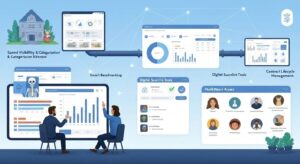
A. Spend Visibility & Categorization

Automated ingestion of AP data? Check.

AI-powered categorization of vendors, line items, and services? Also check.

Instead of filtering through mismatched records, teams get clean, structured data visualised in dynamic dashboards. You can sort by site, vendor, category, or even contract performance, finally getting a clear picture of where your money is going.

B. Smart Benchmarking

With access to data across 1,400+ service categories, tech-enabled GPOs highlight inefficiencies instantly. You’ll know whether you’re paying more than peer hospitals, where your vendors rank in performance, and where renegotiation opportunities lie.

It’s not guesswork, it’s actionable intelligence.

C. Digital Sourcing Tools

Forget starting from scratch. These platforms come with pre-built RFP templates, performance scorecards, and a marketplace of pre-vetted vendors. Events can be launched and tracked digitally, with collaboration tools that bring together procurement, finance, and operations.

That 9-month RFP timeline? It just got slashed in half.

D. Contract Lifecycle Management

Missed renewals and lost documents are a thing of the past. Contracts are tracked, stored, and managed digitally using hospital contract management software, with automated alerts for renewals, insurance lapses, and compliance triggers.

You’ll also get performance analytics tied to SLAs, so vendors stay accountable.

E. Marketplace Access

Access to 40,000+ vendors is only valuable if you can use it. The tech layer allows customisation of pre-negotiated terms, connection to internal procurement systems, and local sourcing flexibility.

You’re no longer limited to national contracts, you’re empowered to source smarter at every level.

7 Key Benefits of Tech-Enabled GPOs in Healthcare

Here’s what a tech-enabled GPO brings to the table:

  1. Complete Spend Transparency: No more blind spots. Get a single source of truth across your organisation, identify duplicate services, maverick spending, and areas ripe for consolidation.
  2. Time & Resource Optimization: Sourcing events go from year-long marathons to streamlined sprints. Automation removes the manual burden from your team and frees them up for strategic work.
  3. Sustainable Cost Reductions: By locking in fair market rates and eliminating leakage from off-contract spend, savings become the rule, not the exception, a core benefit of cost reduction solutions and healthcare cost reduction strategies.
  4. Data-Driven Vendor Decisions: Stop relying on anecdotes or sales promises. With built-in performance scores, peer comparisons, and real-world benchmarks, you’ll confidently choose vendors.
  5. Improved Governance & Risk Mitigation: Contract milestones, insurance renewals, and policy compliance are all proactively monitored. Audit trails are complete, clean, and accessible.
  6. Agility During Market Disruption: When markets shift or suppliers fall through, you’re not stuck. Real-time data helps you pivot quickly, whether sourcing locally during a supply chain freeze or adjusting terms during a labour shortage.
  7. Embedded Advisory Expertise: Technology alone isn’t enough. A strong tech-enabled GPO offers human expertise and people who understand healthcare procurement, stakeholder alignment, and long-term category strategy.

With Valify, that expertise is built into every engagement.

Choosing the Right Tech-Enabled GPO Partner

Not all tech-enabled GPOs are created equal. When evaluating a partner, look for:

  • Healthcare-specific taxonomy: Don’t settle for generic categorization, healthcare procurement has its own language and complexity.
  • Vendor network strength: More isn’t always better. Look for depth, quality, and flexibility in their vendor ecosystem.
  • Data transparency: Who owns the data? Can you access raw exports? Are insights truly usable?
  • Platform integration: Compatibility with your ERP, AP, and contract management systems will determine how seamlessly everything runs.
  • Advisory support: A platform is only as powerful as the people helping you implement it. Make sure strategic support is part of the package.

Conclusion: Procurement as a Strategic Lever

Healthcare procurement isn’t a support function anymore. It’s a strategic lever. When done right, it aligns finance, clinical care, and operations. It reduces waste and increases agility. It also allows your teams to focus on what matters most: patient care.

In a world of tight budgets and rising complexity, tech-enabled GPOs offer something rare: clarity, control, and confidence. They turn chaos into coordination and data into decisions.

Valify is at the forefront of this evolution, bringing unmatched visibility, market intelligence, and strategic execution to hospitals nationwide. Whether tackling a single category or building a system-wide sourcing strategy, Valify gives you the tools and expertise to do it right.

FAQs

Q: How do you benchmark pricing and terms?

We use real-time data from 1,400+ service categories across our network to compare pricing, vendor performance, and contract terms, giving you instant visibility into savings opportunities.

Q: How often is the data refreshed?

Data is updated continuously, with automated ingestion from your AP systems ensuring up-to-date analytics and insights.

Q: Can the platform scale with our enterprise or IDN?

The platform is built for scalability, supporting multi-site, multi-system environments with customizable workflows and integrations.

Q: What’s your success rate in implementing savings?

Through data-driven sourcing and contract optimization, we consistently help clients achieve 10–20% cost reductions across non-labor spend categories.

Q: Do we retain visibility and control over sourcing decisions?

Absolutely. You maintain full transparency and decision-making authority, with tools that enhance, not replace, your procurement team’s capabilities.

Purchasing Power in Hospitals

5 Ways Hospitals Increase Their Purchasing Power with GPOs


Some businesses—think Wal-Mart or Amazon in the retail world—buy a lot of stuff. Their high-volume buying enables them to extract better deals from their vendors, the kind of deals that smaller businesses simply don’t have the clout to command.

Continue reading

GPOS Purchased Services

GPOs and Purchased Services: How to Maximize This Relationship

Healthcare group purchasing organizations (GPOs) are very good at squeezing every penny out of the products you purchase. But for purchased services? Historically, not so much. Most GPOs simply lack the experience, tools, and know-how to effectively leverage their members’ spend data to find opportunities for savings when it comes to their purchased services expenses.

Continue reading

Purchased Services Data

Where is My Purchased Services Data Hiding?


With purchased services categories representing up to 45% of your organization’s non-labor expenses, you should be monitoring your spend the same way you do with medical and surgical products. I only know of three or four health systems that are doing this right now. One of the major problems is that many supply chain leaders believe their GPO is monitoring this information for them. Although there are other ways to maximize your relationship with your GPO, at this time, the GPOs are not able to provide the service of monitoring purchased services spend because they don’t have the knowledge or necessary technology to handle this type of data.

Continue reading