
Healthcare Cost Optimization

The Role of Subject Matter Experts in Healthcare Cost Optimization

Key Takeaways

Valify’s subject matter experts help healthcare organizations turn spend data into actionable cost savings. They provide specialized category knowledge, benchmark interpretation, supplier-market insight, contract evaluation, negotiation strategy, implementation support, and savings validation. Combining technology, analytics, and expertise enables organizations to prioritize opportunities, balance cost with quality and operational needs, execute changes, and sustain savings.

Healthcare organizations manage purchased services across clinical, operational, financial, IT, and facility categories. These services can involve different suppliers, contracts, pricing models, service requirements, and stakeholders, making cost optimization more complex than simply reviewing spend.

Valify’s purchased services can represent 40–60% of non-labor expenses, while many categories remain fragmented or unmanaged.

The challenge is not only identifying a category that costs more than expected. Organizations also need to understand why the difference exists, determine what action makes sense, implement the change, and verify whether savings are actually realized.

This is where subject matter experts (SMEs) add value. Data shows where to look; expertise helps determine what to do next.

Why Healthcare Cost Optimization Requires More Than Spend Data

Purchased Services Are Highly Specialized

Purchased services are different from standardized supply categories. Physician staffing, EVS, waste management, IT, laboratory services, linen, and facility maintenance all have different:
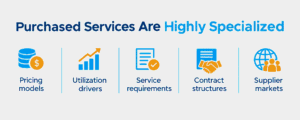
Purchased Services Are Highly Specialized

A benchmark can identify a variance, but it may not explain whether that variance is justified.

The Same Price Does Not Always Mean the Same Value

Two contracts may have different prices because they provide different service levels, geographic coverage, staffing requirements, response times, technology, or quality standards.

An SME can help determine whether a higher-cost agreement provides additional value or whether the organization is paying more than necessary. This is especially important for clinical and patient-facing services, where cost must be considered alongside quality, safety, and continuity.

Where Subject Matter Experts Add Value

Turning Analytics Into a Prioritized Opportunity

Technology can identify fragmented, rogue, off-contract, and high-benchmark spending. Valify combines technology with subject matter expertise to help identify these opportunities.

But not every opportunity should receive the same attention. SMEs can help prioritize categories based on:

  • Spend size
  • Potential savings
  • Contract timing
  • Supplier concentration
  • Operational complexity
  • Implementation requirements

This allows healthcare organizations to focus resources where further action may have the greatest impact.

Understanding the Supplier Market

Identifying a cost issue is only part of the process. Organizations also need to understand the supplier market and determine whether the right response involves an existing supplier, competitive bidding, an aggregated sourcing event, or another strategy.

Valify’s broader model combines benchmarking, supplier intelligence, sourcing, contracting, and advisory services to help move opportunities toward action.

Evaluating Contracts Beyond the Price

Contract optimization is not simply about requesting a lower rate. SMEs can review:

  • Rate structures
  • Escalation clauses
  • Renewal provisions
  • Termination language
  • Service-level agreements
  • Volume commitments
  • Compliance requirements

This broader review can reveal opportunities that may not be visible from invoice data alone.

How SMEs Help Healthcare Organizations Negotiate Better Outcomes
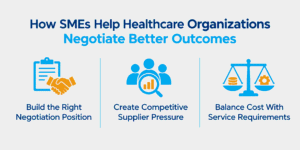
How SMEs Help Healthcare Organizations Negotiate Better Outcomes

Build the Right Negotiation Position

A strong negotiation starts with facts. Spend history, benchmarks, supplier performance, contract terms, and market intelligence can establish the organization’s position.

An SME can then determine where genuine negotiating leverage exists and whether renegotiation, an RFP, supplier consolidation, or another approach is appropriate.

Create Competitive Supplier Pressure

In some categories, competition can improve purchasing leverage. SMEs can help determine when an RFP or sourcing event makes sense and whether purchasing volume can be combined.

A 2025 Journal of Public Economics study found a one-standard-deviation increase in GPO scale was associated with a 2.7% reduction in average hospital supply expenses. The study estimated approximately $48 per discharge and $0.72 million annually per hospital in its model.

Importantly, this research concerns hospital supply expenses and GPO scale, not purchased-services advisory or technology. It does, however, provide broader evidence that purchasing scale and supplier access can influence cost outcomes.

Balance Cost With Service Requirements

Cost optimization should not automatically mean selecting the lowest-priced supplier.

Healthcare organizations also need to consider:

  • Quality
  • Continuity
  • Service levels
  • Patient experience
  • Operational requirements

SMEs help evaluate these factors alongside price when developing sourcing and contracting strategies.

From Negotiated Savings to Implemented Savings

Negotiating an improved contract is only one stage of cost optimization.

Contract Execution

A negotiated rate does not automatically change what facilities pay. Teams may still need to execute agreements, transition suppliers, communicate changes, and coordinate implementation.

Standardizing Where It Makes Sense

Multiple facilities may have different suppliers or individual agreements for similar services. An SME can determine when consolidation or standardization makes sense and when local requirements justify maintaining different arrangements.

Tracking Whether Savings Actually Materialize

The final question is whether negotiated savings appear in actual spending.

Valify states that monthly data updates are used to track and validate realized savings. Ongoing monitoring can help identify changes in spending and contract compliance after an initiative has been implemented.

A Real-World Example of Expertise Closing the Gap

Our case study shows how expertise can connect fragmented data with implementation.

A health system operating dozens of hospitals across different MMIS environments had difficulty analyzing spending centrally. Multiple vendors and facility-specific contracts also created inconsistent agreements.

Valify consolidated facility-level spend data and benchmarked categories to identify opportunities. Two categories were prioritized based on high spend and multiple vendors: print management and elevator maintenance.

The health system achieved:

  • $2.4 million in print-management savings on $18 million of annual spend
  • $1.2 million in elevator-maintenance savings on $3.1 million of annual spend
  • New contracts transitioned in 90 days instead of the expected 120+ days

The example demonstrates the complete process:

Data → Benchmarking → Expertise → Contracting → Implementation

What to Look for in a Healthcare Cost Optimization Expert

Healthcare-Specific Category Experience

General procurement experience can be useful, but purchased-services optimization requires an understanding of healthcare’s operational environment and the specific categories being addressed.

Access to Relevant Benchmarking

Experts should be able to compare spending and contract performance against relevant market information.

Our benchmarking database includes more than $1 trillion in categorized spend and more than 1,400 hospitals across the nation. Its platform covers more than 1,400 unique purchased-services categories.

Contracting and Sourcing Capability

Expertise should extend beyond identifying opportunities.

Organizations should understand whether the team can support RFPs, negotiations, contracting, supplier transitions, and implementation.

Ongoing Savings Management

Optimization should not stop when the contract is signed.

A sustainable program should monitor:

  • Contract compliance
  • Spend changes
  • Vendor performance
  • Renewal timing
  • Preferred-vendor utilization
  • Realized savings

This is where analytics and ongoing expertise can work together to keep savings initiatives on track.

The Valify Approach: Technology Plus Expertise

Valify’s approach combines technology with human expertise rather than treating either one as sufficient on its own.

The complementary roles can be viewed as:

  • Spend analytics: Establishes visibility into purchased-services spend.
  • Benchmarking: Provides market context.
  • Sourcing: Creates supplier competition and identifies alternatives.
  • Contracting: Converts opportunities into agreements.
  • Advisory: Provides category expertise, stakeholder alignment, and implementation support.
  • Ongoing monitoring: Helps track and validate results.

Valify offers a full-service approach spanning expense-management technology, advisory services, benchmarking, contracting, sourcing, and access to its supplier network. The company’s stated objective is to help healthcare organizations move from visibility and insights toward informed decisions and savings.

Conclusion: Expertise Turns Healthcare Cost Data Into Action

Healthcare organizations do not simply need more spend data. They need to understand that data within the context of suppliers, contracts, operations, and healthcare-specific requirements.

Subject matter experts help bridge the gap between “we found an opportunity” and “we know what to do about it.”

Sustainable cost optimization requires a combination of clean data, relevant benchmarks, category expertise, strategic sourcing, contract execution, and ongoing monitoring.

Technology can identify the opportunity. Expertise helps determine the right strategy. Execution turns the strategy into savings. 

FAQs

When should a health system bring in a subject matter expert for cost optimization?

An SME can be useful when a category is highly specialized, involves complex contracts, has multiple suppliers, or requires expertise the internal team does not currently have.

Can healthcare organizations use internal procurement teams instead?

Yes. Internal teams understand their organization’s operations and requirements. External SMEs can complement the knowledge with additional category expertise, benchmarking, market intelligence, or implementation support.

How does an SME adapt strategies to different healthcare facilities?

SMEs can consider facility size, geography, utilization, supplier availability, contract terms, and operational requirements rather than applying the same strategy to every facility.

What information should a health system provide to a cost optimization expert?

Useful information includes AP spend data, vendor information, contracts, pricing, utilization, service requirements, supplier performance, renewal dates, and operational constraints.

How can organizations evaluate whether an expert is delivering lasting value?

Organizations can track implemented savings, actual post-contract spend, contract compliance, supplier performance, implementation timelines, and whether savings continue after the initial initiative.

Valify AI Chat: Turning Purchased Services Data into Clear, Confident Decisions

Valify AI Chat: Turning Purchased Services Data into Clear, Confident Decisions

Key Takeaways

Healthcare organizations need clarity, speed, and confidence to effectively manage purchased services spend. Valify AI Chat delivers all three by transforming complex, fragmented data into intuitive, actionable intelligence. Through a conversational, context-aware experience, teams can move from question to insight to action—faster than ever before.

A New Approach to Managing Purchased Services

Purchased services remain one of the most complex and difficult areas of healthcare spend. Data is often fragmented across hundreds of vendors, multiple departments, and disconnected systems. As a result, organizations struggle to gain clear visibility into where dollars are going—or where opportunities for savings exist.

Traditional approaches rely heavily on spreadsheets and static reports. These methods are time-consuming, difficult to interpret, and rarely provide a complete picture. Even with significant effort, many health systems leave 10–30% of potential savings unrealized due to gaps in visibility and execution.

Valify AI Chat changes this reality.

Introducing Valify AI Chat

Valify AI Chat is a conversational, AI-powered experience designed specifically for the complexity of healthcare purchased services. It transforms how organizations explore, analyze, and act on spend data by replacing static reporting with a dynamic, intuitive interface.

Users can simply ask a question—just as they would in a conversation—and quickly receive clear, relevant answers. No technical expertise or specialized training required.

With AI Chat, clients gain:

  • Clarity into purchased services spend
  • Faster access to actionable insights
  • The ability to explore data without starting over

All within a single, seamless experience.

Built for Purchased Services Decision-Makers

Valify AI Chat introduces a fundamentally different way for teams to interact with their data:

Conversational Exploration

Users can ask questions in plain language—from high-level summaries to detailed category breakdowns—and receive clear, actionable responses instantly.

Context-Aware Intelligence

AI Chat remembers prior questions and responses, allowing users to refine their analysis, compare scenarios, and dig deeper without resetting their workflow.

Continuous Insight Discovery

Each interaction builds upon the last, enabling a natural progression from initial question to deeper understanding and informed action.

Meet Val: Your AI Data Retriever

At the center of the experience is Val, Valify’s generative AI-powered data retriever that transforms complex analytics into a simple, conversational experience. Ask a question in the chat and Val gets to work.

  • Quickly analyzes spend patterns and retrieves key insights
  • Guides teams from insight to action.
  • Helps surface opportunities that might otherwise remain hidden

Val acts as an always-available guide, helping teams navigate complexity and uncover meaningful answers quickly.

What Valify AI Chat Delivers

Valify AI Chat combines advanced AI with healthcare-specific data expertise to deliver measurable impact:

  • Robust Answers, Seamless Flow
    Explore spend across more than 1,400 purchased services categories with ease
  • Insights That Evolve
    Context-aware AI builds on prior questions, enabling deeper analysis without interruption
  • Faster Path to Savings
    Identify cost-reduction opportunities, vendor patterns, and quick-win initiatives
  • AI-Enabled Visibility
    Assess contract coverage, evaluate diversity spend, and analyze category performance
  • Enterprise-Grade Data Protection
    Secure infrastructure, controlled access, and responsible AI governance ensure trust and reliability

From Data to Action—Faster

Valify AI Chat eliminates the need for manual analysis and static reporting. Instead of spending hours compiling and interpreting data, teams can:

  • Identify top savings opportunities in seconds
  • Pinpoint “low-hanging fruit” for immediate impact
  • Gain a clearer understanding of spend patterns across vendors and categories
  • Make decisions with greater clarity and confidence

This shift enables supply chain, finance, and operations teams to focus less on data gathering and more on executing meaningful improvements.

Why It Matters

Healthcare organizations are under increasing pressure to manage costs while maintaining high-quality care. Purchased services—often one of the least visible spend categories—represent a significant opportunity for improvement.

Valify AI Chat helps organizations:

  • Reduce analysis time and reliance on spreadsheets
  • Enable self-service access to insights across teams
  • Improve consistency and transparency in decision-making
  • Discover “low-hanging fruit” or “quick win” saving opportunities with ease
  • Valify is the clear differentiator— there’s no other tech like it in purchased services

By making complex data easier to understand and act upon, Valify AI Chat enables organizations to move with greater clarity and control.

A New Standard in Purchased Services Intelligence

Valify AI Chat is more than a new feature—it represents a shift in how healthcare organizations approach purchased services management.

By combining conversational AI with deep industry data, Valify empowers users at every level—from analysts to executives—to explore insights, uncover opportunities, and take action with confidence.

Frequently Asked Questions: 

What is Valify AI Chat?

Valify AI Chat is a conversational AI experience that helps healthcare organizations explore, analyze, and act on purchased services spend using natural-language questions. It delivers instant clarity and deeper insights across 1,400+ categories.

Why is this feature important?

Purchased services are historically fragmented and difficult to analyze. Leaders often lack a complete picture of spend. Valify AI Chat was built to solve this by replacing static reports with dynamic, intuitive, AI-driven exploration.

How does the conversational experience work?

Users simply type questions — from high-level summaries to detailed category inquiries — and receive clear, actionable answers without needing technical expertise. Users can simply type in questions such as “can I get a pie chart of my laundry and linen spend by supplier?”

What makes the AI “context-aware”?

The system remembers previous questions and responses, allowing users to drill deeper, compare scenarios, and continue the conversation without starting over.

Who is “Val”?

Val is Valify’s generative AI-powered data retriever — a friendly, approachable guide that helps users navigate complex spend data and uncover insights quickly.

What types of insights can users access?

Users can explore spend visibility, contract coverage, diversity classification spend, savings opportunities, and AI-generated charts that highlight trends and patterns.

Is Valify AI chat secure and trustworthy?

Yes. Valify AI Chat is built on responsible AI principles, ensuring secure, transparent interpretation of every inquiry.

Who can use Valify AI Chat?

The feature is available to all Valify customers and is designed for both everyday users and advanced analysts across supply chain, finance, and operations.

How does this improve decision-making?

By turning complex data into intuitive insights instantly, teams can move faster, uncover savings, and make more confident decisions.

What are some questions that are likely to be asked?

  1. Can I get a pie chart of my [pick category] spend by supplier?
  2. Tell me more about [pick vendor]
  3. Tell me more about [pick category]
  4. Do I have any indicators in this category? If so, Summarize them for me.
  5. What are my index scores for this category for the health system and for each entity?

Take the Next Step

See it in action.
Ask a question. Explore your spend. Discover savings.

Connect with Valify today. Contact Us to reduce the cost of health system purchased services

Additional resources From software to services: how AI is changing what healthcare buyers expect
AI for Healthcare Procurement

AI for Healthcare Procurement: Improving Purchased Services Visibility, Savings, and Vendor Management

Key Takeaways

Artificial intelligence is rapidly changing healthcare procurement. From purchased services spend analytics to contract intelligence and supplier benchmarking, AI helps health systems uncover savings opportunities, improve vendor management, and make faster sourcing decisions using enterprise-wide data.

Purchased services are one of the largest and least understood areas of healthcare spending. Unlike labor, pharmaceuticals, and medical supplies, areas that allow for tighter control over spending, there are hundreds of vendors, thousands of invoices, and contracts that cross departments, complicating oversight.

But faced with shrinking margins and staff shortages exacerbated by growing expenses, this approach is proving harder to maintain.

Artificial intelligence is changing that. AI analyzes thousands of data points on purchased services to identify spending trends, opportunities for savings, and improve sourcing and vendor management. AI does not replace procurement professionals. Instead, it enhances decision-making by reducing manual analysis and helping teams focus on strategic sourcing, vendor management, and cost optimization initiatives.

What Is AI in Healthcare Procurement?

AI in healthcare procurement uses machine learning, analytics, and generative AI tools to analyze spending, contracts, vendors, and sourcing opportunities. It helps health systems improve purchased services visibility, identify savings opportunities, streamline sourcing decisions, and reduce unnecessary costs.

Why Traditional Purchased Services Management Falls Short

Health systems have years of purchased services data, but it is often dispersed across ERPs, contract repositories, and departmental systems. Enterprise-wide visibility is hindered by inconsistent vendor names and spend classifications.

Procurement and finance teams often rely on manual spreadsheets to consolidate data, creating savings reports that may already be outdated by the time they are completed. 

Delayed visibility over this explosion of vendor relationships allows duplicate vendors, inconsistent pricing, underutilized contracts, and fragmented purchasing strategies to continue providing unnecessary costs.

What Is the Future of AI in Healthcare Procurement?

AI in purchased services management uses machine learning and advanced analytics to analyze contracts, invoices, supplier performance, and spending data. It helps healthcare organizations identify savings opportunities, improve vendor management, automate analysis, and support strategic sourcing decisions.

AI enhances vendor management by providing a complete view of supplier value through the aggregation of contract, spend, and performance data. AI highlights upcoming renewals, potential cost increases, and where the key contract terms are, which organizations can act on for optimum efficiency in contract management.

How Generative AI and AI Chat Are Changing Healthcare Procurement

Healthcare procurement teams increasingly need quick access to contract terms, supplier performance data, spend analytics, and benchmarking insights. Generative AI can help users interact with procurement data using natural language instead of manually searching reports and dashboards.

For example, procurement leaders may ask:

  • Which purchased services categories have the largest savings opportunities?
  • Which contracts are expiring in the next 90 days?
  • Which vendors are priced above benchmark?
  • What sourcing opportunities should we prioritize this quarter?

AI-powered chat capabilities can instantly surface relevant insights, summarize findings, and help teams make faster, more informed decisions.

From Analytics to Conversation: The Next Evolution of Procurement Intelligence

Traditionally, procurement teams have relied on dashboards, spreadsheets, and manual reporting to uncover insights. The next evolution of healthcare procurement AI is conversational intelligence, which allows users to interact with spend, contract, and benchmarking data using natural language.

Rather than searching across multiple reports, users can ask questions such as:

  • Which purchased services categories represent our largest savings opportunities?
  • Which vendors are priced above market benchmarks?
  • What contracts should we prioritize for review this quarter?

As healthcare organizations continue adopting AI-enabled decision support tools, conversational experiences are helping stakeholders access insights faster and make more informed decisions across purchased services categories.

Five Ways AI Improves Purchased Services Management

AI brings value across the entire purchased services lifecycle, not only during sourcing events. Key benefits include:

  • Enhanced Visibility: By providing dashboards that span the enterprise, organizations attain a better view of spending across vendors, facilities, and service categories, helping to identify trends in spend data and prioritize optimization opportunities.
  • Accelerated Strategic Sourcing: AI identifies strategic sourcing opportunities with the highest potential impact, allowing for the development of RFPs faster, comparing suppliers more effectively, and optimizing procurement processes.
  • Enhanced Vendor Governance: Having a 360-degree view of the supplier network with constant tracking of vendor performance, contract utilization, and service trends improves accountability and decision-making.
  • More Effective Contract Negotiations: Having access to benchmarking, market comparisons, and historical spend data provides procurement teams with objective information for supplier negotiation purposes.
  • Ongoing Cost Optimization: Integrating the AI process allows companies to track their purchased services spending throughout the year, identify new areas for savings, and follow up as market conditions change.

AI Capabilities Health Systems Should Look For

Not every technology platform delivers the same level of value. As healthcare organizations evaluate AI capabilities for purchased services management, the focus should be on practical intelligence that improves decision-making rather than automation for its own sake.

An effective platform should provide:

  • AI-powered spend analytics that automatically classify purchased services spending across the enterprise.
  • Vendor benchmarking that compares pricing, contract competitiveness, and supplier performance against relevant healthcare market data.
  • Contract intelligence that highlights upcoming renewals, pricing trends, utilization patterns, and potential areas of financial risk.
  • Savings opportunity identification based on actual spending behavior rather than assumptions.
  • Executive dashboards that present financial and operational insights in a clear, actionable format.
  • Workflow automation that reduces manual reporting and supports collaboration between finance, procurement, and operational teams.
  • Continuous performance monitoring that helps organizations measure vendor outcomes and track realized savings over time.

When these capabilities work together, procurement teams spend less time gathering information and more time acting on it.

Implementing AI for Purchased Services Management

Successful AI adoption requires a strong data foundation. A single unifying environment allows the standardization of purchased services, accounts payable data, contracts, and vendor information for better reporting and prevention of duplicate records.

AI works with clean data to help identify high-spend categories, duplicate vendors, price variations, and contracts needing attention. Benchmarking provides additional context by making internal spending comparable to external market data, allowing teams to prioritize opportunities based on evidence.

It allows you to monitor vendor performance, contract use, savings, and procurement strategies over time, enabling continuous improvement that turns purchased services management from an occasional analysis into a data-driven operation.

Common Myths About AI in Healthcare Procurement

Amid increasing adoption, many myths about AI remain.

  • AI Replaces Procurement Teams: AI does not replace professionals in procurement, finance, or supply chain. Instead, it provides faster, better insights by reducing manual work while keeping strategic decisions with experienced teams. 
  • AI Only Focuses On Cost Savings: Rather than only looking at savings, AI improves supply contract visibility, compliance, vendor governance, and financial planning to impact enhanced decision-making in total.
  • Too Complicated To Implement: Modern healthcare AI solutions allow organizations to unleash the value locked within their existing data faster by streamlining the adoption experience with automated data processing, dashboards, and guided analytics.

How Valify Helps Health Systems Harness AI for Purchased Services Management

The value of artificial intelligence is not simply in automating analysis. It lies in empowering healthcare leaders with faster access to trusted insights that improve decision-making across the enterprise.

Valify combines healthcare-specific purchased services expertise, proprietary benchmarking intelligence, and advanced analytics to help health systems gain greater control over one of their largest and most complex areas of spend. By transforming disparate data into actionable intelligence, Valify enables organizations to identify savings opportunities, strengthen vendor oversight, and prioritize sourcing initiatives with confidence.

As AI continues to evolve, Valify is extending these capabilities through conversational intelligence, making it easier for stakeholders across finance, supply chain, and operations to access insights, explore spend trends, and uncover opportunities using natural language.

Through a combination of spend analytics, benchmarking, contract intelligence, and strategic sourcing expertise, Valify provides a comprehensive view of purchased services performance across the organization. This enhanced visibility allows leaders to evaluate vendor relationships, assess contract effectiveness, identify areas of financial improvement, and align sourcing strategies with organizational goals.

By equipping decision-makers with timely, data-driven insights, Valify helps health systems move beyond reactive cost management toward a more strategic approach focused on sustainable savings, operational efficiency, and long-term financial performance.

AI Is Reshaping the Future of Purchased Services Management

Purchased services have become one of the largest cost categories for healthcare organizations, and effective management is dependent on more than reviewing contracts from time to time or utilizing spreadsheets.

AI allows health systems to pair a deeper understanding of spending with more definitive benchmarking on vendor performance and discovery opportunities that otherwise may go unnoticed. When paired with excellent governance and well-informed procurement leadership, AI helps you make better sourcing decisions, drive actionable contract performance metrics, and facilitate smart cost optimization over the long haul.

Valify combines AI-powered analytics, healthcare-specific benchmarking, and strategic sourcing expertise with advisory services to provide a complete purchased services management solution that brings these capabilities into practice across health systems.

Transform Purchased Services Management with Valify

Purchased services management doesn’t have to rely on fragmented data or reactive decision-making. Valify gives health systems the visibility, intelligence, and market context needed to uncover savings opportunities, strengthen vendor performance, and optimize procurement strategies with confidence.

Request  a demo to see how Valify can help your organization build a more strategic, data-driven approach to purchased services management.

Purchased Services Solutions
Spend Analytics
Sustainable Savings 

Benefits of AI in Purchased Services Management

  • Improved spend visibility
  • Faster sourcing decisions
  • Better contract management
  • Stronger vendor governance
  • More accurate benchmarking
  • Ongoing cost optimization
  • Reduced manual reporting

Frequently Asked Question’s
1. How does AI improve purchased services management in healthcare?

AI analyzes enterprise-wide spending, identifies trends, supports vendor evaluations, and highlights savings opportunities faster than traditional manual processes.

2. Can AI replace procurement and sourcing teams?

No. AI enhances procurement by providing better data and insights, while experienced professionals continue to lead strategic sourcing and vendor decisions.

3. What types of purchased services can AI help analyze?

AI can support analysis across clinical and non-clinical categories, including IT services, facilities, staffing, laboratory services, environmental services, revenue cycle management, and many other purchased services.

4. Why is benchmarking important when using AI?

Unlike traditional negotiations, benchmarking provides market context to inform whether contract pricing, service levels, and vendor performance are competitive.

5.How does Valify support AI-driven purchased services management?

Valify provides spend analytics, healthcare benchmarks, contract intelligence capabilities, and strategic sourcing expertise powered with AI technology and actionable reporting functionality to reduce spending on purchased services and improve the financial performance of health systems.

6. How is generative AI used in healthcare procurement?

Generative AI helps procurement teams simplify data analysis, summarize contract information, identify sourcing opportunities, and answer complex procurement questions using natural language.

7. What is the difference between AI analytics and AI chat?

AI analytics identifies trends and opportunities within procurement data, while AI chat allows users to interact with that information conversationally to quickly find answers and insights.

8. Can AI identify healthcare contract savings opportunities?

Yes. AI can compare spend patterns, contract terms, utilization rates, and benchmark pricing data to identify opportunities for savings and optimization.

9. Is AI secure for healthcare procurement data?

Modern enterprise AI platforms use security controls, access management, and governance frameworks designed to protect sensitive financial and operational information.

10. How can AI help identify purchased services savings opportunities?

AI analyzes enterprise-wide spend, contract pricing, utilization patterns, and benchmarking data to identify categories where healthcare organizations may be overpaying or missing savings opportunities.

AI is Changing Purchased Services

How AI is Changing Purchased Services Sourcing and Vendor Decisions in Hospitals

Key Takeaways

Most hospitals don’t struggle because they lack vendors. They struggle because they can’t clearly see what they’re paying those vendors across the system. AI helps by cleaning up messy spend data, spotting price differences between facilities, and flagging when contracts drift. That means vendor decisions are based on facts, and savings are easier to hold onto.

Hospital leaders face growing cost pressure. They must reduce expenses without hurting operations or patient experience. Purchased services are one of the largest and least visible areas of hospital spend. It spans hundreds of vendors, contracts, and departments. AI is changing how hospitals source these services, compare vendors, and sustain savings, especially when spend data is clean and centralized.

Hospital spending continues to rise. In 2024, U.S. hospital expenditures grew 8.9% to $1.63 trillion (Centers for Medicare & Medicaid Services, National Health Expenditure Data).

Hospitals also accounted for 40% of total health spending growth between 2022 and 2024 (KFF analysis).

Cost pressure is real. Leaders need better visibility into where money goes, especially in purchased services.

Why Purchased Services Vendor Decisions Are Getting Harder

Purchased services include outsourced and contracted services such as facilities maintenance, IT managed services, environmental services, security, revenue cycle support, and biomedical maintenance.

These costs are often:

  • Spread across departments
  • Managed at the facility level
  • Tied to auto-renewing contracts
  • Recorded inconsistently in AP systems

Vendor decisions are harder today for three reasons:

  • Vendor sprawl
  • Contract drift
  • Price variation across facilities

When vendor data is fragmented, sourcing becomes reactive. Teams debate vendors without a shared source of truth. AI helps only when the data is accurate and normalized.

Featured Snippet Definition:
Purchased services in hospitals are outsourced support for operations and clinical care. They often span multiple departments and vendors, which makes visibility and control difficult.

What AI In Purchased Services Actually Means

AI in this context does not replace your sourcing team. It analyzes large volumes of spend data. It detects patterns, flags risks, and supports better decisions. AI supports sourcing in three main ways.

Pattern Detection

AI scans thousands of transactions. It identifies:

  • Duplicate vendor records
  • Inconsistent naming
  • Pricing variances
  • Unusual spend spikes

Example:
A vendor appears under six different names. AI groups them. Leaders now see total enterprise spend.

Predictive Insights

AI identifies trends and risk signals.

Example:
A category shows a 14% quarter-over-quarter increase without contract changes. AI flags it for review.

Decision Support

AI provides ranked insights. It does not make final decisions.

Example:
If two vendors provide similar services, AI highlights which vendor has stronger compliance or fewer invoice exceptions.

AI requires clean data. Without vendor normalization and proper categorization, outputs will not be reliable.

The Shift From Sourcing Events To Always-On Sourcing

Traditional sourcing was event-driven. Teams ran an RFP every few years. They negotiated and moved on.

That model no longer works.

Costs rise quickly. Vendor markets change. Contracts drift. Hospitals need continuous oversight. AI enables an always-on sourcing model:

  • Continuous spend visibility
  • Ongoing benchmarking
  • Real-time compliance monitoring
  • Triggered sourcing when variance appears

Instead of asking, “When is our next RFP?” leaders now ask, “Where is variance happening today?” With hospital expenditures growing rapidly (CMS data link above), continuous oversight protects margins.

Where AI Improves Purchased Services Sourcing Decisions

AI supports better vendor decisions at every stage of the sourcing lifecycle.

Spend, Cleansing, and Vendor Normalization

Hospitals often maintain thousands of vendor records.

AI helps:

  • Standardize vendor names
  • Identify parent-child relationships
  • Merge duplicates
  • Clean line-item descriptions

Outcome: A reliable baseline before negotiation.

Without normalization, vendor consolidation is nearly impossible.

Category Classification At Scale

Purchased services categories are complex.

AI classifies non-labor spend into consistent categories. This reduces “miscellaneous” buckets and increases clarity.

Outcome: Leaders see top categories by facility and system. They prioritize sourcing using real data.

Benchmarking And Price Variance Detection

Once data is clean, AI highlights pricing differences.

Example:
One facility pays 18% more for the same facilities maintenance scope as another location.

AI flags the variance. Sourcing teams negotiate with evidence.

Smarter Vendor Shortlisting

AI narrows vendor options based on:

  • Pricing signals
  • Compliance history
  • Invoice exception rates
  • Performance trends

Outcome: Faster RFP cycles and stronger negotiating leverage.

Contract Compliance And Off-Contract Spend Alerts

Savings disappear when compliance weakens.

AI monitors:

  • Off-contract purchases
  • Unapproved vendors
  • Spend spikes
  • Scope creep

Outcome: Savings remain protected.

AI Use Cases In Purchased Services

AI Use Case What It Detects What It Improves Who Benefits
Vendor Normalization Duplicate Or Inconsistent Vendors Clear Enterprise Visibility Supply Chain And AP
Category Classification Misclassified Spend Strategic Category Planning Category Owners
Variance Detection Price Outliers Negotiation Leverage Sourcing Leaders
Compliance Monitoring Off-Contract Purchases Savings Retention Finance And Operations
Spend Spike Alerts Sudden Cost Increases Faster Intervention Service Owners

Tables help align leaders on how AI changes decisions.

How AI Changes Vendor Decision Criteria

AI shifts vendor evaluation from subjective to evidence-based.

From Relationship-Led To Evidence-Led Decisions

Relationships matter. Data now drives final decisions.

Leaders compare:

  • Price versus benchmark range
  • SLA adherence
  • Invoice match rates
  • Service consistency

This reduces internal conflict and increases confidence.

Vendor Consolidation Becomes Easier

AI identifies overlapping scopes across vendors.

Example:
Three facilities use different security vendors for similar services. AI shows total system spend and variance.

Consolidation becomes a data-backed discussion.

Total Value Replaces Lowest Price

Lowest cost does not always equal best value.

AI helps measure:

  • Compliance reliability
  • Invoice accuracy
  • Operational performance
  • Risk signals

Vendor selection becomes a total-value decision.

Vendor Decision Scorecard Example

Hospitals can structure decisions using a scorecard.

Decision Factor What To Measure Example Signal Why It Matters
Price Competitiveness Rate Versus Benchmark Outlier Percentage Protects Margin
Contract Terms SLA And Escalation Clauses Non-Standard Language Reduces Risk
Compliance Fit Invoice Match Rate Exception Frequency Lowers Admin Cost
Operational Impact Service Uptime Response Time Supports Patient Flow
Risk Profile Insurance And Cybersecurity Coverage Gaps Protects Operations

Structured frameworks reduce subjective decisions.

The Biggest Risks Of Using AI In Vendor Decisions

AI is powerful. It has limits.

Data Quality Risk

Incomplete or inconsistent AP data leads to flawed outputs.

Solution: Cleanse and normalize data before benchmarking.

False Precision Risk

AI may rank vendors, but scope differences matter.

Solution: Validate service scope before final decisions.

Change Management Risk

Centralized decisions may face resistance.

Solution: Start with high-spend categories and demonstrate wins.

Cyber And Third-Party Risk

Healthcare organizations face growing cybersecurity threats. Vendor risk must be evaluated alongside pricing.

AI supports visibility. Governance remains essential.

A Practical Rollout Plan For Hospitals

Hospitals should follow a phased approach.

Start With Trusted Visibility

  • Cleanse AP data
  • Normalize vendors
  • Categorize spend

Build a baseline of leaders’ trust.

Prioritize High-Impact Categories

Focus on:

  • High spend
  • High variance
  • Low compliance

Quick wins build credibility.

Run Sourcing With Stronger Inputs

Use clean data and benchmarks during negotiations.

Make comparisons apples-to-apples.

Sustain Savings With Continuous Monitoring

Use dashboards and alerts to:

  • Track savings initiatives
  • Flag off-contract purchases
  • Monitor vendor performance

Continuous oversight prevents backsliding.

Where Valify Fits In This Transformation

AI alone does not fix purchased services.

Hospitals need visibility, benchmarking, sourcing leverage, and compliance monitoring working together. Valify helps hospitals gain total visibility into healthcare purchased services by:

  • Cleansing and categorizing non-labor spend across 1,400+ categories
  • Providing line-item insights
  • Supporting benchmarking and PinPoint Benchmarks
  • Connecting hospitals to a preferred supplier network
  • Monitoring compliance through the WorkPlan dashboard
  • Aligning stakeholders through advisory expertise

This integrated approach transforms fragmented vendor decisions into a centralized, data-driven program.

From Spend Confusion To Vendor Clarity

AI is changing purchased services sourcing because it turns complex vendor spend into actionable insights. But the real impact is not automation alone. It is visibility, benchmarking, vendor discipline, and continuous compliance.

Hospital costs continue to rise. Leaders cannot afford blind spots in purchased services.

If you want to understand where your vendor spend varies, where compliance gaps exist, and where sourcing opportunities may be hidden, Schedule a demo with valify and gain total visibility into your purchased services program.

Frequently Asked Questions:

What Are Purchased Services In A Hospital?

Purchased services are outsourced, and contracted services hospitals buy instead of performing internally. They include facilities, IT, security, revenue cycle, and clinical support services.

How Does AI Help Hospitals Choose Vendors?

AI analyzes large volumes of spend data. It identifies pricing variances, duplicate vendors, compliance gaps, and risk signals. This supports informed vendor decisions.

What Data Is Needed Before Using AI For Sourcing?

Hospitals need cleansed AP spend data, normalized vendor names, and consistent category classification. Clean data ensures accurate insights.

Can AI Reduce Off-Contract Spend?

Yes. AI monitors transactions and flags unapproved vendors or purchases outside negotiated agreements.

Is AI Replacing Hospital Sourcing Teams?

No. AI supports decision-making. It provides insights and recommendations. Leaders still validate the scope and finalize vendor selections.

Two colleagues collaborating at a computer

Beyond Onboarding: How Valify Supports Clients Long Term

Key Takeaways

When clients choose Valify, they get support that extends well past onboarding. Through their main point of contact, the Client Success Manager, they gain a trusted partner who helps spot opportunities, solve problems, and keep the momentum going.

Many healthcare platforms promise support. But what happens after onboarding often tells the real story. At Valify, clients often discover that the real value is not just the platform itself, but the partnership that continues to grow after go-live.

In this blog, we’ll look at how that relationship evolves over time, and the role Valify plays at each stage. We’ll also share real examples of the kinds of challenges clients bring forward and how Valify helps them move ahead.

Phase One: Getting the Foundation Right

At Valify, onboarding is a collaborative process designed to set your team up for long-term success. From kickoff through data integration, review, and validation, Valify works alongside clients to build a strong foundation from the start.

That support often includes helping clients:

Bring the right stakeholders into the process. Valify helps identify who needs to be involved across IT, finance, and operations so nothing gets missed early on.

Work through the data with confidence. Clean, accurate data leads to clearer insights. Valify partners with clients to review and validate it upfront.

When these pieces come together early, clients move faster, build trust in the data, and get more value from the platform over time.

Phase Two: Turning Data into Action  

Once onboarding is complete, the Client Success Manager (CSM) steps in as the primary point of contact. Together, the CSM and client establish a regular cadence, often starting with more frequent check-ins before settling into a monthly rhythm.

These conversations are where the work starts to take shape. CSMs help clients move beyond raw data and begin identifying where action is needed. Early on, that support may include:

  • uncovering missed savings opportunities
  • flagging pricing discrepancies
  • highlighting contract misalignment
  • helping clients make sense of complex spend data

In one example, a CSM identified that a client was not receiving the negotiated pricing they believed they had in place. It was not something the client was actively looking for, but once surfaced, it became an immediate opportunity to course correct and capture savings.

“We’re not just here to say, ‘Here’s the technology.’ We take the extra step to support our clients.”
– Heba Zoul-Ghani, Client Success Manager 

This is also where many clients begin to see the full value of the partnership. The CSM is not only there to answer questions. They are actively bringing forward insights, helping clients interpret what they are seeing, and making sure important opportunities do not get missed.

Phase Three: Becoming an Extension of the Team 

After several months, something starts to shift.

Clients are moving beyond learning the platform and reviewing reports. They begin to rely on their Client Success Manager as a trusted extension of their own team—someone they can bring into conversations, pressure-test decisions with, and turn to when the stakes are higher.

At this stage, the work becomes more strategic. Clients begin asking what to do next.

That might look like:

  • preparing for a complex RFP and needing support to build internal alignment
  • identifying new opportunities mid-year to stay on track with savings goals
  • benchmarking a category and understanding how they compare to peers
  • connecting with other health systems to learn what is actually working in practice

The relationship shifts into a more collaborative, strategic partnership. Instead of waiting for inquiries, Valify anticipates what matters next and equips clients to take timely, informed action.

This is also where trust becomes visible. Clients start reaching out between meetings. They bring challenges forward earlier. And they begin to see Valify not as a vendor, but as a partner who understands their goals and is invested in helping them succeed.

Beyond the Platform: the Valify Community

As the relationship grows, so does the level of support. It extends beyond the Client Success Manager and into the broader Valify community.

Purchased services leaders often operate in silos, with limited visibility into how peers are approaching similar challenges. Valify helps bridge that gap by creating structured opportunities for connection and shared learning.

These include:

  • The annual Valify Summit, where clients come together to share experiences and learn from one another
  • The Valify Client Advisory Panel (VCAP), which provides a forum for ongoing discussion and feedback
  • peer-to-peer connections, where clients can exchange ideas and compare approaches in real time

In some cases, these connections are facilitated directly. For instance, if a CSM sees two organizations working through a similar challenge, they may introduce them.

This broader network becomes another layer of support. It allows clients to learn from others, validate their approach, and move forward with greater confidence.

The Real Measure of Success 

At Valify, onboarding opens the door. But the real value comes from the partnership that follows. The platform helps clients uncover opportunities and take action, but what often makes the biggest difference is having the right support behind it. That is the real measure of success: not just better visibility, but greater confidence in what to do next.

Want to see what that kind of support looks like in practice? Connect with Valify to learn how our team helps purchased services leaders turn insight into action.