Sustainable Procurement in Hospitals

Hospital Courier Services: An Overlooked Factor in Operational Efficiency

Key Takeaways

Hospital courier services are often overlooked, yet they are essential to the hospital’s overall operating efficiency. They carry specimens, supplies, and documents among different buildings. Poor management of vendor contracts, scheduling, and routes makes the whole process inefficient and wasteful. On the other hand, if hospitals pool their courier services, buy data analytics, and collaborate with GPOs, the costs will be reduced, performance will be better, sustainability will increase, and the ultimate goal of patient care will be supported.
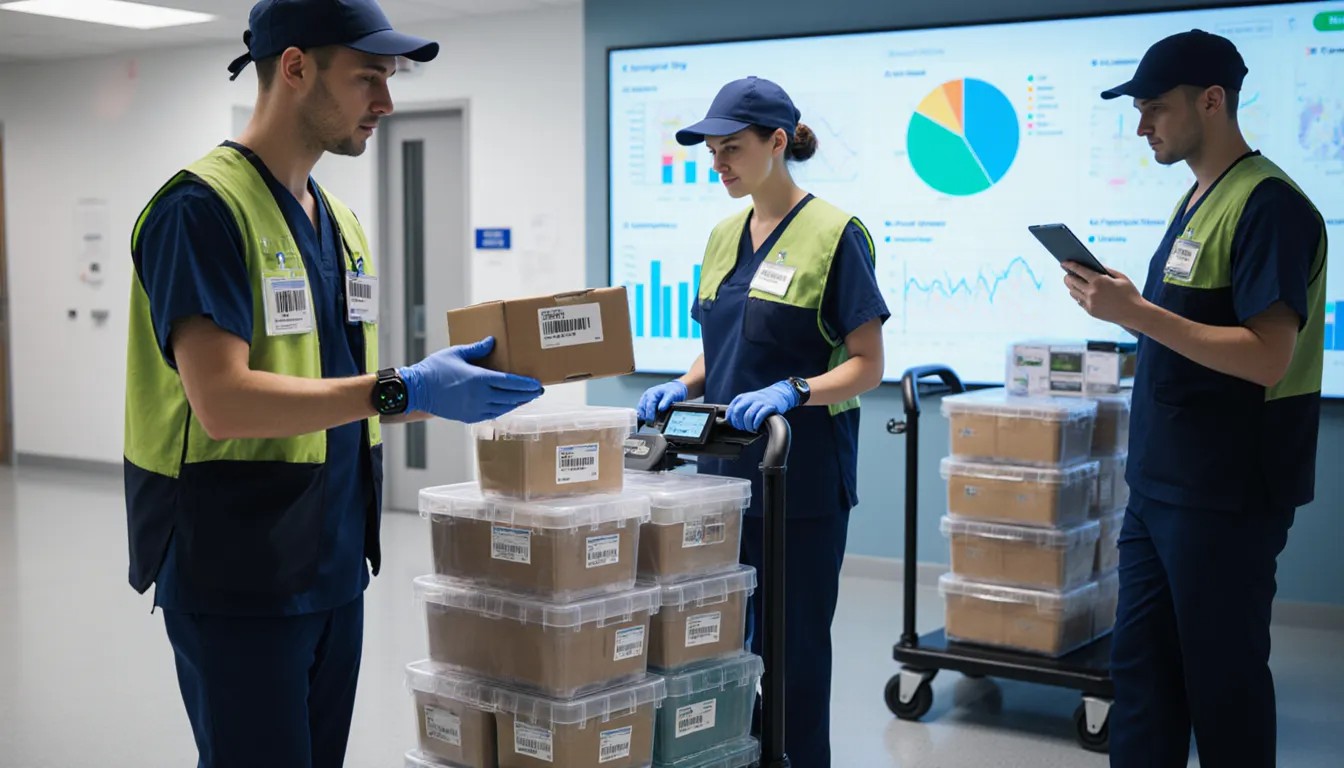
If you enter any hospital on a hectic day, you will observe a lot of movement everywhere. 

Couriers are not involved in headlines or included in strategic dashboards. Still, healthcare systems that focus on efficiency and cost reduction consider hospital courier services one of the most underrated levers for boosting operational performance.

The Invisible Network That Keeps Hospitals Moving

Every day, couriers transport an astonishing range of materials across hospital systems:

  • Lab specimens that must arrive within hours to maintain integrity.
  • Medical records and pharmacy deliveries.
  • Sterile instruments =used between surgery centers.
  • Blood products, vaccines, and even tissue samples.

These deliveries happen hundreds, sometimes thousands, of times each day across facilities, clinics, and labs. And yet, most hospitals treat courier services as an afterthought. Something buried under logistics or facilities management, rarely reviewed beyond contract renewal.

That is where problems begin.

When courier networks operate without a strategy or visibility, inefficiencies multiply. You’ll see duplicate routes between facilities, inconsistent documentation, vehicles running half-empty, and vendors charging premium rates for poorly optimized schedules. Multiply that across a regional health system, and you’re looking at millions in what could be, and should be, avoidable spending.

Hospital courier services are a necessary, around-the-clock operation, they deserve the same level of attention and analytical oversight as any other essential function within the supply chain.


Why Courier Services Are Often Overlooked

There is a simple reason courier performance rarely appears on a CFO’s radar: it is scattered.

Courier operations often fall somewhere between departments: part logistics, part facilities, part lab operations, and sometimes outsourced entirely. With no clear ownership, no centralized data, and limited tracking, the true cost is buried under multiple budget lines.

Add to that the perception that courier costs are “fixed,” like electricity or janitorial services, and you get a blind spot that quietly drains both money and time.

Courier services are the kind of operational layer that’s invisible until you shine a light on it, and once you do, the savings potential is hard to ignore.

The Hidden Costs of Inefficient Courier Operations

The financial impact of inefficient courier networks shows up in surprising ways:

Redundant Routes and Vendors

Different departments or facilities often contract their own courier services, unaware that another vendor already runs the same route. This results in two trucks doing the same job, twice the fuel, twice the labor, and twice the cost.

Empty Backhauls

Couriers deliver specimens or supplies but return empty. Those return miles are a waste, fuel, wear and tear, and paid time with zero value creation.

Unoptimized Schedules

Fixed pickup times often do not align with lab workloads or pharmacy demand. That means couriers run partially full routes multiple times daily when one consolidated trip would suffice.

Compliance and Risk Exposure

Without centralized management, courier documentation can be inconsistent. Missing temperature logs, chain-of-custody gaps, or delayed deliveries can risk not only fines but patient outcomes.

Carbon Footprint and Public Perception

Redundant courier trips also add to environmental impact. As healthcare systems face growing sustainability expectations, courier optimization is an easy and measurable win.

The result is a service that looks routine but actually consumes significant resources, human, financial, and environmental, when left unoptimized.

The Efficiency Equation: Time, Distance, and Data

Optimizing courier operations isn’t just about cutting costs. It’s about aligning movement with mission.

Think of every courier route as a micro supply chain. Each one has its own rhythm, dependencies, and time sensitivity. A specimen delayed by an hour can affect a diagnosis. A late delivery to a surgery center can reschedule procedures. So efficiency here isn’t theoretical.

The key is visibility.

Hospitals need:

  • Real-time data on courier movement
  • Routes
  • Pickup frequency
  • Idle time
  • Load capacity
  • Temperature tracking
  • On-time delivery rates

Modern courier management platforms now provide GPS tracking, route optimization algorithms, and digital chain-of-custody documentation.

When that data connects back to spend analytics, the kind of insight Valify specializes in becomes clear, and patterns emerge quickly:

  • Which routes could be consolidated?
  • Where facilities overlap unnecessarily?
  • Which vendors consistently miss performance benchmarks?

Hospitals can turn courier logistics from an invisible expense into a measurable efficiency strategy with that insight.

The Power of Centralization

Centralization is the strongest improvement most hospital systems can implement in their courier operations.

A centralized logistics team can coordinate all the routes and vendors for all the departments instead of the departments managing their courier contracts on their own. As a result, there is no duplication of work, which allows for strategic partnerships with fewer and better-performing providers.

In addition to this, centralization has other benefits:

  • Route Optimization: Making schedules align with the lab and pharmacy cut-off times to reduce the waiting time and increase the quantity of the load volume per trip.
  • Performance Monitoring: Unified KPIs track delivery accuracy, timeliness, and temperature control.
  • Vendor Accountability: Standardized quality across all facilities is guaranteed by standardizing SLAs (service level agreements).
  • Scalability: New clinics or shifts can be supported quickly without multiple contracts.

Where GPOs and Technology Intersect

Group Purchasing Organizations (GPOs) have traditionally helped hospitals gain leverage on supply pricing, but they also play a growing role in logistics services. Many GPOs now include courier and transportation solutions in their contract portfolios.

Partnering with a GPO that understands local courier networks brings pre-vetted benefits:

  • Access to pre-vetted, compliant providers.
  • Transparent pricing models based on actual route data.
  • Opportunities for shared delivery networks between hospitals in the same region.

When combined with spend visibility tools, hospitals can use GPO frameworks to benchmark courier performance, not just on cost, but on reliability, sustainability, and responsiveness.

GPOs today are not only about buying power. They also provide strong data support that helps hospitals make faster and smarter decisions in courier management.

Sustainability and Courier Efficiency

Sustainability in healthcare is generally seen in terms of energy and waste management, but courier logistics is yet another area that greatly impacts the environment.

Fuel use, vehicle running time, and repeated trips all lead to emissions and costs. Implementing optimization measures throughout the entire courier network, such as combining routes, using the highest-loading vehicles, and using electric or hybrid cars, results in a direct reduction of emissions and costs.

Some hospital systems go even further:

  • Partnering with local courier services that operate eco-friendly vehicles.
  • Building shared delivery hubs that multiple companies use to prevent hauling goods over long distances.
  • Using technology to monitor carbon emissions for each route or vendor for environmental, social, and governance (ESG) reporting.

Improving courier sustainability is not only about reputation. It is about creating long-term value that aligns with public expectations, funding needs, and regulatory pressure.

Overcoming Barriers to Change

Even with clear benefits, improving courier efficiency isn’t always straightforward. Hospitals face a few common hurdles:

  1. Fragmented Ownership: Without a single accountable department, courier reform struggles to gain traction.
  2. Data Gaps: Many hospitals lack accurate visibility into courier volume, routes, and costs.
  3. Cultural Resistance: Departments accustomed to “their” couriers may resist centralization.
  4. Contract Complexity: Multi-year contracts with different vendors complicate consolidation efforts.

Hospitals can overcome these obstacles with strong leadership support and a step-by-step plan. Build a baseline audit that maps routes, volume, and spending. Then, a centralized model can be tested in one region or department before expanding it across the system.

Most successful examples start small and grow once results become visible.

Looking Ahead: Courier Management as a Strategic Priority

The future of hospital courier services lies in data-driven logistics.

Hospitals are beginning to treat courier management like any other performance metric, tracked, analyzed, and continuously improved. Real-time dashboards, GPS tracking, and automated documentation are turning courier work into measurable data streams.

In that future, courier decisions won’t be made by habit or convenience. They’ll be made by insight based on cost, performance, and sustainability data that tell the full story.

The next step is cultural. Hospital leaders must start viewing couriers not as delivery drivers but as critical connectors in the care chain. Their work is the physical link between departments, diagnostics and treatment, and urgency and outcome.

When hospitals invest in strengthening that link, everything downstream becomes smoother, from lab efficiency to patient satisfaction.

Final Thoughts

Hospital courier services rarely make the strategy slides or executive dashboards, but they should. They’re the arteries of healthcare operations, moving the lifeblood of care from one node to another.

When optimized, couriers reduce waste, lower costs, and improve turnaround times. When ignored, they quietly drain budgets and erode efficiency.

The path forward is clear: bring courier operations into the light, measure them, analyze them, centralize them, and treat them with the same attention you give to supply chain, staffing, and technology, as they touch all three.

When hospitals are asked to do more with less, efficiency isn’t found in cutting corners. It’s found in tightening the spaces between them. That’s where Valify can support progress. 

Sometimes, that means taking a fresh look at something as simple and essential as the courier who keeps your hospital running every day.

FAQs

  1. Why are hospital courier services necessary?

Couriers ensure the timely delivery of lab specimens, medications, and medical supplies, which directly affect diagnostics, surgeries, and patient outcomes.

  1. What are the things that make courier operations inefficient?

Multiple vendor contracts, overlapping routes, and empty return trips often consume time and resources, which leads to waste and delays.

  1. What steps can hospitals take to make their courier services more efficient?

By pooling logistics, using technology for route planning, and monitoring performance data, hospitals can consolidate vendors and eliminate duplication of services.

  1. What is the relationship between GPOs and courier management?

Group Purchasing Organizations help hospitals access pre-vetted courier providers with transparent pricing and shared delivery networks that improve cost and quality.

  1. How does courier optimization relate to sustainability?

Optimized routes, fuller vehicle loads, and eco-friendly vehicles reduce fuel consumption and emissions, supporting environmental responsibility and lowering operating costs.

 

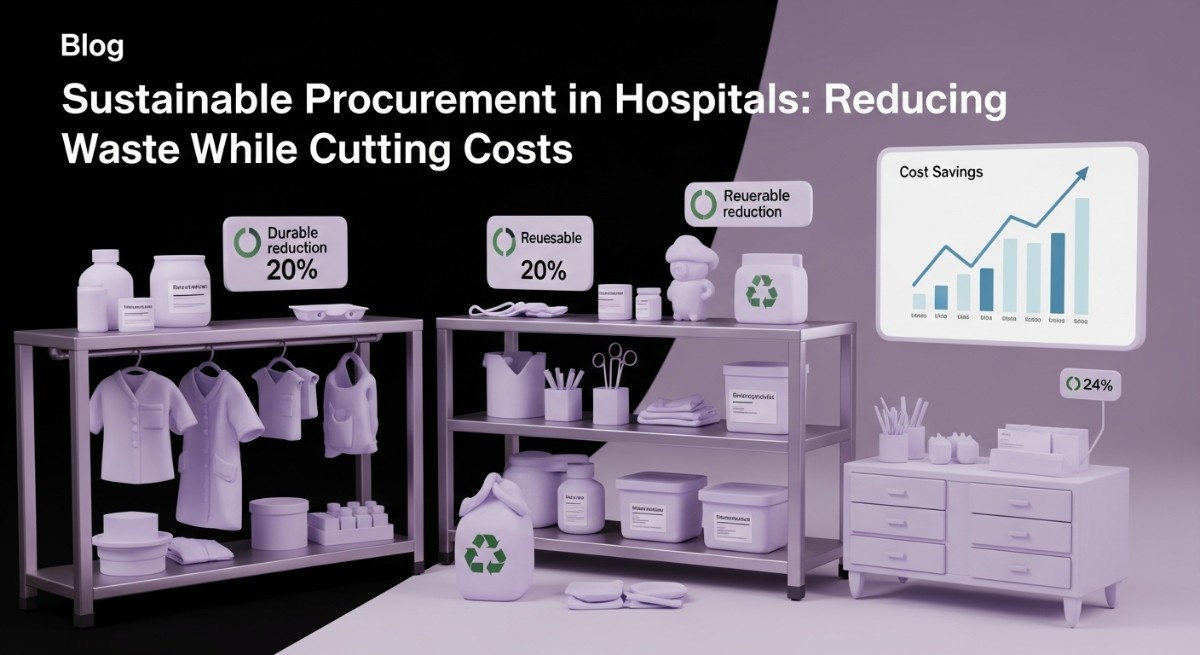
Sustainable Procurement in Hospitals: Reducing Waste While Cutting Costs

Key Takeaways

Sustainable procurement in hospitals means reducing waste while significantly cutting expenses. Those hospitals that consider life cycle costs, data transparency, and local and regional sourcing have the potential to save money, cut emissions, and increase their efficiency in general. Partnering with GPOs and leveraging analytical tools can help uncover waste, optimize contracts, and turn sustainability into a long-term financial and operational asset.

Step into any hospital supply room and you’ll see it, piles of single-use packaging, extra boxes kept “just in case,” and supplies edging toward expiration because they were over-ordered months ago. None of this is due to negligence because hospitals are built to be ready for anything, but that readiness comes at a cost.

The healthcare supply chain is complex. While hospitals rely on it, the supply chain itself is responsible for ensuring reliability—delivering the right product to the right place at the right time. Today, however, another priority is rising alongside reliability: sustainability.

And here’s the shift: sustainability isn’t about being environmentally responsible anymore. It’s about financial responsibility, too. Hospitals that rethink procurement through a sustainability lens aren’t just cutting waste; they uncover serious cost savings.

The True Cost of Traditional Procurement

For decades, hospital purchasing was driven by two main goals: quality and cost. 

But that model created a ripple effect that few anticipated. The U.S. healthcare sector accounts for nearly 10% of national greenhouse gas emissions[1] and produces millions of tons of waste yearly. Many of those costs are avoidable, not just environmentally, but financially.

Why Sustainability and Cost Efficiency Go Hand in Hand

There’s a myth that sustainable products and practices always cost more. But hospitals that have examined the full picture know that’s rarely true.

Sustainable procurement no longer considers “price per unit” but total ownership cost, including purchase, supervision, logistics, and end-of-life disposal. And if you do the math, environmentally safe options usually cost less in the long run.

Consider surgical gowns as an example. The transition from disposable to reusable gowns might require a larger initial investment. Still, the savings throughout the product’s life are due to reduced waste hauling and less frequent interruptions of delivery and ordering. This applies to washable textiles, reprocessable instruments, and efficient cleaning systems.

Sustainable procurement goes far beyond the products themselves. It influences every supply chain step, from vendor selection to data transparency. Hospitals that align their purchasing practices with sustainability principles often find they can streamline vendors, shorten delivery routes, and optimize inventory management, leading to measurable financial savings and a reduced environmental footprint.

At its core, sustainability is really a more thoughtful and deliberate form of efficiency.

Data-Driven Procurement

You can’t improve what you can’t see.

Supply chain data is scattered across GPO contracts, local vendor spreadsheets, and department-level purchase orders for many health systems. That fragmentation makes it hard to know what’s being used or wasted.

That’s where spend analytics platforms like Valify come in. By unifying purchasing data from across all facilities, these tools reveal patterns that once went unnoticed:

  • Which categories generate the most waste?
  • Where product duplication inflates cost?
  • How do supplier delivery routes impact fuel and freight expenses?
  • Which “green” alternatives are already available under existing GPO contracts?

With that visibility, procurement teams can make informed decisions that reduce environmental and financial waste, not through guesswork, but through measurable insight.

In many cases, hospitals find that they don’t need to overhaul their contracts; they just need to optimize how they use them.

The Role of GPOs in Driving Sustainable Procurement

Group Purchasing Organizations (GPOs) have established themselves as key players in the healthcare industry’s quest for cost-effective purchasing and the simultaneous acquisition of sustainability benefits.

Most top-ranking GPOs are adding environmental factors to the list of supplier assessment criteria. In this scenario, hospitals can select the clinically and environmentally approved products without undertaking the laborious task of research anew.

For the regional networks, this is the time when local GPOs excel. They know the nearby supply landscape, transportation costs, waste regulations, and the limitations of national contracts that vendors can handle. Through partnering with local companies, hospitals can realize several key benefits, such as:

  • Lessening freight emissions and cutting delivery costs are among the significant benefits of this arrangement.
  • Buying goods from suppliers that are closer in proximity, thus increasing their reliability and reducing lead times.
  • Taking part in joint recycling or reprocessing programs that are not feasible nationally.

True sustainable value is found at the intersection of national scale and local agility, where the GPOs of large companies provide leverage while the small GPOs provide context. As a result, hospitals can achieve sustainability targets without incurring additional costs.

Sustainable Procurement in Practice

Sustainability in procurement doesn’t always mean total policy change. It often starts with simple, practical decisions that compound over time.

Here’s what it looks like in action:

Standardize Products

Too many variations of the same product drive waste, not just in storage space, but in expired or unused inventory. Standardization simplifies ordering and reduces surplus.

Use Reusable and Reprocessable Supplies

Switching to reusable surgical instruments, containers, and linens reduces recurring purchases and waste disposal costs. It also insulates hospitals from supply chain disruptions.

Source Locally and Consolidated Deliveries

Shorter transport distances mean less fuel consumption and faster restocks. Fewer deliveries cut both costs and carbon emissions.

Implement Waste Segregation and Recycling

Hospitals that sort waste properly can dramatically reduce disposal costs. Partnering with recycling vendors, often through a GPO, turns what was once waste into recoverable value.

Ensure Supplier Accountability

Embedding sustainability clauses in contracts encourages vendors to adopt greener practices — whether through packaging, energy-efficient manufacturing, or take-back programs.

Small adjustments add up, becoming powerful when embedded into daily purchasing practices.

Getting Started: A Framework for Action

Hospitals are eager to go green, but many struggle to figure out where to begin. The key is structure, which can transform sustainability from an idea to a process.

Here’s a practical framework most successful systems follow:

  1. Assess the Baseline

Audit your existing procurement data. What is the waste? Which vendors are the main contributors to freight costs? What is being over-ordered or not used sufficiently?

  1. Set Concrete Goals

Rather than making ambiguous promises, set exact goals: a 10% reduction in supply chain waste, a 15% increase in reusable products, or 20% of spend under sustainable contracts.

  1. Involve Departments from the Start

Procurement does not function in isolation. Bring clinicians, facilities, and finance teams together to make sustainable decisions in the right context, supporting operational workflows and patient care needs.

  1. Use GPO Knowledge

Request your GPO to spot green alternatives and work on the price with suppliers who can meet environmental and financial requirements.

  1. Measure and Communicate

Data analysis tools can help you monitor every month or every quarter. Internally inform the company of the advantages, savings, waste reductions, and supplier performance to maintain the movement’s strength.

  1. Expand the Successful Approaches

Once small pilot programs prove successful, they should be scaled across the entire department or facility. Continuous improvement builds on itself, strengthening the overall strategy and driving greater cost savings over time.

This step-by-step approach turns sustainability into a practical part of procurement, not a side project.

The Challenges — and How to Overcome Them

Transitioning to sustainable procurement can be quite a challenge. The main resistance factors are usually the perception of higher costs, fatigue from changes, and insufficient data.

Perceptions of higher costs fade when lifecycle analyses show that ‘green’ doesn’t always mean expensive. Change fatigue lessens as small victories and pilot projects prove success. Proper data tools make sustainability measurable, replacing abstract goals with concrete metrics.

In the end, the mindset is the primary barrier. When hospitals prioritize sustainability as an efficiency driver rather than an extra initiative, everything else becomes unblocked.

Looking Ahead: Data Will Define the Future

The next phase of sustainable purchasing will mainly rely on data and collaboration. Real-time sharing of metrics related to carbon footprint, waste production, and total cost performance, among others, is now the norm for healthcare institutions, vendors, and group purchasing organizations (GPOs).

Imagine a dashboard that shows the life cycle cost and eco-friendly impact of every product decision simultaneously. For instance, a purchasing agent can immediately see how the change from single-use to reusable affects the budget and emissions.

This level of transparency is coming fast. Platforms like Valify are already paving the way, giving procurement teams visibility that turns sustainability from a philosophy into a measurable discipline.

In the near future, hospitals won’t ask, “Can we afford to be sustainable?”

They will ask, “Can we afford not to?”

Final Thoughts

Sustainable procurement is becoming the standard and not a niche initiative anymore. Smart and responsible hospital operations are increasingly built around it. Waste reduction and cost-cutting are not two different objectives but rather the same one, viewed from a wider perspective. 

Hospitals that consider sustainability when making purchasing decisions to save money and protect their future against regulatory, financial, and supply chain risks.

As healthcare becomes more sustainable, it will not be another marketing ploy but rather a reality, benefiting patients, communities, and healthcare providers.

By buying smarter, reducing waste, and analyzing every process, hospitals care for patients and the entire healthcare system.

Start making data-driven, sustainable decisions today. Discover how Valify can help your organization transform procurement into a force for financial and environmental health.

FAQs

  1. What is sustainable procurement in hospitals?

Sustainable procurement is the purchasing of products and services that are both eco-friendly and cost-efficient. That is, they reduce waste, conserve resources, and lower the total cost over the product’s lifespan.

  1. How does sustainability reduce hospital costs?

Improvements in supply efficiency result from the hospitals cutting their disposal, freight, and inventory costs through preventing overordering, minimizing waste, reusing supplies, and optimizing vendor routes.

  1. What role do GPOs play in sustainable procurement?

Group Purchasing Organizations allow hospitals to identify eco-friendly and economical products, help them negotiate sustainable contracts, and connect with local suppliers to cut down on emissions and freight costs.

  1. Why is data important for sustainable purchasing?

Data analysis uncovers patterns of waste, product duplication, and supplier inefficacies, giving hospitals the power to make the right decisions from both environmental and financial perspectives.

  1. What are the practical steps hospitals can take to start?

Hospitals that consider sustainability when making purchasing decisions can save money and protect their future against regulatory, financial, and supply chain risks.

Hospital Cleaning Services

Optimizing Hospital Cleaning Services for Cost and Compliance

Key Takeaways

Hospital EVS is critical for both safety and cost control, but inefficiencies in labor, supplies, and vendor contracts often go unnoticed. By leveraging data and standardizing practices, hospitals can reduce waste, improve compliance, and make better operational decisions, ensuring cleaning efforts support both patient outcomes and financial health.

Environmental Services (EVS) teams do more than clean; they directly affect patient safety, infection prevention, and the hospital’s regulatory standing. As a result, hospital cleaning is no longer viewed as just operational; it’s now a strategic priority.

However, EVS leaders face constant balancing. They must manage rising costs, meet strict compliance standards, and navigate challenges like fragmented spending, limited visibility, and inconsistent cleaning practices across locations.

The good news? These issues can be solved. Hospitals can optimize performance and cost with greater spend transparency and standardized systems. This blog explores practical, data-driven ways to improve EVS strategy, with tools like Valify playing a key role in providing the visibility needed to make smarter decisions.

Hidden Cost Drivers in Hospital Cleaning Services

1. Labor and Workflow Inefficiencies

Labor is the single most considerable EVS expense. Yet for most hospitals, it’s also the most inconsistently managed.

Too often, staffing levels don’t match actual cleaning demand. You may have an OR needing frequent terminal cleans, but EVS workers are deployed to lower-risk zones instead. Or you’ve got high-traffic areas getting surface wipes while unused spaces are deep cleaned daily.

Without alignment, productivity suffers. And the problems go deeper:

  • Task assignments change shift-to-shift, with no standardization.
  • There’s no unified method to track productivity or time-on-task.
  • Supervisors often rely on intuition, not data, to manage shifts.

This creates wide performance gaps, inconsistent quality, and higher-than-necessary labor costs.

2. Supply and Contract Fragmentation

Another primary hidden cost driver is in supplies and vendor management.

In many systems:

  • The same disinfectants are ordered from multiple vendors, each with different rates.
  • Hospitals stockpile cleaning products that go unused for months.
  • Some EVS managers reorder before inventories are checked, causing overstocking.
  • “Maverick spending” or purchases made outside contracted terms is rarely monitored.

These practices add up fast and reflect the challenges common in hospital purchased services . Without visibility, procurement has no clear line of sight into what’s being bought, in what quantity, and at what cost.

Worse, fragmentation hurts compliance. Using non-standard supplies or unapproved vendors puts hospitals at risk during audits, or in worst-case scenarios, leads to preventable outbreaks.

Ensuring Compliance Through Standardized EVS Practices

1. Structuring a Compliance-First Cleaning Program

Cleaning is compliance. However, even well-meaning EVS teams fall short without structured, documented systems.

To protect patients and meet Joint Commission or CMS guidelines, a hospital must:

  • Use CDC-recommended and EPA-approved disinfectants, no exceptions.
  • Define cleaning frequency by risk zone. An OR needs vastly different treatment than a billing office.
  • Keep training logs, certifications, and SOPs updated and easily accessible.

This standardization doesn’t just safeguard patients. It protects hospitals from failed inspections, legal exposure, and reputational harm.

2. Monitoring and Auditing for Continuous Improvement

Even the best-designed cleaning program will falter without oversight.

  • Regular internal audits ensure procedures are followed.
  • Third-party vendor performance must be tracked, not just assumed.
  • When audits flag inconsistencies, training and retraining cycles should be triggered immediately.

Importantly, all this needs to be data-supported. Manual inspection logs and clipboards aren’t enough. Systems must be in place to track real-time compliance and flag risk in advance.

Optimizing Hospital EVS Spend Through Data-Driven Strategies

Optimizing Hospital EVS Spend Through Data-Driven Strategies

1. Spotting Hidden Spend Leaks

EVS costs are one of the many categories of purchased services in healthcare that often slip through the cracks, buried under generic line items like ‘janitorial services,’ ‘cleaning supplies,’ or vendor codes no one double-checks. But with the right spend analytics technology , hospitals can bring those numbers into focus..

Spend visibility tools make it possible to:

  • Detect contract leakage, where vendors bill beyond agreed terms or underdeliver on services.
  • Identify rogue spending outside procurement oversight, often through one-off purchases or non-contracted vendors.
  • Uncover price discrepancies between facilities, even for identical services or products.

Even a small 2–3% leak in a multi-million-dollar EVS budget can translate into hundreds of thousands in lost value. That’s money better spent on staffing improvements, infection control upgrades, or technology enhancements.

2. Uncovering Redundant Vendors

In many healthcare systems, it’s common to find multiple vendors delivering the same cleaning services across different locations, and no one’s tracking how or why.

This kind of duplication:

  • It prevents volume-based discounts since spending is split across vendors.
  • Makes performance harder to measure and compare.
  • Adds complexity to supply chains and accountability structures.

When spending data is centralized and analyzed, it becomes easy to spot these overlaps. Hospitals can then consolidate vendors based on performance, pricing, and compliance history, leading to tighter controls, streamlined operations, and often better service outcomes.

3. Driving Smarter EVS Category Strategy

Optimizing EVS doesn’t mean cutting corners. It means spending with purpose.

With category-level segmentation, hospitals can break down EVS budgets into meaningful buckets like:

  • Labor (in-house or outsourced)
  • Supplies (disinfectants, PPE, tools)
  • Equipment (floor machines, UV devices)
  • Specialty services (deep cleaning, outbreak response, terminal cleans)

Once segmented, teams can:

  • Target high-variance categories, where costs fluctuate dramatically between sites or shifts.
  • Focus on underperforming cost centers to identify root causes and course-correct.
  • Test pilot programs with measurable outcomes, such as new vendors or revised cleaning workflows.

The foundation of it all? Line-item visibility. When you know exactly where each dollar goes, you can make every one count.

4. Enabling Real-Time, Informed Decisions

EVS contracts can’t be on autopilot. In a dynamic healthcare environment, decisions must be data-informed and agile.

By leveraging real-time spend and performance analytics, hospitals can:

  • Benchmark vendor pricing and results across locations or against external market data.
  • Flag contracts approaching renewal, especially those linked to inconsistent service, compliance risks, or cost issues.
  • Use performance scorecards to drive more innovative sourcing, renewals, and negotiations.

No more defaulting to the same vendor out of habit. Data, not legacy, should justify every contract, every renewal, and every dollar spent.

Best Practices for Sustainable EVS Optimization

  • Regular Evaluation and Governance

Hospitals must build a structure for ongoing evaluation to keep EVS performance consistent and compliant. This starts with cross-functional reviews involving procurement, infection control, EVS leadership, and compliance teams, all working from shared goals.

Teams can use KPIs and audit data to assess whether vendors deliver to standard, while also integrating related areas like hospital waste management to strengthen overall compliance and efficiency. These metrics highlight gaps in service levels, response times, and cleaning quality, especially in high-risk zones like ICUs or surgical suites.

An annual review of EVS spend and contracts is equally critical. It allows systems to renegotiate outdated terms, flag vendors who aren’t meeting benchmarks, and spot new savings opportunities without compromising safety or service.

  • Leveraging Purpose-Built Tools Like Valify

Hospitals need more than spreadsheets to manage EVS spend. Platforms like Valify are designed specifically for healthcare, offering real-time insights into non-clinical spend across systems.

These tools centralize and analyze data, making it easier to compare vendor performance, detect inefficiencies, and benchmark pricing. Instead of relying on fragmented reports, teams can make informed decisions using unified, accurate data.

With this visibility, sourcing becomes smarter and compliance tighter.

Hospitals can align vendors with system-wide standards, improve accountability, and ensure every dollar supports safety and savings by leveraging proven cost reduction solutions.

The Final Sweep: Smarter EVS Starts Here

Environmental Services (EVS) is no longer just an operational necessity; it’s a core driver of cost control and regulatory safety. Effective cleaning services are foundational to hospital performance and reputation, and EVS optimization is one of many healthcare cost reduction strategies that ensure sustainability without compromising patient safety.

To manage EVS efficiently, hospitals need more than manual oversight. They need visibility into spend, standardized practices across facilities, and performance data they can act on. Without these, costs drift, compliance risks rise, and accountability breaks down.

That’s where platforms like Valify come in. By clarifying non-clinical spending and empowering data-driven decisions, Valify helps healthcare systems make EVS strategies more efficient, consistent, and aligned with long-term goals.

FAQs:

Q1 – How can hospitals determine if they are overpaying for EVS services?

Hospitals can uncover overpayments by comparing actual spend against contract terms, analyzing price variations across locations, and benchmarking against market rates. Tools that provide line-item spend visibility and detect contract leakage are essential for identifying hidden costs and non-compliant charges.

Q2 – What compliance benchmarks are critical for hospital cleaning contracts?

Key compliance benchmarks include using CDC-recommended and EPA-approved disinfectants, adherence to cleaning frequency based on risk zones, and up-to-date staff training logs, certifications, and SOPs. Vendors should be regularly audited to ensure alignment with these standards.

Q3 – Can data analytics identify inefficiencies in hospital cleaning operations?

Data analytics can flag workflow gaps, misaligned staffing levels, underutilized supplies, and even redundant vendors. By segmenting EVS spend and tracking productivity metrics, hospitals can pinpoint inefficiencies that would otherwise remain hidden.

Q4 – How does vendor benchmarking contribute to infection control goals?

Benchmarking helps hospitals evaluate vendor performance realistically, comparing cleaning outcomes, response times, and audit results across facilities. This ensures that infection control protocols are consistently upheld and underperforming vendors are held accountable.

Q5 – What are the risks of using legacy EVS vendors without regular performance reviews?

Relying on long-term vendors without regular evaluations can lead to compliance drift, inflated pricing, and outdated practices. Hospitals may miss red flags without performance data, putting patient safety and budget integrity at risk.