Key Takeaways
Hospital courier services are often overlooked, yet they are essential to the hospital’s overall operating efficiency. They carry specimens, supplies, and documents among different buildings. Poor management of vendor contracts, scheduling, and routes makes the whole process inefficient and wasteful. On the other hand, if hospitals pool their courier services, buy data analytics, and collaborate with GPOs, the costs will be reduced, performance will be better, sustainability will increase, and the ultimate goal of patient care will be supported.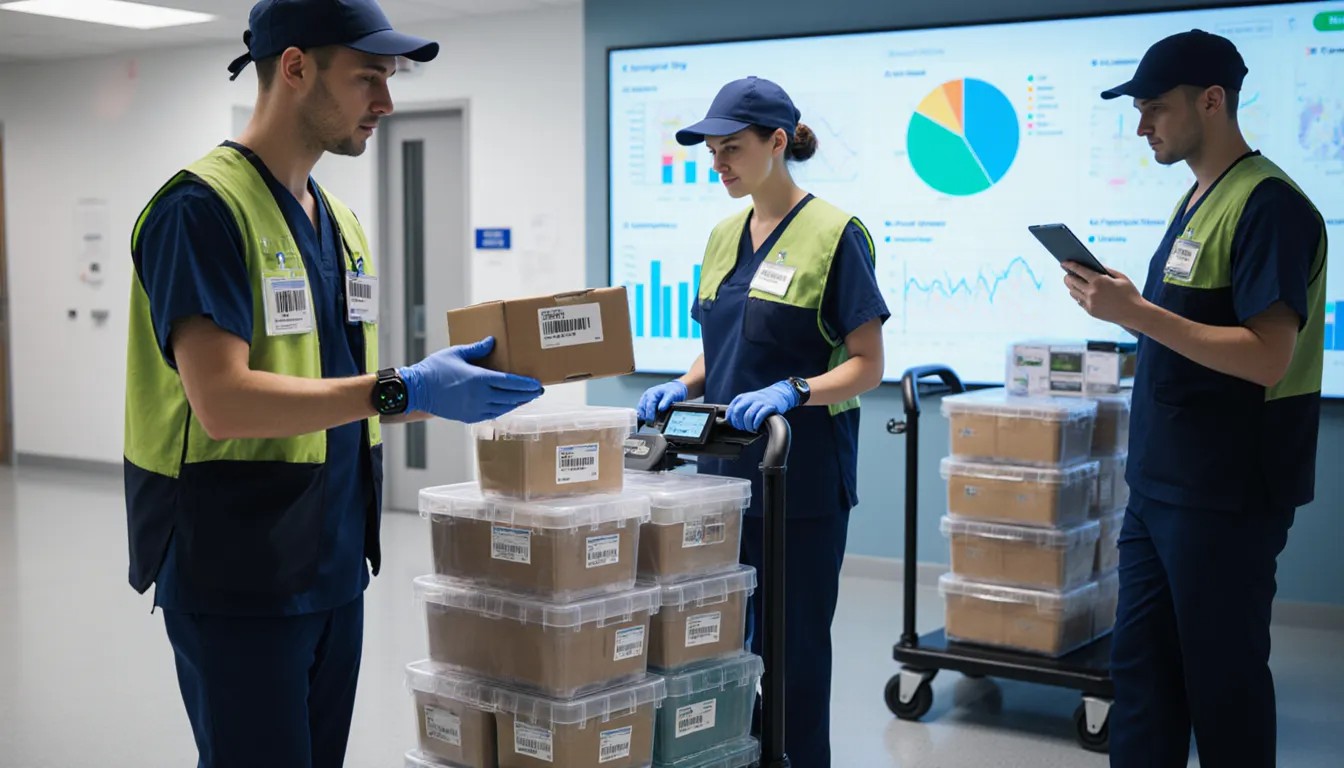
Hospital Courier Services: An Overlooked Factor in Operational Efficiency
If you enter any hospital on a hectic day, you will observe a lot of movement everywhere.
Couriers are not involved in headlines or included in strategic dashboards. Still, healthcare systems that focus on efficiency and cost reduction consider hospital courier services one of the most underrated levers for boosting operational performance.
The Invisible Network That Keeps Hospitals Moving
Every day, couriers transport an astonishing range of materials across hospital systems:
- Lab specimens that must arrive within hours to maintain integrity.
- Medical records and pharmacy deliveries.
- Sterile instruments =used between surgery centers.
- Blood products, vaccines, and even tissue samples.
These deliveries happen hundreds, sometimes thousands, of times each day across facilities, clinics, and labs. And yet, most hospitals treat courier services as an afterthought. Something buried under logistics or facilities management, rarely reviewed beyond contract renewal.
That is where problems begin.
When courier networks operate without a strategy or visibility, inefficiencies multiply. You’ll see duplicate routes between facilities, inconsistent documentation, vehicles running half-empty, and vendors charging premium rates for poorly optimized schedules. Multiply that across a regional health system, and you’re looking at millions in what could be, and should be, avoidable spending.
Hospital courier services are a necessary, around-the-clock operation, they deserve the same level of attention and analytical oversight as any other essential function within the supply chain.
Why Courier Services Are Often Overlooked
There is a simple reason courier performance rarely appears on a CFO’s radar: it is scattered.
Courier operations often fall somewhere between departments: part logistics, part facilities, part lab operations, and sometimes outsourced entirely. With no clear ownership, no centralized data, and limited tracking, the true cost is buried under multiple budget lines.
Add to that the perception that courier costs are “fixed,” like electricity or janitorial services, and you get a blind spot that quietly drains both money and time.
Courier services are the kind of operational layer that’s invisible until you shine a light on it, and once you do, the savings potential is hard to ignore.
The Hidden Costs of Inefficient Courier Operations
The financial impact of inefficient courier networks shows up in surprising ways:
Redundant Routes and Vendors
Different departments or facilities often contract their own courier services, unaware that another vendor already runs the same route. This results in two trucks doing the same job, twice the fuel, twice the labor, and twice the cost.
Empty Backhauls
Couriers deliver specimens or supplies but return empty. Those return miles are a waste, fuel, wear and tear, and paid time with zero value creation.
Unoptimized Schedules
Fixed pickup times often do not align with lab workloads or pharmacy demand. That means couriers run partially full routes multiple times daily when one consolidated trip would suffice.
Compliance and Risk Exposure
Without centralized management, courier documentation can be inconsistent. Missing temperature logs, chain-of-custody gaps, or delayed deliveries can risk not only fines but patient outcomes.
Carbon Footprint and Public Perception
Redundant courier trips also add to environmental impact. As healthcare systems face growing sustainability expectations, courier optimization is an easy and measurable win.
The result is a service that looks routine but actually consumes significant resources, human, financial, and environmental, when left unoptimized.
The Efficiency Equation: Time, Distance, and Data
Optimizing courier operations isn’t just about cutting costs. It’s about aligning movement with mission.
Think of every courier route as a micro supply chain. Each one has its own rhythm, dependencies, and time sensitivity. A specimen delayed by an hour can affect a diagnosis. A late delivery to a surgery center can reschedule procedures. So efficiency here isn’t theoretical.
The key is visibility.
Hospitals need:
- Real-time data on courier movement
- Routes
- Pickup frequency
- Idle time
- Load capacity
- Temperature tracking
- On-time delivery rates
Modern courier management platforms now provide GPS tracking, route optimization algorithms, and digital chain-of-custody documentation.
When that data connects back to spend analytics, the kind of insight Valify specializes in becomes clear, and patterns emerge quickly:
- Which routes could be consolidated?
- Where facilities overlap unnecessarily?
- Which vendors consistently miss performance benchmarks?
Hospitals can turn courier logistics from an invisible expense into a measurable efficiency strategy with that insight.
The Power of Centralization
Centralization is the strongest improvement most hospital systems can implement in their courier operations.
A centralized logistics team can coordinate all the routes and vendors for all the departments instead of the departments managing their courier contracts on their own. As a result, there is no duplication of work, which allows for strategic partnerships with fewer and better-performing providers.
In addition to this, centralization has other benefits:
- Route Optimization: Making schedules align with the lab and pharmacy cut-off times to reduce the waiting time and increase the quantity of the load volume per trip.
- Performance Monitoring: Unified KPIs track delivery accuracy, timeliness, and temperature control.
- Vendor Accountability: Standardized quality across all facilities is guaranteed by standardizing SLAs (service level agreements).
- Scalability: New clinics or shifts can be supported quickly without multiple contracts.
Where GPOs and Technology Intersect
Group Purchasing Organizations (GPOs) have traditionally helped hospitals gain leverage on supply pricing, but they also play a growing role in logistics services. Many GPOs now include courier and transportation solutions in their contract portfolios.
Partnering with a GPO that understands local courier networks brings pre-vetted benefits:
- Access to pre-vetted, compliant providers.
- Transparent pricing models based on actual route data.
- Opportunities for shared delivery networks between hospitals in the same region.
When combined with spend visibility tools, hospitals can use GPO frameworks to benchmark courier performance, not just on cost, but on reliability, sustainability, and responsiveness.
GPOs today are not only about buying power. They also provide strong data support that helps hospitals make faster and smarter decisions in courier management.
Sustainability and Courier Efficiency
Sustainability in healthcare is generally seen in terms of energy and waste management, but courier logistics is yet another area that greatly impacts the environment.
Fuel use, vehicle running time, and repeated trips all lead to emissions and costs. Implementing optimization measures throughout the entire courier network, such as combining routes, using the highest-loading vehicles, and using electric or hybrid cars, results in a direct reduction of emissions and costs.
Some hospital systems go even further:
- Partnering with local courier services that operate eco-friendly vehicles.
- Building shared delivery hubs that multiple companies use to prevent hauling goods over long distances.
- Using technology to monitor carbon emissions for each route or vendor for environmental, social, and governance (ESG) reporting.
Improving courier sustainability is not only about reputation. It is about creating long-term value that aligns with public expectations, funding needs, and regulatory pressure.
Overcoming Barriers to Change
Even with clear benefits, improving courier efficiency isn’t always straightforward. Hospitals face a few common hurdles:
- Fragmented Ownership: Without a single accountable department, courier reform struggles to gain traction.
- Data Gaps: Many hospitals lack accurate visibility into courier volume, routes, and costs.
- Cultural Resistance: Departments accustomed to “their” couriers may resist centralization.
- Contract Complexity: Multi-year contracts with different vendors complicate consolidation efforts.
Hospitals can overcome these obstacles with strong leadership support and a step-by-step plan. Build a baseline audit that maps routes, volume, and spending. Then, a centralized model can be tested in one region or department before expanding it across the system.
Most successful examples start small and grow once results become visible.
Looking Ahead: Courier Management as a Strategic Priority
The future of hospital courier services lies in data-driven logistics.
Hospitals are beginning to treat courier management like any other performance metric, tracked, analyzed, and continuously improved. Real-time dashboards, GPS tracking, and automated documentation are turning courier work into measurable data streams.
In that future, courier decisions won’t be made by habit or convenience. They’ll be made by insight based on cost, performance, and sustainability data that tell the full story.
The next step is cultural. Hospital leaders must start viewing couriers not as delivery drivers but as critical connectors in the care chain. Their work is the physical link between departments, diagnostics and treatment, and urgency and outcome.
When hospitals invest in strengthening that link, everything downstream becomes smoother, from lab efficiency to patient satisfaction.
Final Thoughts
Hospital courier services rarely make the strategy slides or executive dashboards, but they should. They’re the arteries of healthcare operations, moving the lifeblood of care from one node to another.
When optimized, couriers reduce waste, lower costs, and improve turnaround times. When ignored, they quietly drain budgets and erode efficiency.
The path forward is clear: bring courier operations into the light, measure them, analyze them, centralize them, and treat them with the same attention you give to supply chain, staffing, and technology, as they touch all three.
When hospitals are asked to do more with less, efficiency isn’t found in cutting corners. It’s found in tightening the spaces between them. That’s where Valify can support progress.
Sometimes, that means taking a fresh look at something as simple and essential as the courier who keeps your hospital running every day.
FAQs
- Why are hospital courier services necessary?
Couriers ensure the timely delivery of lab specimens, medications, and medical supplies, which directly affect diagnostics, surgeries, and patient outcomes.
- What are the things that make courier operations inefficient?
Multiple vendor contracts, overlapping routes, and empty return trips often consume time and resources, which leads to waste and delays.
- What steps can hospitals take to make their courier services more efficient?
By pooling logistics, using technology for route planning, and monitoring performance data, hospitals can consolidate vendors and eliminate duplication of services.
- What is the relationship between GPOs and courier management?
Group Purchasing Organizations help hospitals access pre-vetted courier providers with transparent pricing and shared delivery networks that improve cost and quality.
- How does courier optimization relate to sustainability?
Optimized routes, fuller vehicle loads, and eco-friendly vehicles reduce fuel consumption and emissions, supporting environmental responsibility and lowering operating costs.

The Valify Editorial Team is dedicated to sharing insights, strategies, and innovations that help healthcare organizations gain control of purchased services spend. Backed by years of expertise in data analytics, procurement, and healthcare technology, the team curates practical resources and thought leadership to guide hospitals and health systems toward greater efficiency and savings. By combining industry knowledge with real-world case studies, the Valify Editorial Team delivers content that empowers decision-makers to drive smarter, data-driven sourcing strategies.