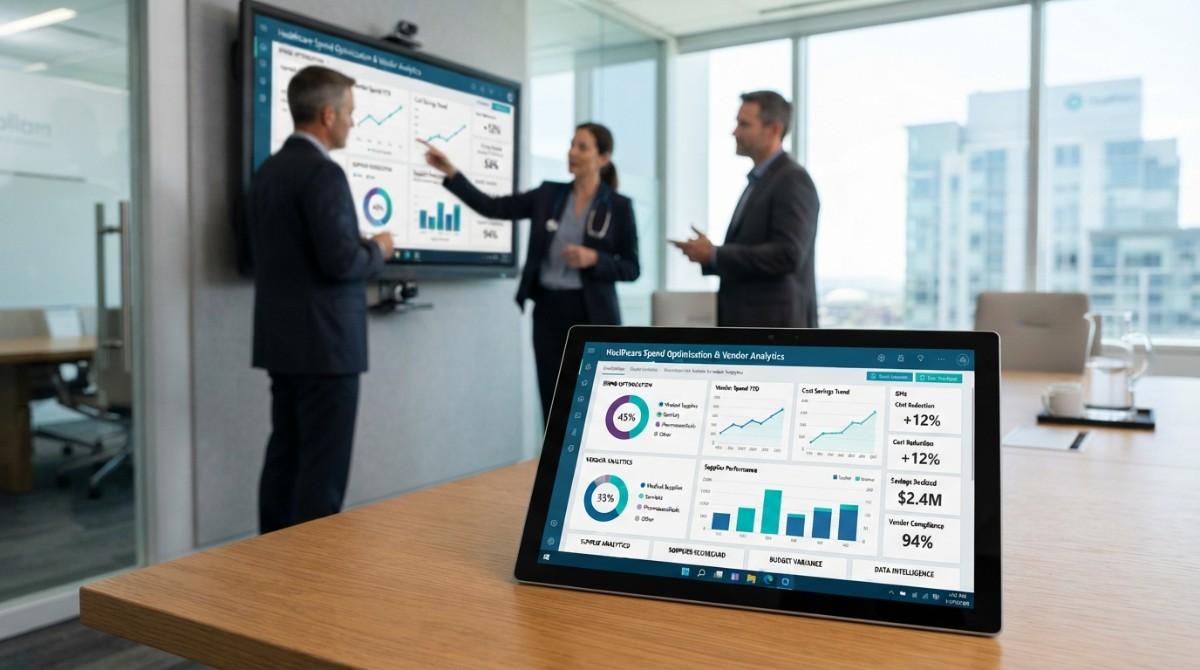
The world of healthcare procurement has been turned on its head. Procurement teams may typically focus on product availability, supplier management, and pricing, but the current market requires a more strategic approach to procurement in healthcare.
Rising costs, workforce challenges, regulatory complexity, and margin pressure are compelling health systems to rethink their approach to spending control. Additionally, innovative tools like advanced analytics, benchmarking, automation, and contract intelligence are providing new avenues for identifying savings and improving decision-making.
Perhaps the biggest change is the growing recognition of purchased services as an area with significant potential for revenue improvement. Tools such as Valify provide organizations with a better look into their purchased services spend, contract performance, vendor relationships, and benchmarking data to make more strategic procurement decisions.
Why Healthcare Procurement Is Entering a New Era
The traditional approach to healthcare procurement has been about getting products at the best price, but also ensuring supply chain continuity. Today it has a much larger role.
Health systems are under increasing economic and operational pressure, and procurement teams are being asked to identify areas of value that should be preserved.
- Ongoing margin pressure
- Rising operating expenses
- Workforce shortages
- Vendor consolidation
- Regulatory complexity
- Demand for financial transparency
- Higher analytics and automations usage
Consequently, healthcare executives are no longer questioning how to procure more effectively. They are debating how spending decisions can be made smarter across the enterprise.
Getting an answer to that question is easier said than done and requires improved visibility into contracts, vendor performance, spending patterns, and market competitiveness. Valify and others in this sector provide tools designed to improve efficiency by integrating spend analytics, benchmarking, and contract intelligence into a comprehensive decision-support platform.
The evolution of procurement and the various elements impacting healthcare organizations in 2026 make up some mega-procurement trends.
Healthcare Procurement Trends
Trend 1: Purchased Services Moves to the Top of the Cost Reduction Agenda
For years, attempts to lower healthcare costs focused on supplies, pharmaceuticals, and the management of inventories. In these areas, the calculations still hold, but organisations will have already recognized many of their savings through more traditional supply chain initiatives.
The next big opportunity is now in the realm of purchased services.
Purchased services account for a large share of non-labor spending, from environmental services and staffing agencies to IT and revenue cycle outsourcing. But most organizations still cannot see how their contracts are performing in the marketplace.
Increased attention is being driven by a few factors:
- Significant non-labor spend
- Limited visibility
- Contract complexity
- Untapped savings opportunities
The focus for healthcare leaders is clear: contract inventory, spend visibility, and benchmarking are top priorities. Valify provides purchased services analytics, vendor performance assessment, and healthcare-specific benchmarking to support these initiatives.
Trend 2: AI-Powered Procurement Becomes Mainstream
Artificial intelligence has gone mainstream in procurement operations. Artificial intelligence in healthcare is improving efficiency and process optimization while ensuring the requisite governance is in place.
Key applications include:
- Spend classification
- Contract analytics
- Vendor analysis
- Savings identification
- Demand forecasting
AI allows teams to ingest and analyze hundreds of data points at speeds that are impossible for humans, allowing them to identify actionable insights. It does not replace procurement professionals but rather allows them to work on more strategic, higher-value work.
Trend 3: Contract Intelligence Replaces Manual Contract Management
More healthcare organizations continue to use spreadsheets and shared drives to manage contracts, which further exposes them to poor visibility into renewals, compliance, and performance.
With the increase in contract portfolios, organizations have been using tools to convert contracts into platforms for actionable insight.
Areas receiving increased attention include:
Automated renewal tracking
- Clause analysis
- Compliance monitoring
- Performance visibility
- Risk identification
Increased visibility of contracts allows for improved contract negotiation, risk mitigation, and the ability to discover areas of savings.
Trend 4: Benchmarking Becomes a Core Procurement Function
Internal data is no longer sufficient to say if contracts are competitive, and organizations increasingly see this.
Thus, benchmarking is now an essential procurement capability.
The first thing healthcare organizations do with benchmarking is evaluate.
- Pricing competitiveness
- Contract terms
- Service levels
- Vendor performance
This enables improved negotiations and enhances the ability to make better sourcing decisions with access to external market intelligence. Valify delves into benchmarking insights tailored for the healthcare stack, aimed at allowing teams to make smarter decisions.
Trend 5: CFOs Become More Involved in Procurement Decisions
Procurement is increasingly treated as a strategic financial function rather than just an operational one.
With margins still under pressure, CFOs are getting more involved in vendor contracts and sourcing choices.
This shift is the result of a few things:
- Increased financial accountability
- Focus on margin improvement
- Demand for measurable savings
- Greater board-level oversight
The vision of finance leaders is to give them visibility into value, performance, and long-term financial impact, thus fortifying collaboration between the finance and procurement teams.
Trend 6: Vendor Consolidation Accelerates
The ever-increasing complexity of vendors is an ongoing challenge for healthcare organizations, sometimes contributing to fragmented purchasing and leading to variable pricing.
Many health systems are trying to tackle this by consolidating their vendor base.
Benefits may include:
- Improved pricing leverage
- Simplified vendor management
- Stronger compliance
- Greater consistency
- Reduced administrative burden
Data analytics and spend visibility give organizations the capability to discover budget consolidation opportunities and unlock more value out of their vendors.
Trend 7: Data Visibility Becomes a Competitive Advantage
Visibility is becoming one of the most important differentiators in healthcare procurement.
Organizations that can quickly understand spending, vendor performance, and contract activity are better positioned to make informed decisions.
Leading health systems are investing in visibility across:
- Vendor spend
- Contract utilization
- Category reporting
- Supplier performance
- Savings tracking
Valify supports this effort by bringing together analytics, contract intelligence, and benchmarking insights into a centralized platform.
Trend 8: Procurement Teams Are Being Measured on Value Creation, Not Just Savings
Traditional procurement metrics focused primarily on cost savings. Today, executive expectations are broader.
Healthcare leaders increasingly view procurement as a contributor to overall organizational performance.
Procurement teams are increasingly evaluated on enterprise value creation:
- Margin improvement
- Vendor performance
- Contract compliance
- Risk mitigation
- Operational efficiency
- Enterprise value creation
Valify helps organizations measure financial impact and identify improvement opportunities across purchased services.
Trend 9: Healthcare Organizations Are Demanding More Vendor Accountability
Healthcare organizations are placing greater emphasis on measurable vendor performance and outcomes.
Price remains important, but value is increasingly defined by results.
Key areas of focus include:
- SLA compliance
- Performance transparency
- Outcome-based contracting
- Vendor responsiveness
- Continuous improvement
Organizations are also adopting structured scorecards and performance reviews to strengthen accountability and improve outcomes.
Trend 10: Continuous Spend Optimization Replaces One-Time Cost Reduction Projects
Traditional cost-reduction efforts were often periodic initiatives. Today’s healthcare environment requires a more continuous approach.
Leading organizations are shifting toward ongoing spend optimization through:
- Continuous monitoring
- Real-time analytics
- Ongoing benchmarking
- Proactive contract management
- Regular vendor evaluations
Rather than waiting for annual reviews, organizations can identify opportunities faster and take action throughout the contract lifecycle. Valify supports this approach through continuous spend monitoring, benchmarking, and opportunity identification.
The Health Systems That Win in 2026 Will See Procurement Differently
Healthcare procurement is no longer just about securing the lowest cost. See procurement as strategic, forward-looking, based on visibility, insights, and long-term value.
This is what the future of healthcare procurement looks like:
- Seeing more
- Knowing more
- Acting faster
- Managing risk proactively
- Optimizing spend continuously
It requires improved data, enhanced governance, and increased alignment across finance, procurement, supply chain, and operations.
Valify helps health systems become smarter purchasers of both purchased services through purchased services analytics, benchmarking, contract intelligence, and opportunity identification.
The organizations that adapt to these changes will be able to improve margins, strengthen vendor performance, and enhance operational resilience.
Prepare Your Procurement Strategy for What Comes Next
Healthcare procurement is transforming the way of doing deals, grounded in data, aided by technology, and supported with a strategic view. Visibility on spending, contracts, and vendors becomes all the more vital as budgets tighten.
Those health systems that engage with spend analytics, benchmarking, contract intelligence, and purchased services optimization will be prepared for future challenges.
The good news is that the transformation to purchased services intelligence can be supported with Valify, providing analytics, benchmarking, contract visibility, and savings opportunity insights in one place to guide organizations toward smarter decision-making and stronger financial performance.
Request a Purchased Services Assessment Demo
Frequently Asked Question’s
What is the biggest healthcare procurement trend in 2026?
More attention is being directed to purchased services to drive greater visibility into service contracts, vendor performance, and non-labor spend.
How is AI changing healthcare procurement?
AI automates spend analysis, contract review, vendor evaluation, savings identification, and forecasting to make quicker decisions.
Why is benchmarking becoming more important in healthcare procurement?
It compares pricing, contract terms, and vendor performance to enable smarter negotiation and competitive contracts.
What role does procurement play in healthcare financial performance?
Procurement improves cost efficiency, strengthens contract performance, supports vendor risk management, and drives margin expansion.
How can health systems prepare for future procurement challenges?
Improve spend visibility, centralize contracts, benchmark regularly, use analytics, and strengthen collaboration across teams.
The Valify Editorial Team is dedicated to sharing insights, strategies, and innovations that help healthcare organizations gain control of purchased services spend. Backed by years of expertise in data analytics, procurement, and healthcare technology, the team curates practical resources and thought leadership to guide hospitals and health systems toward greater efficiency and savings. By combining industry knowledge with real-world case studies, the Valify Editorial Team delivers content that empowers decision-makers to drive smarter, data-driven sourcing strategies.