
Key Takeaways
AI-powered spend analytics helps healthcare organizations reduce costs by providing clear visibility into spending patterns, vendor usage, and pricing discrepancies. It replaces manual reporting with real-time insights, supports informed decision-making, and identifies savings opportunities without disrupting clinical operations. As healthcare shifts toward value-based care and transparency, data-driven spend management is becoming essential.
AI-Powered Spend Analytics in Healthcare | Cut Costs with Valify
The U.S. healthcare system is under relentless pressure. Costs are spiraling. But the goal isn’t just to cut; it’s to cut smartly without compromising care quality.
Yet many hospitals and health systems remain stuck in a loop. Data sits in silos. Vendor relationships are murky. Sourcing processes feel more reactive than strategic. The tools many organizations use aren’t keeping up.
This is where AI-powered Spend Analytics Technology steps in. Not as a tool for blanket budget slashing, but as a high-precision lens that helps procurement and finance leaders find savings without cutting corners.
Valify leads the charge with healthcare-specific, AI-driven Spend Analytics Technology that turns complex spend data into action-ready intelligence.
Why Traditional Cost-Cutting Fails
Many healthcare systems rely on outdated tools or basic business intelligence dashboards. These aren’t built to handle the complexity of modern healthcare procurement.
Here’s what typically goes wrong:
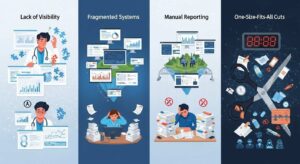
1. Lack of Visibility
Most teams can’t see the whole picture. They may know how much they spent, but not where, why, or with whom. There’s often no clear link between spending and clinical outcomes.
2. Fragmented Systems
ERP, finance, and supply chain platforms often operate in silos. That makes it nearly impossible to get a consolidated view of procurement behavior.
3. Manual Reporting
Reporting is tedious. Analysts spend hours preparing spreadsheets, only for the data to be outdated when decisions are made. These delays slow everything down.
4. One-Size-Fits-All Cuts
When you don’t know where waste lives, your only option is to make general cuts. However, these non-targeted actions risk hurting patient services, staffing, or outcomes.
Most cost-cutting efforts are reactive and ineffective without advanced categorization and AI-driven insights. You can’t optimize what you can’t see clearly.
What Is AI-Powered Spend Analytics?
AI-powered spend analytics is a technology solution that uses artificial intelligence and machine learning to turn disorganized spending data into actionable business intelligence.
Core Functions:
- Cleansing messy or duplicate vendor data
- Normalizing inconsistent formats across departments
- Classifying purchases using healthcare-specific taxonomies (e.g., surgical implants, imaging, purchased services)
- Analyzing historical patterns, pricing trends, and peer benchmarks
It doesn’t just show you how much you’ve spent. It helps you understand what you bought, who you bought it from, and whether it was the best choice, in real time. With a solution like Valify, hospitals and health systems gain transparency and control over spending like never before.
Tangible Ways AI Spend Analytics Reduces Costs in Healthcare
1. Spotting Hidden Spend Leaks
Not all waste is obvious. Some of the most damaging leaks are hidden deep within line-item details.
AI can:
- Detect purchases made outside of approved contracts (contract leakage)
- Flag duplicate or split purchases made by separate departments
- Reveal price inconsistencies for the same product purchased from different vendors or at other locations.
By catching these early, organizations can prevent unnecessary losses and renegotiate more favorable terms.
2. Uncovering Redundant Vendors
Vendor sprawl is a common issue. Over time, health systems work with multiple suppliers for the same products or services.
AI-powered analytics can:
- Identify overlapping vendors supplying the same SKU or category
- Recommend vendor consolidation opportunities.
- Reveal volume-based discounts by directing more spending to fewer preferred partners.
This reduces costs, streamlines supplier management, and strengthens strategic relationships.
3. Driving Smarter Category Strategy
AI doesn’t just provide data, it gives context.
It breaks down spending by particular, healthcare-relevant categories, such as:
- Imaging equipment
- Med/surg supplies
- Purchased services
- Pharmaceuticals
This allows sourcing teams to:
- See exactly where money is going, down to the line item
- Identify categories with the most potential for savings.
- Prioritize efforts based on clinical value vs. financial impact.
No more black-box totals. This is category-level clarity with surgical precision.
4. Empowering Real-Time, Informed Negotiations
You can’t negotiate effectively if you don’t know the market.
AI spend analytics equips teams with:
- Up-to-date benchmarks that validate whether a quoted price is competitive
- Contract performance data that identifies underperforming vendors before renewal
- Scorecards and RFP prep tools to ensure negotiations are based on facts, not gut feel
This kind of intelligence turns every sourcing conversation into a strategic advantage.
5. Eliminating Low-Value or Non-Essential Spend
AI also helps distinguish what’s essential from what’s not.
It can:
- Highlight low-utilization items that offer little clinical value
- Flag maverick spending, unapproved purchases made outside standard processes.
- Suggest changes to formularies or vendor lists based on actual usage data.
Reducing waste doesn’t always mean big moves. Sometimes, it’s a thousand small ones. This is where AI excels.
Addressing the “But We’re Not Ready” Objection
It’s common for healthcare leaders to hesitate. Here are some typical objections and why they shouldn’t hold you back:
- “Our data isn’t clean.”
That’s fine. Valify was built to start with messy data. It gets better over time through machine learning. You don’t need perfection to get started.
- “We already use ERP or BI tools.”
Those tools weren’t designed specifically for healthcare spend categorization or benchmarking. Valify adds intelligence to your existing systems; it doesn’t replace them.
- “Our team doesn’t understand AI.”
You don’t need technical expertise. Valify’s dashboards are intuitive and easy to use, and support is provided every step of the way.
- “Will this disrupt our current workflows?”
Valify is a light-touch integration. It overlays your existing systems without requiring a complete infrastructure overhaul.
Preparing for What’s Next in Healthcare Spend Management
- Regulatory shifts: (price transparency laws, CMS reforms) force provider organizations to rethink spend governance. With federal mandates increasing accountability, health systems need better visibility into spending. Price transparency rules and CMS reforms demand accurate, clean, real-time data to meet compliance standards.
- Value-based care: models demand cost control without harming patient outcomes. Hospitals must find ways to reduce costs while maintaining high-quality care. AI spend analytics enables identifying non-essential or low-value spending without disrupting clinical operations.
- AI-powered analytics: will move from optional to essential in helping organizations stay competitive and compliant. As healthcare decisions become more complex, AI will be critical for benchmarking, contract management, and vendor performance tracking. Manual tools won’t keep up with the pace of change.
- Valify’s adaptive platform: ensures ongoing support as purchasing behavior and regulations evolve. Valify grows with your organization, refining data accuracy, updating category logic, and surfacing new savings opportunities as market conditions and internal needs shift.
Savings Don’t Start with Cuts, They Start with Clarity
The key to reducing healthcare costs isn’t about slashing budgets, squeezing suppliers, or cutting departments. It’s about truly understanding where your money is going and why. With AI-powered spend analytics, healthcare leaders no longer rely on assumptions or outdated reports. They can make confident, data-backed decisions that reduce waste while protecting care quality.
Valify empowers organizations to cut through the complexity and uncover meaningful, measurable savings. It turns spent data into a strategic asset; clear, actionable, and always talking.
Ready to hear what your data has been trying to tell you? Let Valify help you finally listen.
FAQ:
Q1. How long does implementation take, and how soon can hospitals expect to see results with Valify?
Implementation with Valify is fast and non-disruptive. Most hospitals begin seeing clean, categorized spend insights within a few weeks. Measurable cost savings and sourcing opportunities typically surface within the first 60–90 days of active use.
Q2. How does Valify ensure accuracy in categorizing healthcare-specific spend data?
Valify uses AI models trained on billions of dollars in real healthcare spend. Its algorithms are built specifically for healthcare taxonomy, not general business categories. The system continuously learns and improves through feedback loops and expert validation to ensure high accuracy and relevance.
Q3. Can Valify integrate with our current ERP and supply chain systems?
Yes. Valify is designed to integrate seamlessly with your existing ERP, finance, and supply chain tools. It acts as an intelligence layer, without replacing your current systems or disrupting your workflows.
Q4. What types of savings (direct and indirect) do clients typically identify?
Clients commonly uncover direct savings from vendor consolidation, contract compliance, and price standardization. Indirect savings come from reduced manual reporting time, improved sourcing efficiency, and better alignment between clinical value and spend.
Q5. How does Valify support teams post-implementation to keep insights actionable?
Valify provides ongoing support through dedicated client success teams, customizable dashboards, and regular performance reviews. New opportunities continuously surfaced through the platform, ensuring your team stays ahead of spend trends and always has clear next steps.

Shara Smith serves as the Marketing Director for both Valify and Valify Solutions Group, where she oversees all facets of marketing, including strategic planning, branding, digital marketing, and event management. She joined Valify in September 2021, bringing with her a wealth of experience in healthcare marketing and business development.
