
Key Takeaways
Contract renewal focuses on continuing an existing agreement, while contract optimization focuses on improving its value. Optimization evaluates spend, pricing, supplier performance, utilization, terms, and market benchmarks. For healthcare organizations, proactive optimization can identify opportunities to renegotiate, restructure, source alternatives, reduce costs, improve performance, and achieve sustainable savings beyond simply signing a renewal.
Contract Optimization vs. Contract Renewal: Understanding the Difference
A purchased services contract reaches its expiration date. The vendor sends updated pricing, the service has been working reasonably well, and the organization agrees to continue the relationship.
The contract is renewed.
There is nothing inherently wrong with that approach. Renewing can preserve a strong supplier relationship and avoid unnecessary disruption. The problem is assuming that renewing automatically means the contract is still delivering the best possible value.
That is where contract optimization takes a different approach.
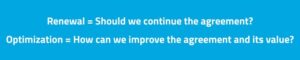
Renewal asks whether the organization should continue an existing agreement. Optimization asks whether the agreement can be improved based on current spend, market conditions, utilization, supplier performance, contract terms, and operational requirements.
A contract can be valid, compliant, and operationally necessary while still being outdated.
Valify’s guidance on hospital contract renewal management explains how passive renewals can leave healthcare organizations with outdated pricing, unfavorable terms, missed sourcing opportunities, and unresolved vendor performance issues. We help health systems evaluate contract competitiveness through benchmarking, spend analytics technology, vendor performance data, and contract intelligence before renewal decisions are made.
The distinction is simple:
For health systems managing complex purchased-services portfolios, understanding the difference can change how contracts are reviewed and managed.
5 Key Differences Between Contract Renewal and Contract Optimization
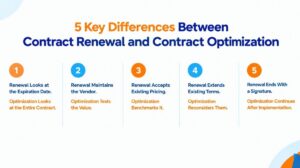
1. Contract Renewal Looks at the Expiration Date. Optimization Looks at the Entire Contract.
Renewal is often triggered by a calendar event. The contract is approaching expiration, so the organization decides whether to extend it.
Optimization should start much earlier.
A renewal conversation typically asks:
- Is the contract expiring?
- Do we want to continue with the vendor?
- What are the proposed new rates?
- Are both parties willing to extend the agreement?
An optimization review asks broader questions:
- What are we spending today?
- How has spending changed since the contract was signed?
- Are the original terms still appropriate?
- Has utilization changed?
- Has the service scope changed?
- Are current rates competitive?
- Are there opportunities to restructure pricing or terms?
This distinction matters because purchased-services contracts rarely operate in a static environment. Health systems acquire facilities, service requirements change, utilization shifts, and market pricing moves.
Waiting until the renewal window can leave little time to investigate those changes.
Valify’s contract-management approach emphasizes visibility into upcoming contract expirations and creating opportunities for proactive review. The purpose is not simply to remind a team that a contract is expiring. It is to give leaders the information needed to determine what should happen next.
Key takeaway: A renewal date should trigger a review, not automatically trigger a signature.
2. Renewal Maintains the Vendor. Optimization Tests the Value.
Renewing a contract generally assumes that the existing supplier remains the right choice.
Optimization tests that assumption.
Supplier performance should be evaluated alongside the price being paid. A vendor may be meeting some expectations while falling short in others. Leaders should review:
- Service-level agreements
- Quality metrics
- Response times
- Compliance
- Stakeholder satisfaction
- Operational issues
- Service reliability
This does not mean that every optimization exercise should result in a new supplier.
A strong-performing vendor may still have pricing that needs to be renegotiated. Similarly, a vendor with competitive pricing may not be providing the level of service the organization requires.
A practical way to think about the decision is:

This keeps contract optimization focused on value rather than making cost reduction the only objective.
For healthcare organizations, that distinction is especially important. Purchased services can directly affect facilities, staff, clinical operations, patient experience, and other parts of the organization.
The right contract is not necessarily the cheapest one. It is the one that delivers the appropriate combination of price, quality, service, flexibility, and operational value.
3. Renewal Accepts Existing Pricing. Optimization Benchmarks It.
This is one of the most important financial differences.
A vendor’s proposed increase does not automatically mean the increase is reasonable.
Before accepting new rates, healthcare leaders should understand how current pricing compares with relevant market data. That requires more than looking at last year’s invoice.
Consider:
- Unit pricing
- Total spend
- Service volume
- Geography
- Facility characteristics
- Service complexity
- Utilization
- Pricing escalators
- Contract scope
There is an important difference between knowing what you pay and knowing how competitive the price is.
For example, a health system may know that it pays $X for a particular service. That number alone does not indicate whether the rate is competitive. A relevant benchmark can provide the context needed to determine whether the price is reasonable for the organization’s size, geography, volume, and service requirements.
Benchmarking can uncover contracts that warrant:
- Renegotiation
- Competitive bidding
- Scope changes
- Supplier consolidation
- Contract restructuring
Valify’s purchased-services benchmarking capabilities are designed around this type of analysis. Its approach can compare invoice pricing and contracted pricing, evaluate peer comparisons, and provide market intelligence to help healthcare leaders make more informed sourcing and contracting decisions.
Key takeaway: Don’t negotiate a renewal from the vendor’s starting point. Negotiate from an informed understanding of market value.
4. Renewal Extends Existing Terms. Optimization Reconsiders Them.
Price is only one part of a contract.
An agreement can have an acceptable rate and still contain terms that limit flexibility or create unnecessary cost over time.
An optimization review should examine:
- Automatic renewal provisions
- Price escalation clauses
- Termination rights
- Notice periods
- Service-level agreements
- Performance requirements
- Volume commitments
- Minimum fees
- Additional charges
- Scope of services
- Renewal length
Consider a hospital with a contract that offers a reasonable starting rate but includes automatic annual increases, a long renewal period, and limited termination flexibility.
The initial price may look competitive. The overall commercial structure may not be.
This is why contract optimization examines the entire relationship rather than focusing only on the price per unit.
It also allows health systems to determine whether the contract still reflects how services are actually being delivered. A service agreement written several years ago may not account for newly acquired facilities, changed utilization, expanded service requirements, or changes in the organization’s operating model.
Valify’s recent purchased-services content emphasizes proactive contract reviews, renewal windows, and cross-facility pricing differences as important considerations for healthcare organizations managing complex contract portfolios.
Key takeaway: Optimization examines the whole commercial relationship, not just the price per unit.
5. Renewal Ends With a Signature. Optimization Continues After Implementation.
A renewal can create a new contract and move the organization on to the next priority.
Optimization does not end when the agreement is signed.
After a contract has been renegotiated, restructured, or sourced, healthcare leaders should continue monitoring:
- Actual spend
- Negotiated pricing
- Contract compliance
- Supplier performance
- Utilization
- Preferred vendor adoption
- Off-contract spend
- Realized savings
This is where the difference between negotiated savings and realized savings becomes important.
A contract may contain a lower negotiated rate on paper, but the organization may not achieve the expected financial result if utilization changes, contracted pricing is not consistently applied, or departments continue purchasing outside the agreement.
The contract therefore needs to be connected to what happens after implementation.
Valify’s WorkPlan supports ongoing savings management by helping organizations track initiatives, monitor progress, identify unapproved spend, and measure captured savings. This supports the broader idea of sustainable savings rather than treating the signed contract as the end of the process.
Key takeaway: Optimization is successful only when the improvement shows up in actual performance and spend.
A Practical Framework for Contract Optimization
Healthcare leaders do not need a complicated process to determine whether a contract should simply be renewed or more actively optimized.
A practical framework is:
1. See
Understand spend, vendors, facilities, invoices, utilization, and current contract terms.
2. Benchmark
Determine whether current pricing and terms remain competitive against relevant market information.
3. Evaluate
Assess supplier performance, utilization, scope, risk, service requirements, and stakeholder expectations.
4. Act
Choose the appropriate path: renew, renegotiate, competitively source, restructure, consolidate, or change suppliers.
5. Monitor
Track compliance, performance, spend, and realized savings after implementation.
This approach aligns closely with Valify’s purchased-services model, which combines spend analytics, benchmarking, contract management, sourcing, and advisory support. Rather than treating each activity as a separate exercise, the model connects visibility and analysis with the actions required to improve purchased-services performance.
That connection matters because optimization is not simply a technology exercise or a negotiation exercise. It requires accurate data, relevant benchmarks, contract intelligence, supplier insight, and the expertise to determine what action makes sense.
The Bottom Line: Renewal Keeps a Contract Alive. Optimization Makes It Perform Better.
Renewal is about continuing an existing agreement.
Optimization is about making sure that agreement continues to support the organization’s financial and operational goals.
For healthcare leaders, the goal should not be to renegotiate every contract. That would create unnecessary work and could disrupt relationships that are already delivering strong value.
Instead, organizations should identify contracts where the data suggests a meaningful opportunity to improve pricing, terms, supplier performance, flexibility, or utilization.
The strongest approach combines:

Before the next renewal cycle, look beyond the expiration date. Understand what the organization is spending, how the contract compares with the market, whether the supplier is meeting expectations, and whether the current terms still reflect today’s needs.
Then make the decision based on evidence.
Sometimes the right answer will be renewal.
Sometimes it will be renegotiation.
And sometimes the data will show that a broader sourcing or contracting strategy is warranted.
The important thing is knowing the difference before the signature is on the page.
Ready to turn contract renewals into opportunities for measurable savings?
See how Valify can help your organization combine spend visibility, market intelligence, and contract insights to make smarter renewal decisions.
Frequently Asked Questions
What are the biggest risks of passively renewing a healthcare contract?
Passive renewal can allow outdated pricing, automatic increases, unfavorable terms, limited flexibility, and unresolved performance issues to continue without meaningful review.
How far in advance should hospitals start reviewing an upcoming contract renewal?
The review should begin well before the formal renewal window. High-value or complex purchased-services contracts may require months of preparation for benchmarking, stakeholder review, sourcing, and negotiation.
Can contract optimization improve value without changing the vendor?
Yes. Optimization can involve renegotiating pricing, changing service scope, improving performance requirements, restructuring terms, or addressing utilization while maintaining the existing supplier relationship.
What role does automation play in managing healthcare contract renewals?
Automation can improve visibility into expiration dates, renewal windows, spend changes, compliance, and savings initiatives. This helps teams identify contracts requiring attention before deadlines become urgent.
What recent trends are making purchased-services contract optimization more important for health systems?
Rising healthcare costs, acquisitions, decentralized purchasing, changing service requirements, vendor proliferation, and market pricing changes all make ongoing visibility and contract review increasingly important.

The Valify Editorial Team is dedicated to sharing insights, strategies, and innovations that help healthcare organizations gain control of purchased services spend. Backed by years of expertise in data analytics, procurement, and healthcare technology, the team curates practical resources and thought leadership to guide hospitals and health systems toward greater efficiency and savings. By combining industry knowledge with real-world case studies, the Valify Editorial Team delivers content that empowers decision-makers to drive smarter, data-driven sourcing strategies.