
Key Takeaways
Healthcare spend analytics has evolved from static reporting to actionable intelligence. By cleansing and categorizing accounts payable data, benchmarking expenses, identifying savings opportunities, and tracking results, Valify helps health systems improve purchasing decisions. Its integrated analytics, contract management, sourcing tools, and AI capabilities support informed decisions and measurable financial improvements.
The Evolution of Healthcare Spend Analytics: From Reports to Actionable Intelligence
Healthcare organizations generate enormous amounts of financial and purchasing data through accounts payable (AP) transactions, vendor invoices, contracts, departments, and facilities. Yet having access to this information does not automatically give health systems a clear picture of their purchased services expenses.
Purchased services spending is often spread across multiple vendors, locations, and departments. Without consistent categorization and visibility, it can be difficult to identify overlapping suppliers, evaluate contract pricing, or determine which categories deserve attention.
The challenge is no longer simply collecting reports. It is understanding what the data reveals and deciding what should happen next.
- Reports tell organizations what happened.
- Spend analytics explains spending patterns and where opportunities may exist.
- Actionable intelligence helps teams determine what to do next.
Valify’s expense management technology is developed to help health systems identify purchased services savings opportunities. By combining data categorization, quality control, benchmarking, market-share insights, and category-specific RFP templates, Valify helps organizations connect purchased services data with informed decisions and potential savings.
The Evolution of Healthcare Spend Analytics
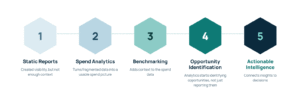
Stage One: Static Reports Created Visibility, But Not Enough Context
Traditional financial reports give healthcare leaders a starting point for understanding purchased services expenses. They help teams monitor spending, review budgets, and identify changes that may require further investigation.
What Traditional Reports Can Tell Healthcare Leaders
Standard reports can show:
- Total purchased services spending
- Expenses by vendor, department, and facility
- Historical spending changes
- Expenditure by general category
- Differences between reporting periods
This information remains important for financial oversight. The limitation is that a summary does not always explain what is driving the numbers.
Where Reporting Stops
A report may show that one facility spends more on environmental services than another. It does not necessarily explain whether the difference comes from service requirements, contract pricing, vendor selection, or purchasing practices.
Other details may also remain difficult to identify:
- Vendors recorded under different names
- Purchases made outside preferred contracts
- Similar services assigned to different GL codes
- Categories where pricing deserves further review
- Spending patterns could indicate an opportunity for standardization
Visibility means knowing what was spent. Insight means understanding the patterns, differences, and potential opportunities behind spending.
Traditional reports establish the baseline. A more detailed view of purchased services helps health systems understand where further analysis may be worthwhile.
Stage Two: Spend Analytics Turns Fragmented Data Into a Usable Spend Picture
Purchased services expenses rarely sit neatly within one department or vendor record. Transactions can be distributed across facilities, coded differently, and recorded under variations of the same supplier name. These inconsistencies make it harder to understand the full scope of spending.
Why AP Data Needs to Be Cleaned and Categorized
Before health systems can evaluate purchased services expenses, they need a consistent view of what those expenses represent.
Valify’s spend analytics technology cleanses and categorizes a health system’s entire AP spend data, using automated categorization and expert quality control to improve data consistency and identify potential contract opportunities.
Moving From Transactions to Categories
Valify’s Immediate Insights platform automates spend categorization across 1,400+ unique purchased services categories and seven service lines, with visibility down to the line-item level.
Its capabilities include:
- Identifying duplicate vendors with name variations
- Consolidating categories associated with multiple GL codes
- Identifying spending from decentralized and non-PO purchasing
- Distinguishing vendors by facility and department
- Providing visibility into approximately 95% of a health system’s total spend, as stated by Valify
This level of categorization helps teams move beyond reviewing individual transactions. They can examine spending by service category, identify the vendors involved, and understand where expenses are concentrated.
Moving Beyond a Single Facility or Department
A department may understand its own purchasing activity without knowing how its vendors compare with those used elsewhere in the health system. A consolidated view can reveal overlapping suppliers, differences in purchasing practices, and categories that warrant a closer look.
When facilities work from a consistent view of purchased services spending, finance and supply chain teams have a stronger foundation for coordinating reviews and evaluating opportunities across the organization.
Stage Three: Benchmarking Adds Context to the Spend Data
Categorized spending shows health systems what they pay and which vendors account for their expenses. Healthcare benchmarking adds another important question: how do those results compare with relevant peers?
Spend Data Shows Your Organization’s Position
Internal data can reveal a category accounts for a significant share of purchased services spending. It can also show how expenses vary across facilities and vendors.
However, historical spending alone cannot establish whether pricing is competitive.
Benchmarking Adds an External Reference Point
Valify’s CheckPoint Benchmarks provide directional benchmarks across more than 1,400 purchased services categories. Users can apply filters to make comparisons more relevant to their facilities.
These comparisons help health systems identify categories where spending or pricing warrants additional review.
Benchmarking Is Not Simply About Finding the Lowest Price
A higher price does not automatically indicate an unfavorable contract. Service scope, geographic requirements, utilization, and other operational factors can affect costs.
For this reason, benchmarking should help teams ask better questions rather than trigger automatic purchasing changes. Valify’s PinPoint Benchmarks also incorporate operational metrics and market conditions to support more informed sourcing and vendor negotiations.
The objective is to understand where differences exist, why they may exist, and whether further action is justified.
Stage Four: Analytics Starts Identifying Opportunities, Not Just Reporting Them
Once purchased services data is categorized and benchmarked, health systems can begin prioritizing specific areas for review.
Four common areas of opportunity include:
- Fragmented spending: Multiple vendors provide similar services across departments or facilities. Reviewing these arrangements may reveal opportunities to consolidate suppliers or standardize purchasing.
- Rogue or off-contract spending: Departments purchase services outside preferred vendor arrangements. Identifying these transactions helps teams investigate why established agreements are not being used.
- Benchmark variances: Pricing or spending differs from relevant comparisons. These categories may warrant a closer look at contract terms, service requirements, and vendor performance.
- Contract opportunities: Expiring agreements, upcoming action dates, and contracts that could be aligned create opportunities to review sourcing strategies before renewal deadlines.
Valify’s Purchased Services Assessment uses four data-driven opportunity identification metrics to help members prioritize categories with savings potential and identify quick wins. Its findings can include standardization opportunities, rogue spending, and ranked benchmark opportunities.
Contract visibility is another part of this process. Valify’s Contracts Dashboard helps teams identify expiring contracts, receive upcoming expiration alerts, find opportunities to make agreements coterminous, and evaluate on-contract versus off-contract spending by category.
These capabilities help turn a broad spending review into a prioritized set of opportunities. Teams can then assess the financial potential, operational requirements, and feasibility of each one before deciding how to proceed.
Stage Five: Actionable Intelligence Connects Insights to Decisions
Identifying an opportunity is not the same as realizing savings. Once analytics highlights an area for review, healthcare leaders need to determine what action is appropriate and who should take responsibility.
Depending on the findings, next steps may include:
- Reviewing existing contract terms and vendor pricing
- Evaluating vendor consolidation or purchasing standardization
- Investigating off-contract transactions
- Preparing a sourcing event or request for proposal (RFP)
- Coordinating decisions around upcoming contract expirations
- Confirming operational requirements before changing suppliers
The decision should reflect more than a potential price difference. Teams must consider service requirements, contract conditions, implementation effort, and the impact of any change on facility operations.
Savings also need to be monitored after implementation. Valify’s WorkPlan supports this ongoing process by tracking savings initiatives, monitoring progress against goals, and flagging issues such as unapproved spending and data-quality discrepancies.
This creates a more connected approach: identify an opportunity, evaluate it, take action, and monitor the result.
The Next Evolution: Asking Questions Directly of the Data
Analytics is also changing how healthcare professionals access information. Traditional dashboards require users to navigate reports, apply filters, and compare results. Conversational AI offers another way to explore purchased services data.
Introduced in August 2026, Valify AI Chat provides a conversational, context-aware experience that lets users ask questions, request clarification, and explore information without starting each analysis from scratch.
Teams can use it to investigate:
- Spend patterns across vendors and categories
- Potential savings opportunities and quick wins
- Vendor trends across purchased services
- Questions that emerge during a spending review
For example, a supply chain leader could ask which purchased services categories have the greatest potential for savings, then follow up by examining the vendors and spending patterns behind those findings.
Conversational analytics makes spend information easier to explore. It does not replace accurate categorization, reliable underlying data, or professional judgment. Instead, it provides another way to access insights and determine what action may be appropriate.
What Modern Healthcare Spend Analytics Should Ultimately Deliver
For purchased services, modern spend analytics should connect six essential capabilities:
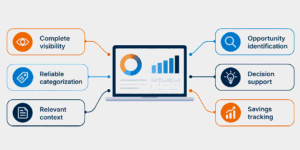
- Complete visibility: Understand the full scope of purchased services expenses across facilities, departments, and vendors.
- Reliable categorization: Organize fragmented AP transactions into consistent, meaningful categories.
- Relevant context: Use benchmarks, contract details, and vendor information to evaluate spending patterns.
- Opportunity identification: Surface categories and purchasing practices that warrant further investigation.
- Decision support: Give finance and supply chain teams the information needed to evaluate options and select appropriate next steps.
- Savings tracking: Monitor implementation, preferred vendor adoption, and progress toward financial goals.
These capabilities work together. Categorization makes spending easier to understand, benchmarking adds context, and opportunity identification helps teams prioritize their efforts. Contract management and ongoing monitoring then help connect those decisions with results.
Conclusion: The Evolution Is From Knowing to Acting
Healthcare spend analytics has beyond producing reports that summarize historical expenses. For purchased services, the progression is:
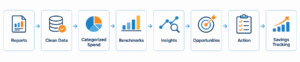
The objective is not simply to generate more data or add more dashboards. It is to give health systems a clear view of their purchased services expenses, identify where opportunities may exist, and determine which actions are worth pursuing.
Valify brings together purchased services spend analytics, benchmarking, contract visibility, sourcing capabilities, and savings tracking to support this process. By connecting fragmented AP data with practical next steps, health systems can make more informed purchasing decisions and work toward measurable financial improvements.
Explore Valify’s Spend Analytics Technology to learn how complete purchased services visibility can help identify opportunities and support more informed decisions.
FAQs
How can healthcare organizations determine whether their spend analytics data is accurate enough to support decision-making?
Organizations should examine duplicate vendor records, inconsistent GL codes, category assignments, and missing transaction details. Regular data-quality checks help teams identify discrepancies and validate findings before making purchasing decisions.
What organizational roles should be involved in evaluating purchased services analytics and acting on its findings?
Finance, supply chain, procurement, accounts payable, and operational leaders should be involved. Finance evaluates the financial impact, supply chain reviews vendors and contracts, and operational teams confirm that proposed changes meet service requirements.
How can healthcare organizations protect sensitive financial and supplier information when using spend analytics and AI tools?
Organizations should evaluate access controls, encryption, data retention policies, vendor security practices, and applicable compliance requirements. They should also confirm how AI tools process and retain organizational information and restrict access to authorized users.
How can spend analytics support long-term strategic planning rather than only immediate cost-reduction initiatives?
Historical trends, benchmark comparisons, vendor information, and contract expiration dates can help health systems plan sourcing activities, prioritize categories, and evaluate standardization opportunities. Ongoing savings tracking helps determine whether improvements are sustained.
What should healthcare organizations consider when expanding spend analytics across multiple facilities or service lines?
Organizations should consider data consistency, category definitions, system integration, stakeholder responsibilities, and differences in local service requirements. Common categorization standards support meaningful comparisons while allowing teams to account for legitimate operational variations.

The Valify Editorial Team is dedicated to sharing insights, strategies, and innovations that help healthcare organizations gain control of purchased services spend. Backed by years of expertise in data analytics, procurement, and healthcare technology, the team curates practical resources and thought leadership to guide hospitals and health systems toward greater efficiency and savings. By combining industry knowledge with real-world case studies, the Valify Editorial Team delivers content that empowers decision-makers to drive smarter, data-driven sourcing strategies.
