Valify AI Chat: Turning Purchased Services Data into Clear, Confident Decisions

Valify AI Chat: Turning Purchased Services Data into Clear, Confident Decisions

Key Takeaways

Healthcare organizations need clarity, speed, and confidence to effectively manage purchased services spend. Valify AI Chat delivers all three by transforming complex, fragmented data into intuitive, actionable intelligence. Through a conversational, context-aware experience, teams can move from question to insight to action—faster than ever before.

A New Approach to Managing Purchased Services

Purchased services remain one of the most complex and difficult areas of healthcare spend. Data is often fragmented across hundreds of vendors, multiple departments, and disconnected systems. As a result, organizations struggle to gain clear visibility into where dollars are going—or where opportunities for savings exist.

Traditional approaches rely heavily on spreadsheets and static reports. These methods are time-consuming, difficult to interpret, and rarely provide a complete picture. Even with significant effort, many health systems leave 10–30% of potential savings unrealized due to gaps in visibility and execution.

Valify AI Chat changes this reality.

Introducing Valify AI Chat

Valify AI Chat is a conversational, AI-powered experience designed specifically for the complexity of healthcare purchased services. It transforms how organizations explore, analyze, and act on spend data by replacing static reporting with a dynamic, intuitive interface.

Users can simply ask a question—just as they would in a conversation—and quickly receive clear, relevant answers. No technical expertise or specialized training required.

With AI Chat, clients gain:

  • Clarity into purchased services spend
  • Faster access to actionable insights
  • The ability to explore data without starting over

All within a single, seamless experience.

Built for Purchased Services Decision-Makers

Valify AI Chat introduces a fundamentally different way for teams to interact with their data:

Conversational Exploration

Users can ask questions in plain language—from high-level summaries to detailed category breakdowns—and receive clear, actionable responses instantly.

Context-Aware Intelligence

AI Chat remembers prior questions and responses, allowing users to refine their analysis, compare scenarios, and dig deeper without resetting their workflow.

Continuous Insight Discovery

Each interaction builds upon the last, enabling a natural progression from initial question to deeper understanding and informed action.

Meet Val: Your AI Data Retriever

At the center of the experience is Val, Valify’s generative AI-powered data retriever that transforms complex analytics into a simple, conversational experience. Ask a question in the chat and Val gets to work.

  • Quickly analyzes spend patterns and retrieves key insights
  • Guides teams from insight to action.
  • Helps surface opportunities that might otherwise remain hidden

Val acts as an always-available guide, helping teams navigate complexity and uncover meaningful answers quickly.

What Valify AI Chat Delivers

Valify AI Chat combines advanced AI with healthcare-specific data expertise to deliver measurable impact:

  • Robust Answers, Seamless Flow
    Explore spend across more than 1,400 purchased services categories with ease
  • Insights That Evolve
    Context-aware AI builds on prior questions, enabling deeper analysis without interruption
  • Faster Path to Savings
    Identify cost-reduction opportunities, vendor patterns, and quick-win initiatives
  • AI-Enabled Visibility
    Assess contract coverage, evaluate diversity spend, and analyze category performance
  • Enterprise-Grade Data Protection
    Secure infrastructure, controlled access, and responsible AI governance ensure trust and reliability

From Data to Action—Faster

Valify AI Chat eliminates the need for manual analysis and static reporting. Instead of spending hours compiling and interpreting data, teams can:

  • Identify top savings opportunities in seconds
  • Pinpoint “low-hanging fruit” for immediate impact
  • Gain a clearer understanding of spend patterns across vendors and categories
  • Make decisions with greater clarity and confidence

This shift enables supply chain, finance, and operations teams to focus less on data gathering and more on executing meaningful improvements.

Why It Matters

Healthcare organizations are under increasing pressure to manage costs while maintaining high-quality care. Purchased services—often one of the least visible spend categories—represent a significant opportunity for improvement.

Valify AI Chat helps organizations:

  • Reduce analysis time and reliance on spreadsheets
  • Enable self-service access to insights across teams
  • Improve consistency and transparency in decision-making
  • Discover “low-hanging fruit” or “quick win” saving opportunities with ease
  • Valify is the clear differentiator— there’s no other tech like it in purchased services

By making complex data easier to understand and act upon, Valify AI Chat enables organizations to move with greater clarity and control.

A New Standard in Purchased Services Intelligence

Valify AI Chat is more than a new feature—it represents a shift in how healthcare organizations approach purchased services management.

By combining conversational AI with deep industry data, Valify empowers users at every level—from analysts to executives—to explore insights, uncover opportunities, and take action with confidence.

Frequently Asked Questions: 

What is Valify AI Chat?

Valify AI Chat is a conversational AI experience that helps healthcare organizations explore, analyze, and act on purchased services spend using natural-language questions. It delivers instant clarity and deeper insights across 1,400+ categories.

Why is this feature important?

Purchased services are historically fragmented and difficult to analyze. Leaders often lack a complete picture of spend. Valify AI Chat was built to solve this by replacing static reports with dynamic, intuitive, AI-driven exploration.

How does the conversational experience work?

Users simply type questions — from high-level summaries to detailed category inquiries — and receive clear, actionable answers without needing technical expertise. Users can simply type in questions such as “can I get a pie chart of my laundry and linen spend by supplier?”

What makes the AI “context-aware”?

The system remembers previous questions and responses, allowing users to drill deeper, compare scenarios, and continue the conversation without starting over.

Who is “Val”?

Val is Valify’s generative AI-powered data retriever — a friendly, approachable guide that helps users navigate complex spend data and uncover insights quickly.

What types of insights can users access?

Users can explore spend visibility, contract coverage, diversity classification spend, savings opportunities, and AI-generated charts that highlight trends and patterns.

Is Valify AI chat secure and trustworthy?

Yes. Valify AI Chat is built on responsible AI principles, ensuring secure, transparent interpretation of every inquiry.

Who can use Valify AI Chat?

The feature is available to all Valify customers and is designed for both everyday users and advanced analysts across supply chain, finance, and operations.

How does this improve decision-making?

By turning complex data into intuitive insights instantly, teams can move faster, uncover savings, and make more confident decisions.

What are some questions that are likely to be asked?

  1. Can I get a pie chart of my [pick category] spend by supplier?
  2. Tell me more about [pick vendor]
  3. Tell me more about [pick category]
  4. Do I have any indicators in this category? If so, Summarize them for me.
  5. What are my index scores for this category for the health system and for each entity?

Take the Next Step

See it in action.
Ask a question. Explore your spend. Discover savings.

Connect with Valify today. Contact Us to reduce the cost of health system purchased services

Additional resources From software to services: how AI is changing what healthcare buyers expect

Environmental Services (EVS) Spend Optimization for Hospitals

Key Takeaways

Environmental Services (EVS) is a critical healthcare function ensuring clean, safe environments that support infection control, compliance, and patient care. However, many hospitals treat EVS as a facility cost with limited benchmarking and visibility, leading to overspending. Valify helps health systems optimize EVS through spend analytics, benchmarking, and contract intelligence.

Environmental Services (EVS) is a vital healthcare service that guarantees clean, safe surroundings for the patient and aids in infection prevention steps, compliance with standards of care.

EVS often gets treated like a building maintenance expense rather than a relevant purchased services category; there are limited benchmarking efforts and considerable missed savings opportunities.

EVS budgets are being strained at the same time as labor costs are rising, staffing is a challenge, and working through multiple vendor contracts can be complicated.

Healthcare organizations can control EVS spending and enhance performance with spend analytics, benchmarking, and contract visibility. Valify is the tool that can uncover these opportunities at a health system level, allowing better sourcing decisions with quantifiable cost and savings.

What Are Environmental Services (EVS) in Healthcare?

Environmental Services includes the cleaning, sanitation, disinfection, waste disposal, and support activities necessary to help provide a secure healthcare environment.

Although EVS is usually connected with housekeeping, it goes beyond general cleaning duties. Good EVS programs can reduce infection risk, instill patient trust and confidence, meet regulatory guidelines, and even improve operations.

Core responsibilities typically include:

Patient Room Cleaning

  • Daily room cleaning
  • Terminal cleaning following discharge
  • Patient room turnover

Infection Prevention Support

  • Disinfection protocols
  • High-touch surface cleaning
  • Isolation room procedures

Common Area Maintenance

  • Waiting rooms
  • Hallways
  • Public spaces
  • Administrative areas

Waste Management Coordination

  • General waste handling
  • Regulated medical waste support
  • Hazardous waste coordination

Floor and Facility Maintenance

  • Floor care programs
  • Carpet cleaning
  • Surface maintenance
  • Specialty floor restoration

Because these services touch nearly every area of a hospital, even small improvements in efficiency or contract performance can have a meaningful operational and financial impact.

Why EVS Is a High-Impact Purchased Services Category

Environmental Services (EVS) is one of the biggest, most operationally sensitive outsourced categories in healthcare, with labor costs, wage inflation, and staffing shortages affecting EVS providers hard.

In multi-facility systems with varying vendors and pricing models, it becomes increasingly challenging to compare contracts or ensure competitiveness.

Valify for Healthcare EVS is a source-independent solution that enables healthcare organizations to analyze their total spend across facilities, benchmark pricing against peer practice data, and identify opportunities for contract optimization.

As EVS affects both financial and patient safety, improved visibility and better vendor management can enhance clinical outcomes as well as bottom-line performance.

Common Reasons Hospitals Overspend on EVS Services

Healthcare organizations often don’t overspend due to one issue, but through gradual inefficiencies over time.

Legacy Contracts

Long-standing agreements with automatic renewals, outdated pricing, and outdated service scopes often lead to unnecessary costs. Valify helps benchmark contracts against current market rates before renewal.

Limited Performance Visibility

Without consistent KPIs or reporting, vendor performance is difficult to measure. Valify centralizes contracts and spends data to improve visibility and accountability.

Scope Creep

Extra services are often added over time without formal contract updates, increasing costs and complexity.

Staffing Inefficiencies

Over time, uneven staffing and inefficient scheduling can drive up labor costs without improving outcomes.

Multi-Vendor Complexity

Multiple EVS vendors across facilities create inconsistent pricing and reduce negotiating power. Valify helps identify fragmentation and consolidation opportunities.

Signs Your Hospital May Be Overspending on EVS

Not every contract will need a prompt look-in, but sometimes there are telltale signs to look for.

When a detailed assessment of EVS spend may help your organization:

  • Your contract for Environmental Services was not benchmarked for over 3 years.
  • Facilities may offer services at other price points for a similar service.
  • Wage costs keep rising with no signs of productivity or service delivery gains.
  • You informally evaluate vendors instead of using standard scorecards.
  • Operational metrics tend to be hard to track repeatedly.
  • Contract renewals also happen, usually attached to existing pricing or service level against the market, without running the numbers.
  • These indicators do not always indicate that an organization is overspending. They also tend to imply obscure contract performance and pricing competitiveness.

Comparing EVS agreements against healthcare market data and performing a spend/savings analysis of purchased services spending across facilities will help organizations to uncover opportunities that lead to operational excellence while ensuring better financial performance.

Strategies for Optimizing Environmental Services Spend

Cost reduction of EVS does not mean the cost of service work. The best healthcare organizations combine a financial stewardship approach with an operational performance approach compared to benchmarking data across the full range of healthcare competencies.

Rather than examining only contract pricing, they review the total lifecycle of their EVS program, from vendor selection and staffing models to contract management and performance measurement.

Strategy 1: Centralize Contract Visibility

Without a holistic, organized approach to EVS contracts across hospitals or departments, it is hard to understand overall spending in the organization and identify discrepancies.

Having a single repository of contracts helps healthcare leaders see vendor relationships, renewal dates, pricing structures, and commitments for services. This allows for a more consistent reporting of contracts and reduces the risk of missing renewal opportunities or hiring duplicate service providers.

Strategy 2: Conduct Contract Benchmarking

Market conditions that were competitive for contract pricing several years ago may not be the same today.

Benchmarking enables organizations to objectively assess their EVS agreements against healthcare-focused market data, gaining insights into pricing, contract terms, and service levels. Unbiased market intelligence enables procurement and finance teams to secure the best deals and challenge vendor offers.

Strategy 3: Evaluate Staffing Efficiency

Since labor is the single largest cost for most EVS contracts, similarly small improvements in staffing efficiency mean big dollars.

Staffing schedules, overtime usage, productivity, and workload distribution should be routinely assessed by healthcare organizations. Do not only strive for labor cost reduction. Achieve staff numbers by managing operational needs while maintaining adequate cleaning quality and patient safety.

Strategy 4: Standardize Performance Metrics

To get the best out of an EVS contract, you should have benchmarks on how well it is being managed.

To assess operational and financial performance, organizations should implement standardized KPIs across their facilities. Common performance measures include:

  • Cleaning quality scores
  • Room turnaround times
  • Labor productivity
  • Patient satisfaction metrics

Standardizing reporting increases accountability and allows for easier vendor comparison across locations.

Strategy 5: Reassess Vendor Relationships

Vendor relationships must change and adapt with the organization. The ongoing review of service quality, pricing competitiveness, contractual flexibility, and operational performance ensures existing agreements remain optimal.

Valify integrates benchmarking, spend analytics, and contract intelligence into one view for healthcare executives to utilize effective vendor assessments by evaluating sourcing opportunities with the greatest potential returns.

How Spend Analytics Improves EVS Cost Management

Many healthcare organizations have contract data and payment records, but lack a clear, connected view of spending. Spend analytics turns fragmented data into actionable insights for better decisions.

Visibility Into Actual Spend

A full view of EVS spending shows how money is distributed across vendors and facilities.

Key capabilities include:

  • Vendor-level spend analysis
  • Facility-level reporting
  • Category-level visibility

This enterprise view helps identify pricing differences, trends, and inefficiencies. Valify organizes fragmented data into clear insights across the health system.

Contract Opportunity Identification

Spend analytics helps identify savings opportunities early. Organizations can track:

  • Upcoming renewals
  • Pricing variations
  • Vendor consolidation opportunities

Valify highlights these risks and opportunities to support better negotiation timing and improved contract outcomes.

Data-Driven Decision Making

Better sourcing decisions come from reliable data, not assumptions. Combining spend analytics, benchmarking, and contract visibility helps align finance, procurement, and operations.

Valify brings these capabilities together in a healthcare-specific platform that improves purchased services decisions and strengthens financial performance.

Take the Next Step Toward EVS Spend Optimization

Environmental Services (EVS) contracts comprise one of the top five highest costs for many healthcare organizations, yet most have little visibility into value and performance.

Given the increasing labor costs and operational pressures, EVS contract review is more than procurement. It is now a financial strategy.

Hospitals can mitigate waste without sacrificing quality of service by leveraging visibility through benchmarking contracts, performance tracking, and spend analytics.

Schedule a demo to learn how Valify can use the largest source of Environmental Services software spend analytics, benchmarking intelligence, and purchased services expertise to drive down your clients’ environmental service costs!

Frequently Asked Question’s

What is Environmental Services (EVS) in healthcare?

EVS consists of cleaning, sanitization, disinfection, waste management, and facility support to ensure environmental hygiene in healthcare.

Why is EVS a high-spend category?

It is labor-intensive, often outsourced across multiple facilities, and typically involves large, long-term contracts.

How can hospitals reduce EVS costs without affecting quality?

By using spend analytics, benchmarking contracts, optimizing staffing, and tracking performance better, rather than cutting corners.

What should be benchmarked in EVS contracts?

Pricing, scope of work, staffing levels, service quality, contract terms, and vendor performance.

How often should EVS contracts be reviewed?

Regularly, and always before renewal or when market or operational conditions change.

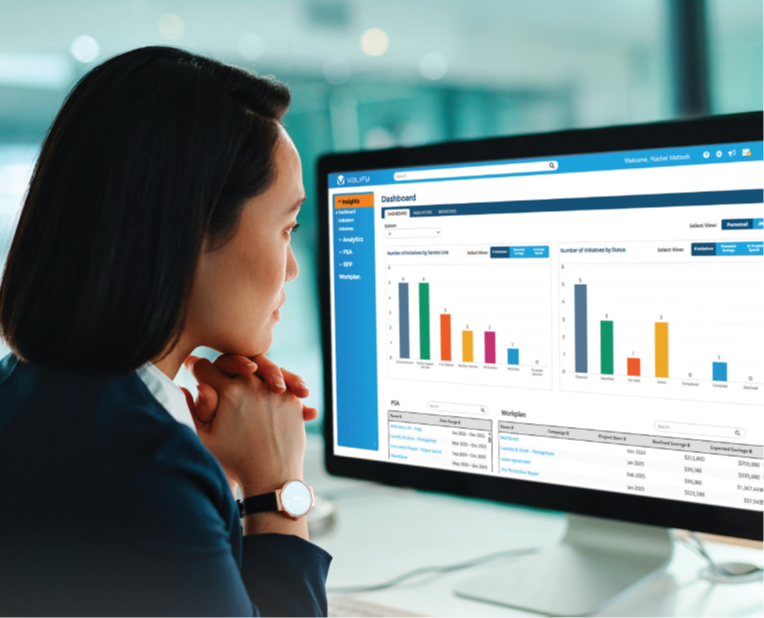
dark haired woman looking at graph on computer screen

Behind the Innovation: Valify Insights

With thousands of categories and vendors, hospital spending on purchased services can be significant. Yet, the data needed to manage these costs is often opaque and fragmented, making it difficult for organizations to spot trends and identify savings opportunities.

Valify’s advanced technology platform directly addresses this challenge with the introduction of Valify Insights.

“Valify Insights was born out of a need to look deeper at what triggers and constitutes a savings opportunity in purchased services,” said Les Popiolek, Chief Executive Officer of Valify. “Our goal is to cut through the complexity and make data analysis both simple and sophisticated for hospitals and health systems.”

hands working at table with tablet displaying graphs

By applying a quantitative approach, Valify Insights enables healthcare organizations to quickly pinpoint where savings in purchased services exist, prioritize which areas to address, and estimate the potential value of these opportunities. Whether it’s confirming that current cost-saving efforts are on track or revealing unexpected opportunities to reduce spending with specific vendors or categories, Valify Insights brings simplicity, clarity and actionable insights to the decision-making process.


The Power Behind Valify Insights

Valify Insights is powered by two core technologies.

The first being Valify’s proprietary technology and data intelligence platform focused exclusively on purchased services, which the company has been operating for more than a decade. Today, Valify has amassed and processed billions of rows of data from more than 1,400 hospitals across the nation, representing over $1.3 trillion in categorized purchased services spend.

As Popiolek put it, “I can say with great confidence that no one else has the sheer volume of data we do and can analyze it in such meaningful ways like our technology can.”

Purchased services data is complex. There are dozens of details – like contracts, invoices, vendors, hospitals, and time periods – that can be used to examine how, where and when money is spent. This creates a daunting number of ways that hospitals and health systems can analyze the past and present of their purchased services spend.

people pointing at sheet of paper displaying data

This is where AI comes in as the second technology core to Valify Insights. While adhering to strict data security and compliance standards, Valify Insights leverages AI to rapidly automate, interpret and digest all the data into something actionable.

For instance, the Valify Score – a pivotal feature within Valify Insights – evaluates data across numerous attributes (not just cost) to assign a score to each service category a hospital outsources, showing which categories require urgent action and which can be addressed later. Moreover, AI continually updates Valify Scores as new spending data becomes available, offering real-time guidance to support cost-saving initiatives.


A GPS to Value

Purchased services are usually managed at the hospital or even department level – rarely are they managed across a system. This can lead to missed opportunities if not using technology and data to connect the dots.

If a health network looks at its holistic purchased services spend, it could appear that the organization reduced total spend in a certain category. Valify Insights can peel back the layers and see that at certain hospitals within the system, spend has actually increased – prompting the question about why this is happening, which could be because each hospital is using a different vendor or there aren’t consistent contracts in place.

“Valify Insights provides clarity as to what is happening with a health system’s purchased services spend, so more can be uncovered as to why it is happening,” said Popiolek.

However, the real value hospitals and health systems gain from Valify Insights is what they choose to do with the data.

“Valify Insights is like a GPS system for driving value in purchased services management,” Popiolek explained. “The route you take to get to your destination is up to you. In other words, it’s what you do with the data that truly makes a difference.”

Clients should know that with its end-to-end suite of services, Valify is fully equipped to help them transition their insights into an action plan. This includes benchmarking services, expert advisory consultants, and access to a preferred supplier network portfolio with pre-negotiated supplier terms and vendors that have already passed a rigorous RFP process. In fact, Valify can manage purchased services initiatives and programs from start to finish.


Unmatched in the Industry

Valify Insights can be the driving force behind how health systems set their purchased services priorities. With data from hospitals across the nation and of all GPO affiliations, subscribers have an unfound gateway to create greater value and procure quality outsourced services for their organizations.

“The speed and depth of insights we provide is unequivocally unmatched in the industry,” Popiolek emphasized. “I’m confident that no other company in the market can provide the insights we do, and I challenge anyone to try.”


Take control of your purchased services strategy today. Contact us to learn how Valify Insights can help you uncover new savings opportunities.

Staffing Locum Tenens Webinar

Key Takeaways: Locum Tenens Webinar

Key takeaways from recent webinar on Dialysis coming soon!


A large percentage of a hospitals overall cost structure is comprised of staffing and related payroll. Yet, the outsourced staffing industry does not maintain adequate transparency when it comes to managing costs to the end users, making price assessments difficult for health systems.

Below we’ve compiled the key takeaways from our recent educational webinar in which we provide information for health systems to more easily assess pricing and best practices when evaluating Staffing and Locum Tenens vendors. Read the synopsis below.

Click here to request the full webinar recording.

Staffing_Locum Tenens_Webinar deck_thumbnail-2

Also check out our in-depth articles on Staffing and Locum Tenens for additional background information.

Continue reading

Market Analysis: Dialysis

Market Analysis: Dialysis

Dialysis is a necessary procedure that allows nearly 500,000 patients in the United States with kidney failure the opportunity to live normal, productive lives. The treatment removes waste, salt, and extra water when the native kidneys are no longer able. Though there are several types of dialysis, the most common is Hemodialysis, in which blood is removed from the body, run through a dialyzer, cleaned, and replaced into the body. Dialysis takes three hours to complete and is offered by health systems as inpatient and outpatient treatments.

Continue reading

Category Deep Dive Locum Tenens

Category Deep Dive Locum Tenens: Are You Realizing Savings in this Purchased Service?

Category Deep Dive_Locum Tenens (2).jpg

To ensure there’s no disruption to patient care or billable services, covering open, or even absent, healthcare positions is critical. According to Select International, a position vacancy for one physician can translate to an annual loss of $250,000 to $1.4 million.[1] Cost efficient staffing strategies must be in place to keep services and revenue flowing. In our previous post, we discussed the opportunities for cost-containment in staffing. This post, however, will focus on a specific part of staffing–locum tenens.

Continue reading

Category Snapshot Staffing

Category Snapshot Staffing: A Big Opportunity for Cost-Containment


A report by Kaufman, Hall & Associates revealed that the number of hospital mergers and acquisitions increased 55%, from 66 announced in 2010, to 102 in 2016.[1] Last year also saw a flurry of mergers nationwide, from Kansas to New Jersey, with healthcare systems around the country consolidating in order to maintain their financial viability in an era of legislative uncertainty  and marketplace volatility. Both independent and newly acquired hospitals are actively seeking areas for cost-containment to strengthen their bottom lines. One way to do this is to closely examine all purchased services expense categories (over 1,200!) for hidden savings opportunities. In this post, we’ll discuss, specifically, the category of staffing and what to look for when researching this category.

Continue reading

Power Benchmarking

How to Benchmark Your Capital Equipment Service Contract Spend

capital-equipment

Investment in capital equipment is a decision that shouldnt be made lightly, particularly for health care organizations. There are many factors to consider when selecting equipment that best suits your needs, with the bottom line being the consideration of total lifetime costs associated with its use. Other factors may include: Continue reading

Waste Management

A Closer Look at Savings in Hospital Waste Management

Hospital waste management is a system more complex than it first seems, involving a complicated group of disposal methods that can increase the burden of healthcare logistics on any organization. When it comes to different types of waste, healthcare facilities must use a strict set of guidelines to dictate the appropriate way to dispose of waste safely and effectively.

Continue reading